Eski Pano
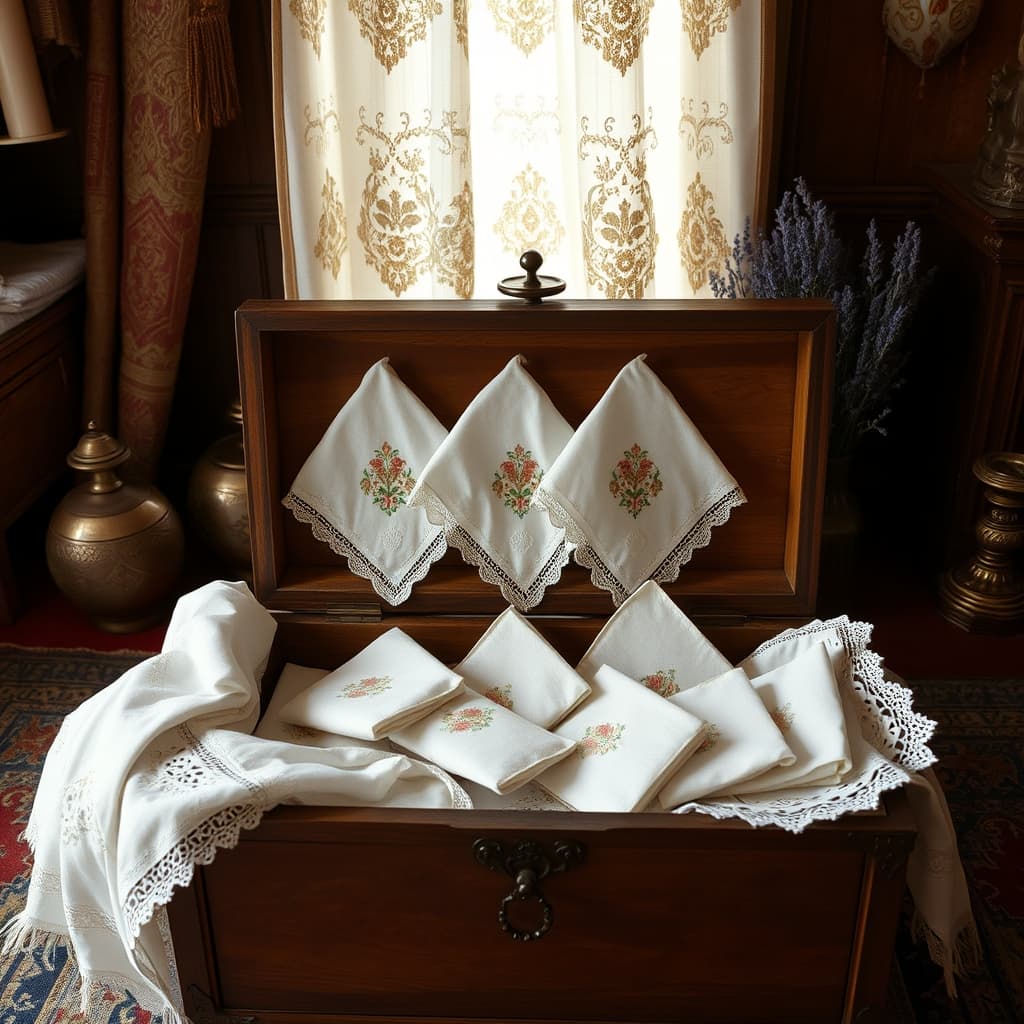
There was a time when one of the quietest yet most meaningful corners of the house was the dowry room. The trunks were not opened every day, but whenever they were, they released not only fabric but also a long feeling of expectation about the future. Embroidered handkerchiefs were among the most delicate pieces in that world. With lace edging, initials stitched into the corners, and sometimes stored with the scent of lavender or soap, these small pieces of cloth were more than household items waiting to be used; they were details of a life being imagined in advance. Looking at them called forth future guests, holiday visits, wedding bundles, the drawers of a new home, and even the kind of order that would one day govern family life. That is why the embroidered handkerchief, despite its modest size, became a strong symbol shaping the rituals of the home.
Seen through the lens of object stories, the true story of the handkerchief lies in the fact that it carried expectation more than mere utility. Especially in dowries prepared for young women, embroidered handkerchiefs made patience, hand labor, and preparation visible. Every stitch laid along the edge felt like a silent sentence written for a future time. Bundles to be presented at weddings, clean cloths to be offered to guests, carefully kept pieces to be taken from drawers on special days, all of these were imagined before that stage of life had even begun. Domestic rituals were shaped exactly in this way: moments not yet lived took form around objects prepared in advance. Here the handkerchief turned from a personal belonging into a small yet influential rehearsal for the order of family life.
The effect of the waiting that grew in the dowry room also relates to the invisible order created by women's labor in the home. The handkerchiefs inside the trunk would be counted, arranged so their fold lines would not be disturbed, shown sometimes to neighbors or relatives, and sometimes linked to the next generation with the phrase, “I have set this aside for my daughter.” In this way the handkerchief created a language of preparation moving across generations. Ideas of cleanliness, order, and hospitality within the home were shaped through that language. Which objects belonged to everyday use and which to special occasions, what should be stored away and what brought out only at certain times, all were learned through such small possessions. The waiting around the embroidered handkerchief in the dowry room was in fact like a school teaching the boundaries, refinements, and sense of time of domestic life.
The ritual power of this object also comes from the fact that it was touchable yet not easily consumed. A handkerchief is, on one level, an everyday necessity: it wipes a brow, rests in the palm, waits ready in a drawer. Yet once embroidered, it rises beyond ordinary function and gains a more ceremonial meaning. It stops being just a cloth anyone might use and becomes something to protect, to store, perhaps to bring out only at specific moments. In old domestic life, the value of many objects was defined precisely by this double meaning: they were useful, yet symbolic at the same time. Because the embroidered handkerchief carried both qualities together, it remained in memory as one of the quiet but durable elements of household ritual.
Today dowry rooms have largely disappeared and traditions of preparation have changed. Yet when the embroidered handkerchief and the waiting that grew around it are remembered, what comes to mind is not only an old object, but a way of life that built the future with patience. In that understanding, the home was not something simply acquired ready-made; it was a world woven by labor. Rituals arose from that labor, from ways of storing, and from the meanings attached to small objects. For that reason the embroidered handkerchief did more than decorate domestic life in the past; it shaped its time, its seriousness, and its emotional order. That a small piece of cloth can carry so much memory is due precisely to this.
The Embroidered Handkerchief and the Waiting That Grew in the Dowry Room: How Did It Shape the Rituals of Domestic Life