Eski Pano
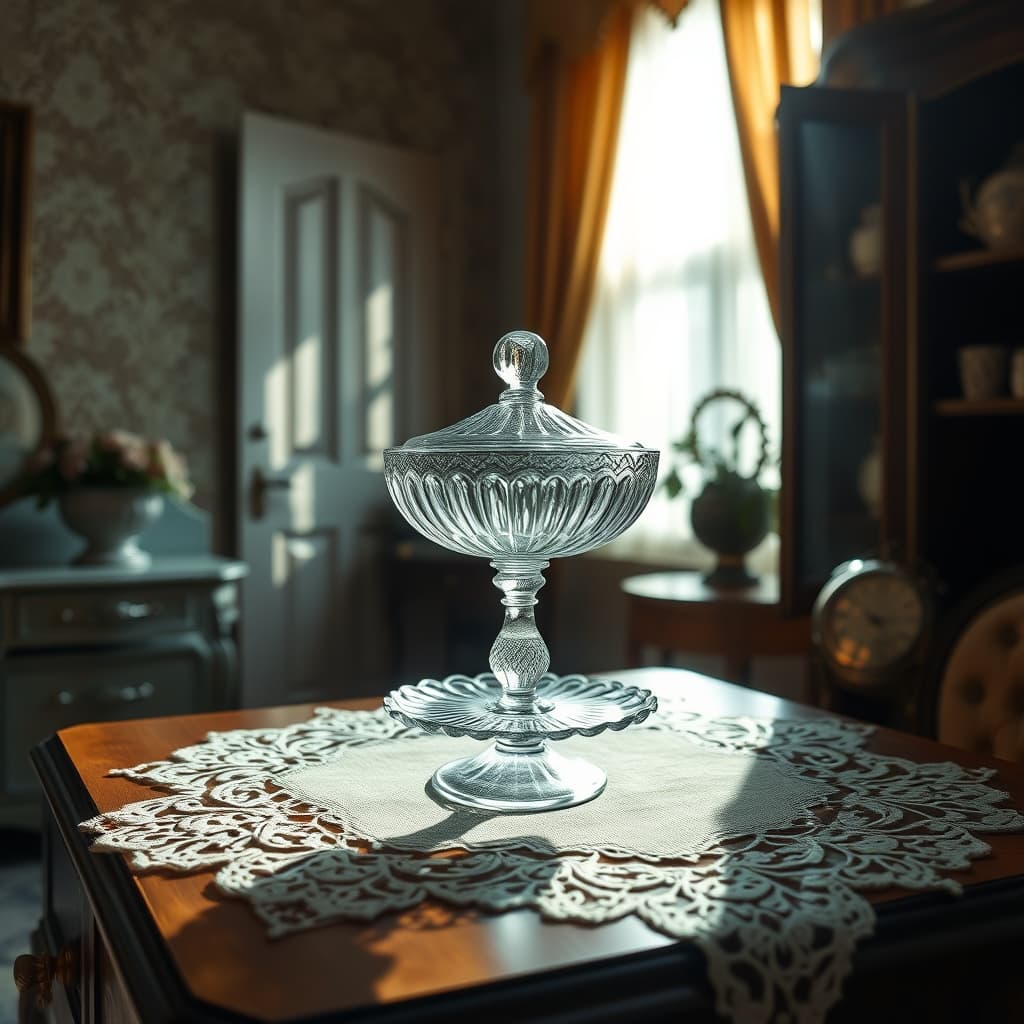
There was a time when a crystal sugar bowl was not merely an elegant object placed on the table, but a small sign of care and continuity within the family. When it caught the light, the cut glass scattered trembling reflections onto the walls, and on holiday mornings or evenings with guests, the room suddenly felt more attentive and composed. What mattered was not only the sugar cubes placed inside, but how the bowl was held, where it was returned, and by whom it was entrusted to the next pair of hands. Some objects are precious not only because they are used, but because they are passed on. The crystal sugar bowl belonged to that category. Visible on the table, it also represented the quiet continuity inside the household.
From the perspective of object stories, the transformation of such items into heirlooms depends less on material value than on symbolic meaning. A crystal bowl might first have entered a house in a bridal trousseau, then remained for years in a display cabinet, and later been given to a daughter or to the person seen as capable of carrying the domestic order onward. That transfer is never only a change of place. Along with the object moves a way of setting the table, a style of receiving guests, and the feeling that objects themselves carry memory. In older homes, items lined up on cabinet shelves were not kept merely for show. They served as visible memory for the order of family life. The sugar bowl was one of the most delicate parts of that memory.
As it passes from hand to hand, the meaning of the crystal bowl grows. For the first owner, it may have been a proud sign of a new home. For the next generation, it becomes a flash of light that recalls the grandmother’s sitting room. A small scratch on the lid, a slight wear near the handle, or a faint mark at the base shows that it was not simply stored away, but lived through with the family. It was offered with holiday coffee, placed on the table during engagement visits, protected from children’s careless hands, and polished with special attention on cleaning days. Family legacy is not always built through grand declarations. Often it is formed through such repeated acts of care.
The details of daily life explain this transformation even better. In one house the sugar bowl might be taken out only when guests arrived; in another, it might stand on embroidered cloth at Sunday breakfast. The lid was closed carefully so the sugar would not soften, and after serving it was returned to the same shelf without fail. At first, children saw it only as a bright object. Over time they learned which aunt it had come from, which wedding chest had once carried it, and why during every move it was wrapped separately in newspaper. At that moment the object stopped being merely decorative and entered the family narrative. Sometimes people feel the past less in a photograph than in the weight of such an object resting in their hands.
For that reason, the crystal sugar bowl becoming a family legacy is no accident. It belongs to the class of objects that are both fragile and enduring. It demands care, yet carries a quiet resilience that can bind generations together. In a time of simpler tables, changing domestic arrangements, and quickly consumed possessions, to look at such an object is to see not only an elegant design, but a continuity of family life that has been carefully protected. The crystal sugar bowl passed from hand to hand holds within it the light, sounds, and etiquette of older homes. How it turned into a family legacy is therefore answered by something larger: the way families choose certain objects as vessels for memory itself.
The Crystal Sugar Bowl and Its Becoming a Family Heirloom Passed from Hand to Hand: How Did It Turn into a Family Legacy?