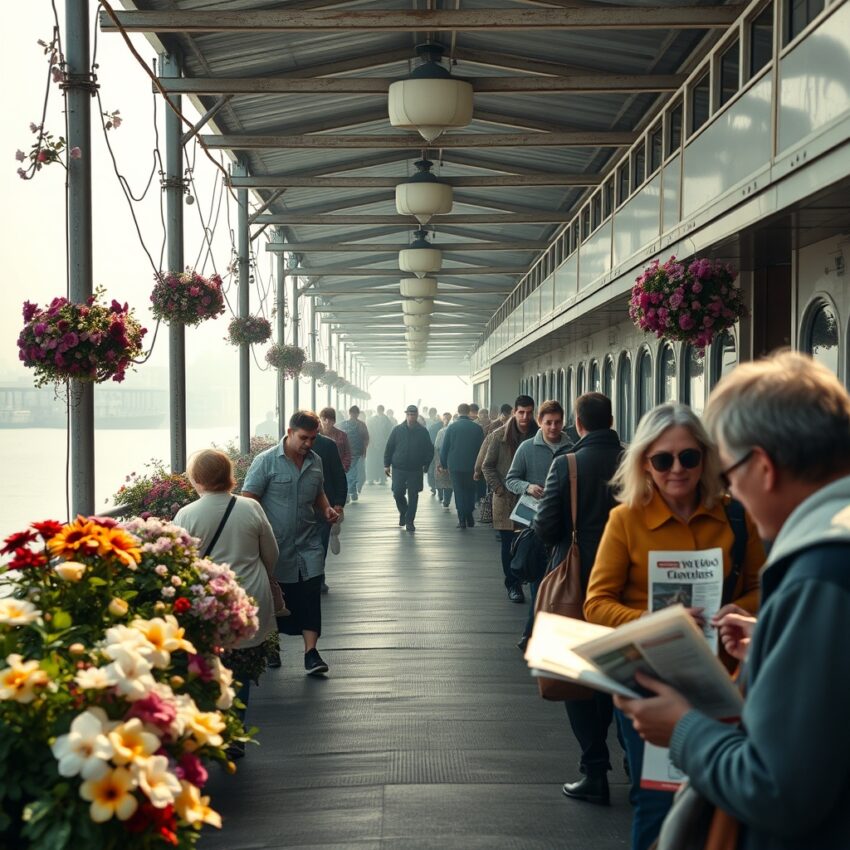
🇹🇷 Türkçe | İskeleye Varan Sabahların Bugüne Bıraktığı Sessiz Terbiye
Bir zamanlar şehir hatlarının yolculuğu yalnız bir yerden bir yere ulaşmanın yolu değildi; günün ruhunu ağırlaştırmadan düzenleyen, insanın içinde küçük bir sükûnet bırakan hareketli bir ara dünyaydı. Sabah erken saatlerde iskeleye yaklaşırken denizin üstüne ince bir buğu iner, vapur düdüğü kıyıda bekleyenleri aynı ritme çağırırdı. Kadınların çantalarından sabunla karışık hafif kolonya kokusu yükselir, erkeklerin ceketlerinde tütün ve rüzgâr birbirine karışır, simitçinin sesi taş rıhtımda yankılanırdı. Çiçek kokulu sokaklardan geçerek iskeleye gelen insanlar, daha vapura binmeden şehrin başka bir terbiyesine girmiş olurdu. Yolculuk, aceleci bir kalabalığın değil, birbirine yer açmayı bilen bir topluluğun alışkanlığıydı. Bugünden bakınca hafızada kalan yalnız martılar ya da suyun çizdiği köpük değil; o yolculukların insan davranışına sinen sakin ölçüsüdür.
Zamanın İzinde bu sahneye bakıldığında şehir hatları, eski şehir hayatının görünmez görgü kurullarından biri gibi görünür. İskeleden binerken sırayı gözetmek, yaşlıya oturacak yer bırakmak, pencereyi rastgele değil karşıdakini düşünerek açmak, gazeteyi yanındakinin omzuna taşırmadan okumak, yüksek sesle konuşmamak gibi küçük davranışlar orada kendiliğinden öğrenilirdi. Vapur, bir mahallenin başka bir mahalleye karıştığı ama yine de inceliğin kaybolmadığı bir ortak mekândı. Sabah işine giden memur, yanında okul çantasıyla oturan çocuk, file içinde pazara gidecek meyvelerini taşıyan kadın, hepsi aynı salonda birkaç duraklığına da olsa ortak bir hayat kurardı. Çiçek kokulu sokakların bıraktığı şey tam da buydu: gündelik hayata sinmiş, gösterişsiz bir nezaket.
Bu yolculukların hatıraya dönüşmesinde deniz kadar kıyıların da payı vardır. İskeleye çıkan sokaklar çoğu yerde çiçekli balkonların, kapısı yarı açık bakkalların, kaldırıma sabah suyu serpmiş komşuların arasından geçerdi. Sardunya, yasemin, ıhlamur ya da hanımeli kokusu insanın üstünde kalır; vapura bindiğinde mahalle kokusu da onunla yolculuk ederdi. Bu yüzden şehir hatları yalnız deniz ulaşımı değil, semtlerin birbirine taşıdığı bir his zinciriydi. Bir yolcu karşı kıyıya geçerken yalnız yer değiştirmez, kendi mahallesinin ritmini de karşı kıyıya biraz taşırdı. Vapur salonunda açılan bir gazete, simit kırıntısı, çay kaşığının ince sesi ve denize bakan sessiz yüzler, modern şehir kalabalığının içinde bile yavaş olabilen bir hayatı anlatırdı.
Bugüne kalan sessiz alışkanlıkların çoğu işte bu hareket hâlindeki terbiyeden süzülmüştür. Toplu taşımada alçak sesle konuşmak, sırada hakkını beklemek, manzarayı yalnız kendi gözün için değil başkasıyla paylaşılabilir bir şey gibi görmek, sabah telaşında bile selamı eksik etmemek biraz o eski şehir hatları kültüründen gelir. Çünkü vapur yolculuğu insanı mecburen bir bekleme ve beraberlik hâline sokardı. Deniz, aceleyi törpüler; iskele, kalabalığı hizaya koyar; yolculuk, insanın kendini biraz geri çekip çevresini fark etmesini sağlar. Eski gazetelerde, kartpostallarda ve siyah beyaz aile fotoğraflarında gördüğümüz o ağırbaşlı şehir görüntüsünün ardında biraz da bu ortak yolculuk disiplini vardır.
Şimdi şehir büyüdü, hatlar değişti, kıyılar kalabalıklaştı; ama çiçek kokulu sokakların iskeleye bağladığı eski günler hâlâ bazı davranışlarımızın içinde yaşamayı sürdürüyor. Birine yol vermek, oturduğun yeri toparlayıp kalkmak, denize bakarken istemeden susmak, sabahın ilk çayını ayakta değil sakince içmek gibi küçük tavırlar, belki de o yolculukların bizde bıraktığı en kalıcı mirastır. Hatıraların tozlu raflarında şehir hatlarının ayrı bir çekmecesi varsa, bunun sebebi yalnız güzel manzara değildir. Orada saklanan şey, bir şehrin insanına deniz üstünde öğrettiği sessiz hayat adabıdır.
🇬🇧 English | The Quiet Discipline Left by Mornings That Reached the Pier
There was a time when traveling on the city lines was not merely a way of moving from one place to another; it was an in-between world that ordered the spirit of the day without burdening it and left a small calmness inside a person. In the early morning, a light mist settled over the water as people approached the pier, and the whistle of the ferry called those waiting on the shore into the same rhythm. A faint scent of soap and cologne rose from women’s handbags, tobacco and wind mingled in men’s jackets, and the cry of the simit seller echoed across the stone quay. Those who arrived at the pier by passing through flower-scented streets had already entered another discipline of urban life before even stepping aboard. The voyage belonged not to a rushed crowd, but to a community that knew how to make room for one another. What remains in memory today is not only the seagulls or the foam drawn by the water, but the quiet measure those journeys left inside human behavior.
Seen in the trace of time, the city ferries resemble one of the invisible schools of manners in older urban life. Boarding in order, offering a seat to an elder, opening a window with consideration for others, reading a newspaper without spreading it onto a neighbor’s shoulder, and speaking in a restrained tone were all habits learned there almost without instruction. The ferry was a shared place where one neighborhood blended into another without losing refinement. The civil servant going to work, the child sitting beside him with a school bag, the woman carrying produce in a string bag on the way to market, all formed a common life for a few stops at least. That was what the flower-scented streets left behind: an unshowy courtesy dissolved into everyday life.
The reason those journeys turned so easily into memory has as much to do with the streets leading to the pier as with the sea itself. The roads to the docks often passed beneath balconies full of flowers, in front of grocery shops with half-open doors, and beside neighbors who had just sprinkled water on the pavement. The scent of geranium, jasmine, linden, or honeysuckle stayed on a person’s clothes, so that when one boarded the ferry, the neighborhood traveled too. For that reason the city lines were not only sea transport; they were also a chain of feeling carried from district to district. A passenger crossing to the opposite shore changed not only place, but also brought a little of the rhythm of his own quarter across the water. A newspaper opened in the saloon, crumbs from a simit, the delicate sound of a tea spoon, and quiet faces turned toward the sea all described an urban life capable of being slow even in the middle of a crowd.
Many of the quiet habits that survive today have filtered out of precisely that discipline in motion. Speaking softly on public transport, waiting one’s turn in line, seeing a view as something shareable rather than possessed, and not forgetting a greeting even in the rush of morning all come partly from that older ferry culture. The ferry compelled people into a condition of waiting and togetherness. The sea softened haste, the pier arranged the crowd, and the voyage asked each person to step back a little and notice the presence of others. Behind the dignified city scenes we still see in old newspapers, postcards, and black-and-white family photographs lies some of this common discipline of travel.
The city has grown now, the routes have changed, and the shores are more crowded, yet the old days linked to the pier by flower-scented streets still live within certain small gestures. Letting someone pass, leaving one’s seat in order before standing up, falling unintentionally silent while looking at the water, drinking the first tea of the morning with composure instead of hurry, these may be the most lasting inheritance of those journeys. If the city lines occupy a special drawer on the dusty shelves of memory, it is not only because the view was beautiful. What is preserved there is the quiet urban etiquette the sea once taught its people.
🇧🇷 Português (Brasil) | A Disciplina Silenciosa Deixada pelas Manhãs que Chegavam ao Cais
Houve um tempo em que viajar pelas linhas da cidade não era apenas uma forma de ir de um lugar a outro; era um mundo intermediário que organizava o espírito do dia sem pesá-lo e deixava dentro da pessoa uma calma discreta. Nas primeiras horas da manhã, uma névoa fina pousava sobre a água enquanto as pessoas se aproximavam do cais, e o apito do barco chamava quem esperava na margem para o mesmo ritmo. Das bolsas das mulheres subia um leve cheiro de sabonete e colônia, nos casacos dos homens o tabaco se misturava ao vento, e a voz do vendedor de simit ecoava no píer de pedra. Quem chegava ao cais depois de passar por ruas com cheiro de flores já tinha entrado, antes mesmo de embarcar, em outra disciplina da vida urbana. A travessia não pertencia a uma multidão apressada, mas a uma comunidade que sabia abrir espaço para o outro. O que permanece na memória hoje não são apenas as gaivotas ou a espuma desenhada pela água, mas a medida serena que essas viagens deixavam no comportamento das pessoas.
Quando se olha pelo rastro do tempo, os barcos da cidade parecem uma das escolas invisíveis de boas maneiras da antiga vida urbana. Entrar respeitando a fila, ceder lugar a um idoso, abrir a janela pensando também em quem está ao lado, ler o jornal sem invadir o ombro do outro e falar em tom contido eram hábitos aprendidos ali quase sem explicação. O barco era um espaço comum onde um bairro se misturava ao outro sem perder a delicadeza. O funcionário indo ao trabalho, a criança sentada ao lado com a mochila da escola, a mulher levando frutas e verduras numa sacola de rede para o mercado, todos formavam uma vida comum, ao menos por alguns pontos. Era isso que as ruas perfumadas de flores deixavam: uma cortesia sem exibicionismo, espalhada pela rotina.
Essas viagens se tornaram lembrança também por causa das ruas que levavam ao cais. Muitas vezes o caminho passava por sacadas floridas, mercearias de porta entreaberta e vizinhos que tinham acabado de jogar água na calçada. O cheiro de gerânio, jasmim, tília ou madressilva ficava na roupa, e quando a pessoa embarcava, o bairro embarcava junto. Por isso, as linhas da cidade não eram apenas transporte sobre o mar; eram também uma corrente de sensações que passava de um bairro a outro. Ao atravessar para a margem oposta, o passageiro não mudava apenas de lugar, mas levava consigo um pouco do ritmo do seu próprio quarteirão. Um jornal aberto no salão, migalhas de simit, o som delicado da colher no chá e os rostos silenciosos voltados para a água descreviam uma vida urbana capaz de ser lenta mesmo em meio à multidão.
Muitos dos hábitos silenciosos que chegaram até hoje saíram justamente dessa disciplina em movimento. Falar baixo no transporte público, esperar a própria vez na fila, olhar uma paisagem como algo que pode ser compartilhado e não possuído, não esquecer o cumprimento nem mesmo na correria da manhã, tudo isso vem um pouco da antiga cultura dos barcos. A travessia colocava as pessoas numa condição inevitável de espera e convivência. O mar diminuía a pressa, o cais organizava a multidão, e a viagem fazia cada um recuar um pouco para perceber melhor a presença dos outros. Por trás das imagens de cidade sóbria que ainda vemos em jornais antigos, cartões-postais e fotografias de família em preto e branco, existe um pouco dessa disciplina coletiva de viagem.
Hoje a cidade cresceu, as rotas mudaram e as margens ficaram mais cheias, mas os velhos dias ligados ao cais por ruas com cheiro de flores continuam vivos em certos pequenos gestos. Dar passagem a alguém, ajeitar o lugar antes de se levantar, ficar em silêncio sem perceber ao olhar o mar, tomar o primeiro chá da manhã com calma em vez de pressa, talvez sejam as heranças mais duradouras dessas travessias. Se as linhas da cidade ocupam uma gaveta especial nas prateleiras empoeiradas da memória, isso não acontece apenas por causa da beleza da paisagem. O que se guarda ali é a etiqueta silenciosa de vida urbana que o mar ensinou às pessoas.