🇹🇷 Türkçe | Sokak Lambasının Çevresinde Kurulan Ortak Ev Hissi
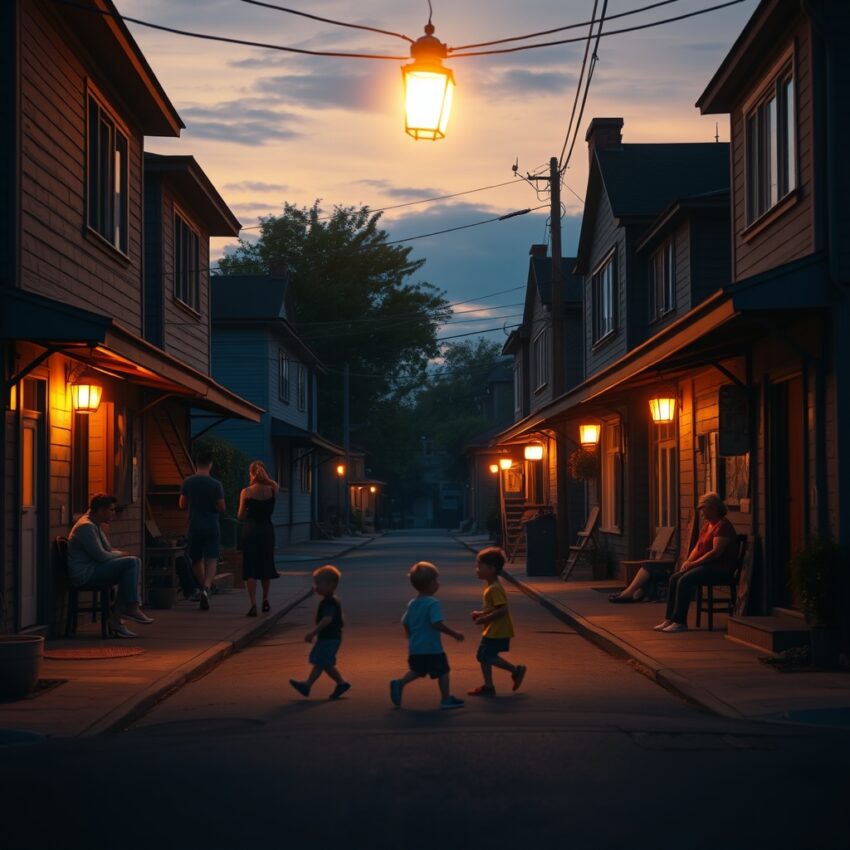
Bir zamanlar akşam olmak çocuklar için oyunun bitmesi değil, biçim değiştirmesi demekti. Güneş çekildiğinde sokak büsbütün boşalmaz, tam tersine mahalle başka bir tona geçerdi. Pencerelerden yemek kokuları yayılır, annelerin sesleri ara ara duyulur, bakkal kepengi yarıya iner ama köşe başındaki sokak lambası yanınca oyun yeniden toplanırdı. O sarı ışığın altı, mahallenin görünmez merkezi gibiydi. Seksek çizgileri, lastik oyununun gergin ritmi, topun kaldırıma çarpan sesi, ip atlayan çocukların sayışmaları, hepsi lambanın çevresinde biraz daha uzardı. Çünkü sokak lambası yalnız aydınlatmazdı; çocuklara ve büyüklerine “henüz dağılmayın” diyen bir akşam izni gibi çalışırdı. Böylece sokak, herkesin gözünün önünde ama kimsenin tam sahip olmadığı ortak bir eve dönüşürdü.
Mahalle Kültürü bakımından bu ortak ev hissi, sokağın yalnız geçiş alanı değil, paylaşılan bir yaşam yüzeyi olmasından kaynaklanır. Eski mahallelerde akşam saatleri kapı önü yaşamıyla çocuk oyunlarının iç içe geçtiği zamanlardı. Kadınlar tabure çıkarır, büyükler günün yorgunluğunu kapı önünde atar, bir yandan da çocukların oyununu göz ucuyla takip ederdi. Sokak lambasının çevresinde aydınlanan küçük alan, hem oyunun sahası hem de mahallenin güven çemberi olurdu. Çocuklar orada daha rahat hareket ederdi; çünkü hangi pencerenin açık, hangi komşunun kapıda olduğu bilinirdi. Bu görünürlük, denetim kadar şefkat de taşırdı. Biri düştüğünde bir evden kolonya gelir, biri susadığında başka bir evden su uzanır, hava serinleyince “artık içeri gelin” sesi aynı lambanın ışığına karışırdı. Ortak ev tam da bu karşılıklı fark etme hâliyle kurulur.
Oyunların sokak lambası altında uzaması, çocukluk zamanını mevsimle ve mahalle düzeniyle birlikte düşünmeyi de öğretirdi. Yaz akşamlarında serinlik çökerken oyun biraz daha cesaretlenir, son bir ebe, son bir tur, son bir sayı diye diye gecikirdi. Kışa yakın günlerde ise lambanın etrafındaki dar aydınlık daha kıymetli olur, çocuklar o sınırın dışına daha az taşardı. Bu fiziksel çember, oyunun ritmini belirlerdi. Ama daha önemlisi, sokağı bir yabancı alan olmaktan çıkarırdı. Çünkü ışığın altında görünen her yüz tanıdıktı: üst komşunun çocuğu, fırından yeni dönmüş abi, pencereye dirseklerini koymuş teyze, bakkaldan son ekmeği alan bir başka anne. Mahallenin insanları o akşam sahnesine kendi küçük hareketleriyle katılır, çocukların oyunu da bu sahnenin kalbine yerleşirdi.
Sokağın ortak eve dönüşmesinde seslerin rolü de büyüktü. Lambanın altında yükselen çocuk kahkahası, kapı önündeki sohbet, uzaktan gelen radyo sesi, tabak toplayan bir mutfağın gürültüsü aynı akşam dokusunu örerdi. Ev ile sokak arasında bugünkü kadar sert bir sınır yoktu; biri ötekine taşar, birbirini tamamlar, birinin sıcaklığı ötekine sinerdi. Bu yüzden sokakta uzayan oyun günleri, yalnız çocuklara ait bir hatıra değildir. O günler aynı zamanda mahallenin birlikte yaşama bilgisidir. Çocuk oyunu, komşu dikkatini ve akşam serinliğini aynı ışık altında bir araya getirir.
Bugün o sahneyi hatırlayanlar için sokak lambası basit bir belediye detayı olmaktan çok uzaktır. O lamba, bir mahallenin akşam ruhunu toparlayan işarettir. Altında uzayan oyunlar sokağı güvenli, tanıdık ve paylaşılan kılmıştır. Ortak ev dediğimiz duygu, dört duvarın içinde değil, bazen o lambanın çevresindeki birkaç metrelik aydınlıkta doğmuştur. Çocukluk biraz orada uzamış, komşuluk biraz orada görünür olmuş, mahalle biraz orada kendi sesini bulmuştur. Bu yüzden hafızada kalan, yalnız oyun değil; ışığın altında bir arada kalabilme hâlidir.
🇬🇧 English | The Shared Sense of Home Formed Around the Streetlamp
There was a time when evening did not mean the end of play for children, but simply a change in its form. When the sun withdrew, the street did not empty completely; on the contrary, the neighborhood shifted into another tone. Smells of dinner drifted from windows, mothers’ voices were heard now and then, the grocer’s shutter came halfway down, and yet once the streetlamp at the corner lit up, the game gathered itself again. The yellow circle beneath that lamp felt like the neighborhood’s invisible center. Hopscotch lines, the tight rhythm of elastic-jump games, the sound of a ball striking the pavement, the counting voices of children skipping rope, all continued a little longer around it. The streetlamp did more than provide light; it worked like an evening permission telling children and adults alike not to disperse just yet. In that way, the street became a shared home, visible to everyone and fully owned by no one.
From the perspective of neighborhood culture, this sense of a common home came from the fact that the street was not only a passageway but a shared surface of life. In older neighborhoods, evening hours were the time when doorstep life and children’s games intertwined. Women brought out stools, elders rested from the day at their thresholds, and all the while they kept half an eye on the children playing. The small illuminated area around the streetlamp became both the field of the game and the neighborhood’s circle of safety. Children moved more freely there because they knew which windows were open and which neighbors were still outside. That visibility carried affection as much as supervision. If someone fell, cologne came from one house; if someone grew thirsty, water arrived from another; when the air turned cooler, the call to come inside mixed with the light of that same lamp. The shared home was built precisely through that reciprocal act of noticing one another.
The way games stretched out under the streetlamp also taught children to feel time together with the season and the rhythm of the neighborhood. On summer evenings, as coolness settled in, the game became a little bolder and lingered through one last round, one last tag, one last count. As winter approached, the narrow band of light around the lamp grew more precious, and children strayed less beyond it. That physical circle helped set the rhythm of the game. More importantly, it kept the street from feeling like a foreign place. Every face under the light was familiar: the child from upstairs, an older brother returning from the bakery, an aunt leaning on the windowsill, another mother carrying home the last loaf from the grocer. The people of the neighborhood entered that evening scene through their own small gestures, and the children’s game occupied its center.
Sound also played a major role in turning the street into a shared home. Children’s laughter beneath the lamp, conversations at the doorway, a radio playing from far away, and the clatter of dishes from a kitchen all wove the same evening fabric. The boundary between house and street was not as hard as it is today; one spilled into the other, completed it, and carried its warmth outward. For that reason, those long game-filled evenings in the street do not belong only to children’s memory. They also preserve the neighborhood’s knowledge of living together. Street play brought children’s energy, neighbors’ attention, and the coolness of evening into one pool of light.
Today, for those who remember that scene, the streetlamp is far more than a municipal detail. It is the sign that gathered the evening spirit of a neighborhood into place. The games stretched beneath it made the street feel safe, familiar, and shared. The feeling of a common home was not always born within four walls; sometimes it emerged in those few square meters of light around the lamp. Childhood lengthened a little there, neighborliness became visible there, and the neighborhood found part of its voice there. That is why what remains in memory is not only the game, but the ability to remain together beneath the light.
🇧🇷 Português (Brasil) | O Sentimento de Casa Compartilhada Formado ao Redor do Poste
Houve um tempo em que anoitecer não significava o fim da brincadeira para as crianças, mas apenas uma mudança de forma. Quando o sol ia embora, a rua não se esvaziava por completo; ao contrário, o bairro entrava em outro tom. O cheiro da comida saía pelas janelas, a voz das mães surgia de vez em quando, a porta metálica do mercadinho descia até a metade, e ainda assim, quando o poste da esquina se acendia, a brincadeira se reunia de novo. O círculo amarelo debaixo daquela luz parecia o centro invisível do bairro. As marcas de amarelinha, o ritmo tenso do elástico, o barulho da bola no chão e a contagem das cordas continuavam ali por mais tempo. O poste fazia mais do que iluminar; ele funcionava como uma licença da noite dizendo a crianças e adultos que ainda não era hora de se dispersar. Desse modo, a rua se transformava numa casa compartilhada, vista por todos e pertencente por inteiro a ninguém.
Do ponto de vista da cultura de bairro, esse sentimento de casa comum vinha do fato de a rua não ser apenas lugar de passagem, mas uma superfície de vida compartilhada. Nos bairros antigos, a noite era o momento em que a vida na porta e as brincadeiras infantis se misturavam. As mulheres levavam banquinhos para fora, os mais velhos descansavam do dia na entrada de casa e, ao mesmo tempo, observavam as crianças brincando. A pequena área iluminada ao redor do poste virava tanto o campo do jogo quanto o círculo de segurança do bairro. As crianças se moviam com mais liberdade ali porque sabiam quais janelas estavam abertas e quais vizinhos ainda estavam por perto. Essa visibilidade trazia afeto tanto quanto vigilância. Se alguém caía, vinha colônia de uma casa; se alguém ficava com sede, aparecia água de outra; quando o ar esfriava, o chamado para entrar se misturava à luz do mesmo poste. A casa compartilhada nascia justamente desse ato mútuo de perceber uns aos outros.
O fato de as brincadeiras se alongarem sob o poste também ensinava a sentir o tempo junto com a estação e o ritmo do bairro. Nas noites de verão, quando a temperatura ficava mais fresca, a brincadeira ganhava coragem e se estendia em mais uma rodada, mais um pega, mais uma contagem. Quando o inverno se aproximava, a faixa estreita de luz ao redor do poste ficava ainda mais preciosa, e as crianças saíam menos daquele limite. Esse círculo físico ajudava a dar compasso ao jogo. Mais importante ainda, ele impedia que a rua parecesse um lugar estranho. Todo rosto sob a luz era conhecido: a criança do andar de cima, o irmão mais velho voltando da padaria, a tia apoiada na janela, outra mãe levando para casa o último pão do mercadinho. As pessoas do bairro entravam naquela cena noturna com pequenos gestos próprios, e a brincadeira infantil ficava no centro de tudo.
Os sons também tinham grande papel em transformar a rua numa casa comum. A risada das crianças sob a luz, a conversa nas portas, um rádio vindo de longe e o barulho da louça sendo recolhida na cozinha teciam o mesmo tecido da noite. A fronteira entre casa e rua não era tão rígida quanto hoje; uma transbordava para a outra, completava a outra, deixava seu calor do lado de fora. Por isso, aquelas noites longas de brincadeira não pertencem apenas à memória infantil. Elas também guardam o saber do bairro de viver junto. A brincadeira de rua colocava no mesmo círculo de luz a energia das crianças, a atenção dos vizinhos e o frescor da noite.
Hoje, para quem se lembra dessa cena, o poste de luz está longe de ser um detalhe urbano qualquer. Ele é o sinal que reunia o espírito da noite do bairro. As brincadeiras prolongadas sob sua luz tornavam a rua segura, familiar e compartilhada. O sentimento de casa comum nem sempre nascia dentro de quatro paredes; às vezes surgia naqueles poucos metros iluminados ao redor do poste. A infância se alongava um pouco ali, a vizinhança se tornava visível ali, e o bairro encontrava ali parte de sua voz. Por isso, o que permanece na memória não é só a brincadeira, mas a possibilidade de permanecer junto sob a luz.