 Eski Pano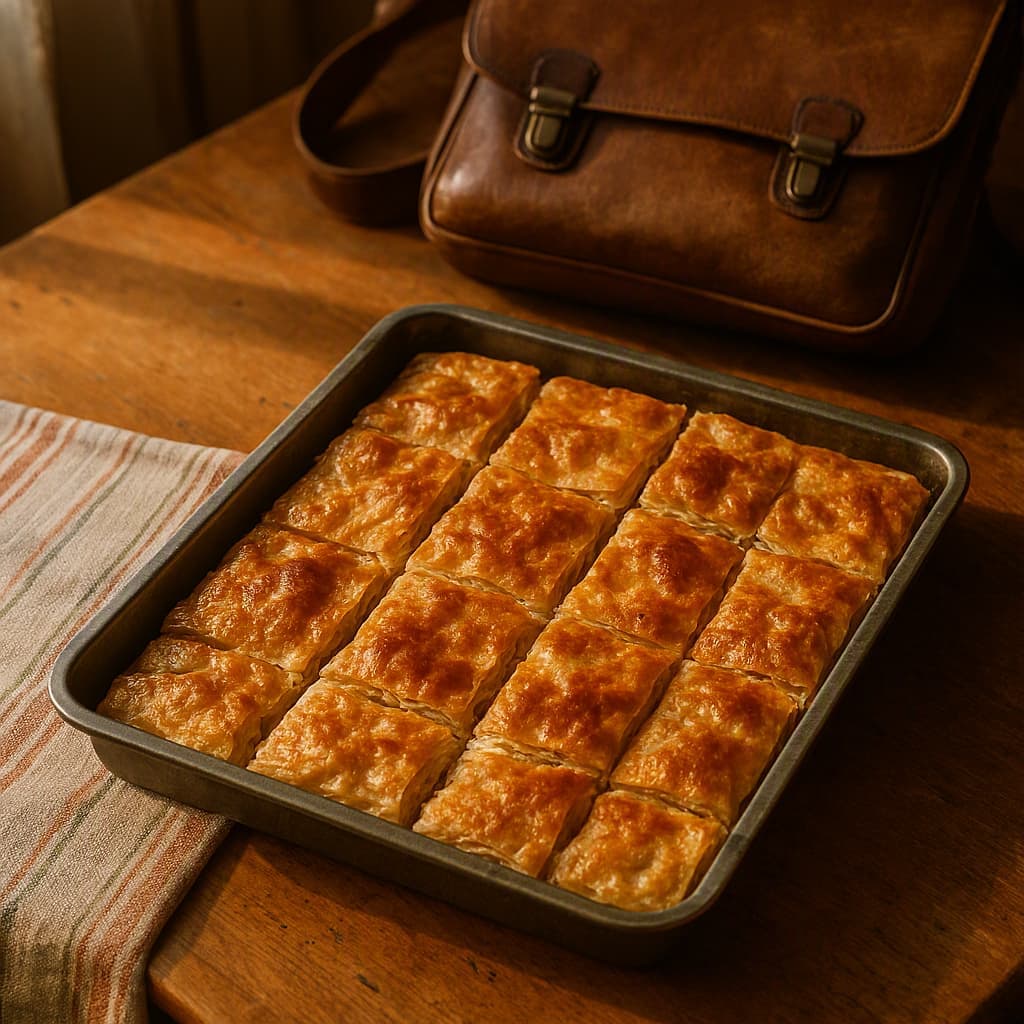
Tray Börek And The First Spoon After School begins with a memory that shines because it is both ordinary and carefully shared. There is the tray of warm börek, set among rooms, streets, school mornings, shop windows, family cupboards, and kitchens where time moved with a slower confidence. In memories of tray börek during seasonal changes, the past looks brighter not because it was perfect, but because people gave repeated gestures enough attention to become meaningful.
The strongest surface is crisp pastry, school bags near chairs, steam from the kitchen, square slices, and the first piece taken before anyone sat down. These details give the scene its emotional grain. They keep nostalgia from floating away and return it to the practical world of buttons, lenses, fabric, leather, pastry, waiting, and touch. A smock, camera, chest, shoe, or tray may seem modest, yet each one gathered social meaning because people used it, protected it, noticed it, and spoke around it.
The Shared Dream Inside The Object
Around tray börek during seasonal changes, people learned the comfort of a family dish that marked the change of season. The lesson arrived through simple actions. A collar was straightened, a photograph was allowed to develop, a chest was opened carefully, shoes were tried on with visible pride, or a slice of börek was taken from the tray while the kitchen was still warm. These gestures made private feeling visible enough for others to join.
Eski Pano returns to such objects because they are small doors into the culture of daily life. Official history can describe schools, technology, dowries, holidays, and food traditions, but the intimate history lives in how a child stood in a smock, how a family waited for an image, how a chest smelled when opened, how new shoes changed a walk, and how a hot tray pulled everyone toward the table.
Why The Brightness Remains
The brightness in this memory is not only the softness of distance. It is also the memory of shared expectation. Everyone knew that a school morning, a photograph, a family object, a new pair of shoes, or a tray from the oven carried more than its practical use. It announced a small threshold. Something was beginning, being kept, being celebrated, or being served at exactly the right moment.
Modern routines often make these thresholds less visible. Uniforms change, photographs appear instantly, heirlooms compete with storage problems, celebrations move behind apartment doors, and family dishes fit into crowded schedules. Yet the tray of warm börek still speaks because it reminds us that emotion needs form. When care has a shape, people can recognise it, share it, and remember it with precision.
Looking back at tray börek during seasonal changes, the useful inheritance is a more patient way of noticing. It asks us to see that ordinary objects become memory when they pass through many hands and many small expectations. That is why this scene still feels tender. It does not ask us to live in the past; it asks us to let today become memorable with equal care.
There is one more quiet reason this memory lasts. Around tray börek during seasonal changes, people did not treat anticipation as wasted time. Waiting for a bell, image, chest, visit, or slice gave feeling a place to gather. The delay made the moment more social, and the social shape made it memorable.