 Eski Pano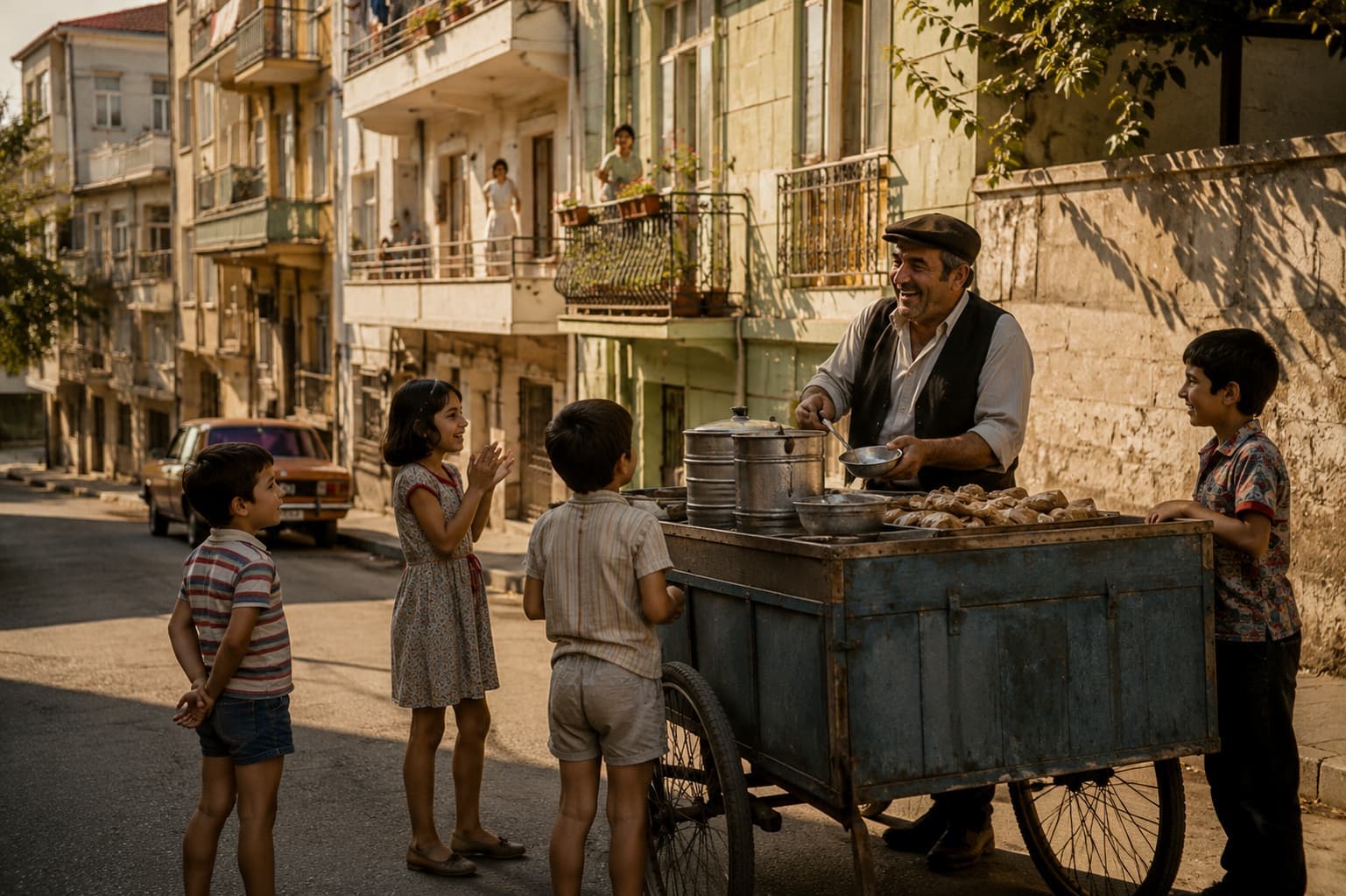
The Street Vendor’s Voice On Holiday Afternoons starts with a vendor’s modest cart at the corner of a familiar street. It is an ordinary thing in an ordinary place, yet it carries a whole arrangement of voices, pauses, and expectations. When people remember the cheerful call of a street vendor drifting through relaxed holiday days, they rarely recall a single fact. They remember the light on a wall, the slow approach of an hour, someone making room, and the feeling that everyday life was happening in the presence of others.
This is why the scene remains persuasive. It does not ask memory to become a museum display. It lets memory remain practical. Someone waited, listened, folded, served, repaired, waved, or sat down. The object was useful, but its usefulness was social. It made a shared rhythm visible, and that rhythm gave people a modest confidence that they belonged to a place and to one another.
A Ritual With Human Scale
In the older routines around the cheerful call of a street vendor drifting through relaxed holiday days, attention was not treated as a scarce resource. Families, neighbours, and passing acquaintances had room to notice one another. A small event could develop slowly: a departure at a platform, a voice coming through static, a handmade cloth placed away carefully, a familiar call from the street, or a dessert cooling before it was divided. Such moments did not need to be spectacular to become important.
Eski Pano follows these details because public history often records the large change while private memory preserves the human method. It remembers who adjusted the dial, who saved a place, who reached for a glass, who explained a sound, who carried the tray, and who stayed a few minutes longer. This record is not less serious because it is domestic or local. It shows how culture was practiced before it was named.
What The Detail Still Teaches
Today, many experiences are immediate, personalised, and quickly replaced. The memory of the cheerful call of a street vendor drifting through relaxed holiday days offers another pace. It reminds us that repetition can be generous when it leaves space for conversation, care, and recognition. The value of a vendor’s modest cart at the corner of a familiar street lies not in wishing for an exact return to the past, but in noticing the conditions that allowed a simple object to become a shared reference point.
There is also a lesson about maintenance. Things gained meaning because people kept them, cleaned them, mended them, stored them, and brought them out again. That care made time tangible. A familiar mark or worn edge could prompt a story, and a story could make a younger listener feel connected to a room, a street, a kitchen, or a journey they had never experienced themselves.
Remembering the cheerful call of a street vendor drifting through relaxed holiday days therefore means more than admiring a nostalgic image. It means recognising a form of everyday hospitality. The scene says that a bench, device, piece of cloth, street call, or family dish can hold emotional history when people give it patient attention. In that sense, the past survives not as a fixed picture, but as an invitation to make our own ordinary moments more visible and more shareable.