 Eski Pano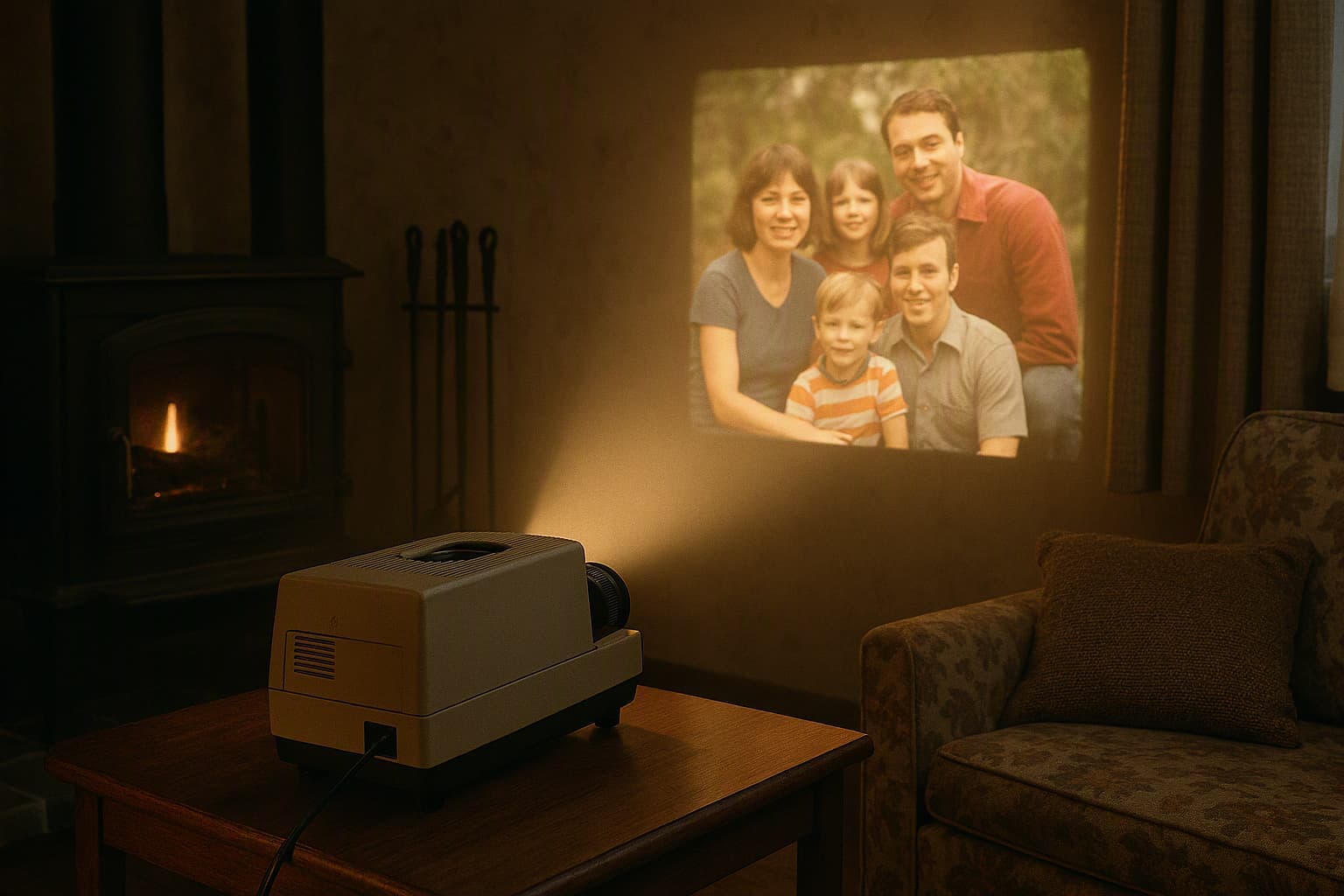
Slide Projectors And The Quiet Excitement Of Family Salons begins with a scene where memory gathers around a visible point of attention. There is the glowing slide projector, placed inside rooms, streets, kitchens, stairwells, public days, and family evenings where ordinary life learned to make meaning slowly. In memories of families gathering around a slide projector, the past remains vivid because people shared waiting, looking, repairing, listening, and eating in ways that left a shape behind.
The strongest texture is stove warmth, white walls, clicking trays, lowered voices, and images appearing as if yesterday had returned. These details keep the scene close to the senses. They prevent nostalgia from becoming only a soft glow and return it to light, tools, clocks, walls, pans, flags, and the gestures of people who knew how to gather without making too much noise. The memory is strong because it is practical as well as tender.
The Ritual Around The Object
Around families gathering around a slide projector, people learned the patience of watching memory arrive one frame at a time. The lesson was carried by action. A flag moved in river light, a slide appeared on a wall, a clock was wound, a repairman climbed stairs, or a pan was placed where everyone could reach. These small events taught people how to recognise shared time. They made private feeling visible enough to become social.
Eski Pano follows these scenes because they show how cultural memory lives below official language. National days, analogue devices, household clocks, repair visits, and kitchen dishes all have public explanations, but their emotional life depends on smaller details. It depends on who stood by the window, who waited by the stove, who trusted the tick, who opened the door, and who tore bread for the first bite.
Why It Still Feels Near
This memory still feels near because it describes relationships as much as objects. A national day becomes a civic feeling. A slide projector turns images into a family room. A wind-up clock gives time a household voice. A refrigerator repairman restores confidence in the ordinary. A pan of menemen makes summer abundance something everyone can share. Each scene turns use into belonging.
Modern routines can hide that transformation. Ceremonies become images, photographs become files, clocks become silent screens, repair becomes replacement, and food can become an individual portion. Yet the glowing slide projector still speaks because it remembers a more visible rhythm. It tells us that ordinary acts become memorable when people are allowed to see and join the care behind them.
Looking back at families gathering around a slide projector, the useful inheritance is a patient respect for shared attention. The past does not need to be copied exactly. It needs to be read for the habits it preserved: waiting together, repairing together, looking together, and eating together. Those habits can still make the present warmer if we let them.
There is also a quiet lesson about presence. Around families gathering around a slide projector, people did not only consume a moment; they inhabited it. The object helped them stay long enough for feeling to gather, and that stay is what memory protects.