 Eski Pano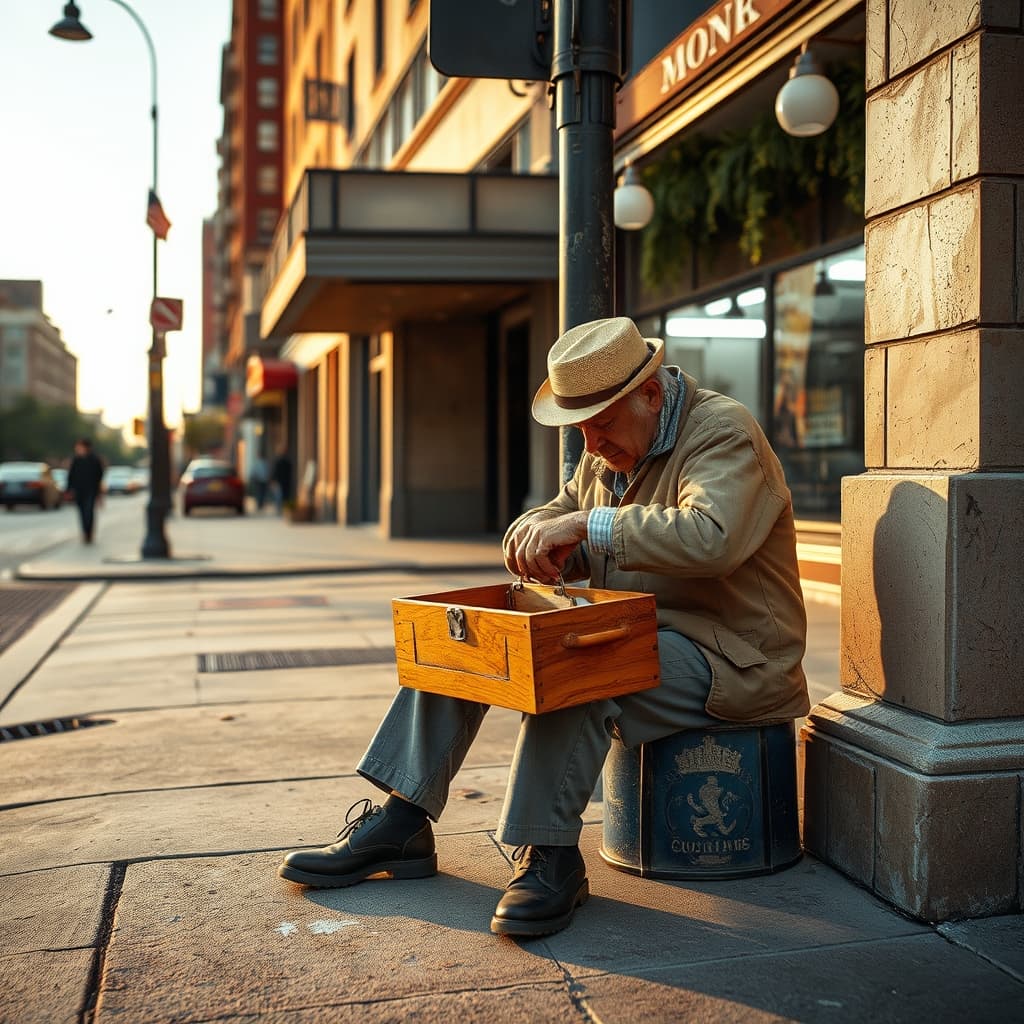
The Shoe Shiner’s Corner Watch In The Old City begins with a kind of ordinary brightness that older city memories often carry. There is the wooden polish box, placed inside a scene where people still measured the day by visits, voices, work, food, and light. In memories of the shoe shiner’s corner watch, nothing needs to be exaggerated. The feeling is already present in the small arrangements of daily life, in the way a street, room, corner, or table could gather more meaning than anyone planned.
The strongest trace is brush taps, dark polish, passing clerks, warm pavement, and greetings exchanged without stopping the day. These details give the past its surface. They prevent nostalgia from becoming a blank glow, because they keep the exact textures of waiting, pride, appetite, tidiness, and shared attention. A person remembers not only what happened, but where the hand rested, what sound came first, which smell arrived from the kitchen, and how the afternoon air moved through a curtain or across a pavement.
A Public And Domestic Ritual
The ritual around the shoe shiner’s corner watch joined private feeling with public habit. People dressed carefully, listened for a signal, opened a stored object, paused at a corner, or waited for dessert to cool. Through these acts they learned the dignity of skilled work performed in the open rhythm of the street. The lesson was practical, but it also taught emotional scale. It suggested that a small thing can carry a large amount of care when a community agrees to notice it.
Eski Pano values these scenes because they sit between personal memory and cultural evidence. They are not official monuments, yet they explain a period with rare intimacy. A festival morning, an analogue device, a suitcase in a familiar room, a working corner of the street, or a kitchen dessert can reveal how people organised attention. They show what counted as respect, what counted as preparation, and what counted as belonging.
What It Still Teaches
Today many of these rhythms have changed. The city wakes through screens, messages arrive without the ceremony of waiting, travel leaves fewer objects in the corner, street work is pushed aside by speed, and kitchen time is often compressed into convenience. Yet the memory does not return simply to complain about the present. It returns because it carries a skill that still matters: knowing how to let an ordinary moment become shared.
the wooden polish box still feels alive because it gathered people around a visible point of attention. Someone noticed it, prepared it, waited beside it, used it, or passed it to another person. The object became a hinge between inner life and social life. That hinge is why the memory remains warm. It does not insist that everything was easier before. It reminds us that meaning often required participation.
Looking back at the shoe shiner’s corner watch, the useful part is not a perfect return. It is the recovery of a slower attention, one able to see care in polish, patience in waiting, memory in a corner, and generosity in a bowl. The past becomes valuable when it helps the present notice itself more clearly, and this small scene still has that quiet power.