 Eski Pano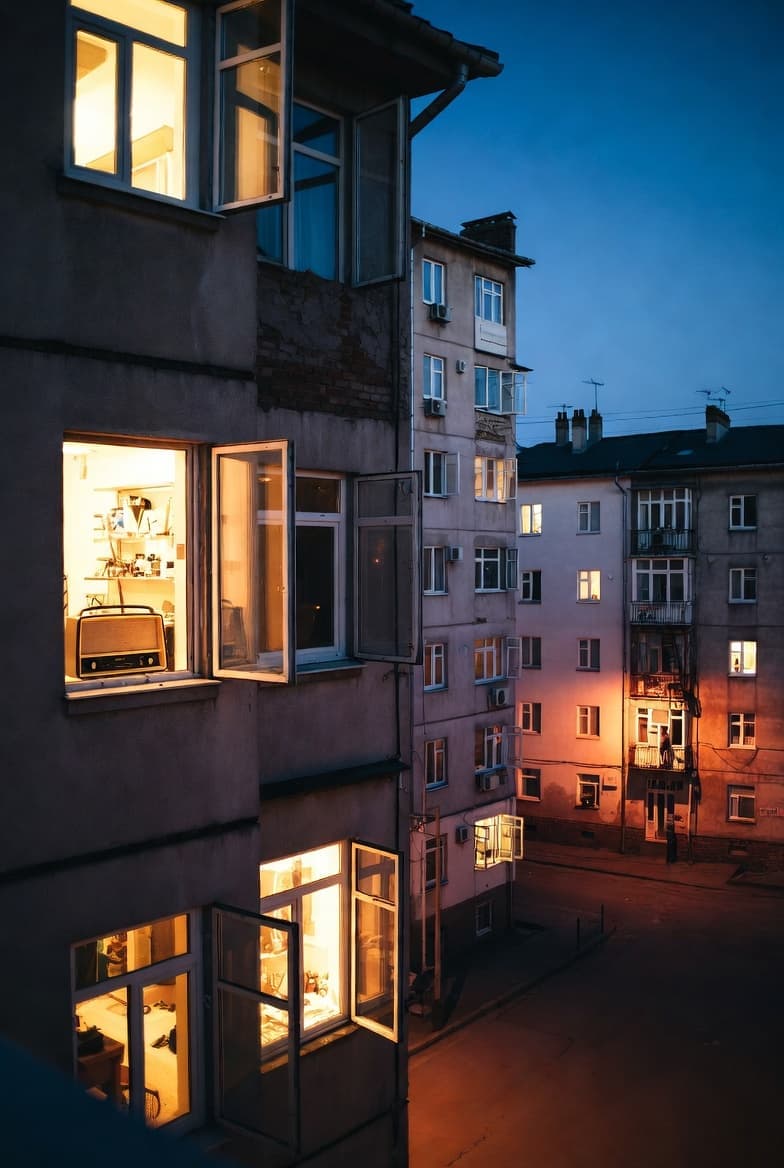
Open-Window Radio Voices And The Strength Of Neighbourliness begins with a scene shaped by shared attention rather than spectacle. There is the radio by the open window, placed among family journeys, salon tables, dowry rooms, open windows, kitchens, and the everyday sounds that made old neighbourhoods feel inhabited. In memories of radio sounds from open windows strengthening neighbours, the past remains vivid because ordinary things helped people move through the day together.
The strongest texture is summer curtains, familiar songs, balcony voices, street echoes, and music drifting from one household into another. These details keep the memory practical and close. They remind us that culture is not only carried by grand events, but also by baskets, charts, hangers, radios, soup bowls, and the small gestures that gather around them. Each object created a point of attention where family, neighbours, and routines could briefly meet.
The Quiet Form Of Belonging
Around radio sounds from open windows strengthening neighbours, people learned the trust created by hearing one another’s evenings. They learned it without needing to name it. A family boarded a train together, numbers were solved by hand, a room waited for future ceremonies, a song crossed an open window, or soup called everyone to the table. These acts made belonging visible through rhythm, not through declarations.
Eski Pano follows these modest scenes because they reveal how daily life makes memory durable. Official records may tell us where railways ran, what devices were used, how homes were arranged, or what people ate. But intimate memory tells us how a weekend felt, how a calculation gathered curiosity, how an object waited in a quiet room, how a street heard the same song, and how the first spoonful changed the table.
Why The Memory Holds
The reason this memory holds is not simply that the past is far away. It holds because the objects had social edges. They invited others to notice, wait, help, listen, taste, or remember. A picnic journey became more than transport. A calculation became more than arithmetic. A hanger became more than metal. A radio became more than sound. A soup became more than food.
Modern routines often make these edges less visible. Travel becomes individual, calculation becomes instant, stored objects become clutter, sound moves into headphones, and meals are squeezed into separate schedules. Yet the radio by the open window still speaks because it shows how meaning grows when an ordinary act is shared in time and space. The memory is less about old things than about the relationships they made easier to practise.
Looking back at radio sounds from open windows strengthening neighbours, the useful inheritance is a patient respect for small meeting points. If today’s homes and streets can give ordinary objects a little shared attention again, they can produce memory with the same warmth. The past does not ask to be copied. It asks to be noticed well enough to teach the present.
There is also a gentle lesson about limits. Around radio sounds from open windows strengthening neighbours, people accepted that not everything had to happen alone or instantly. Waiting together gave the moment its shape, and the shape made care visible. That is why the memory feels both useful and tender.