Eski Pano
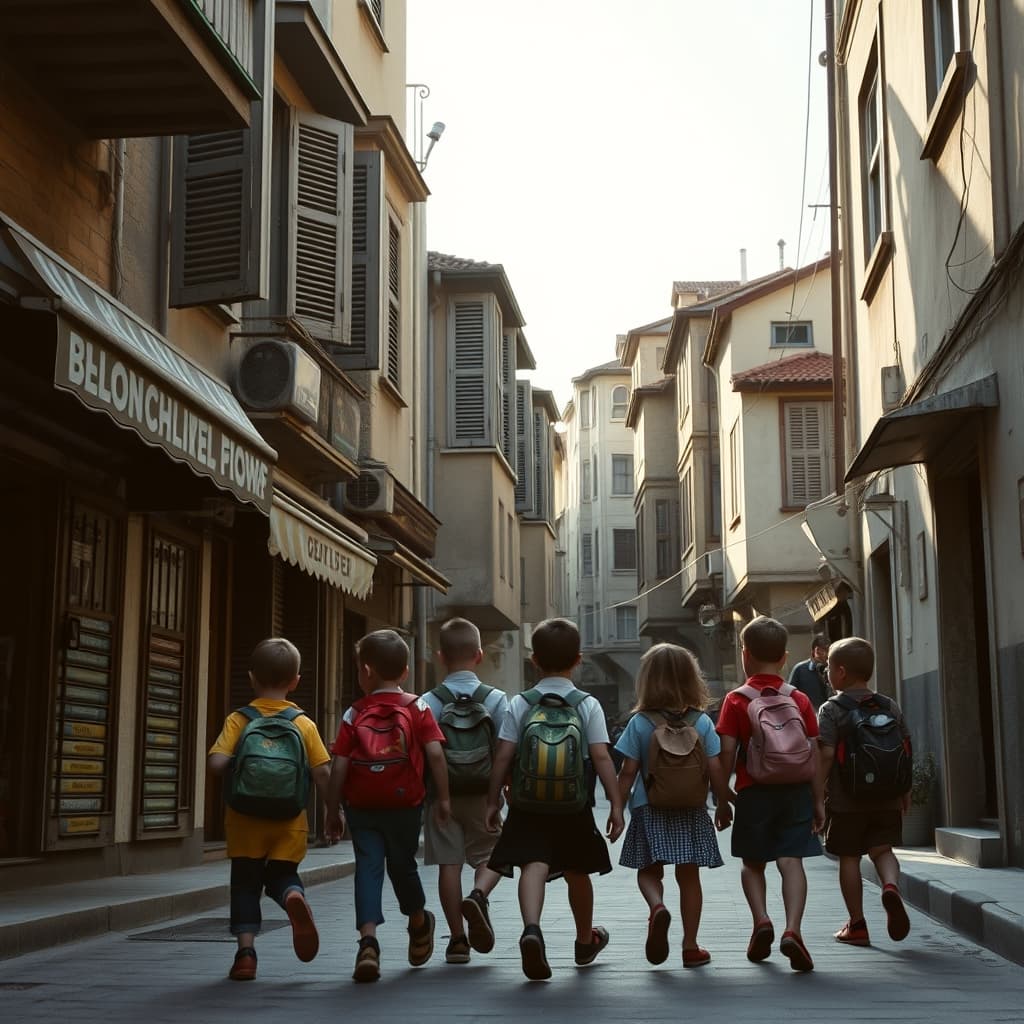
There was a time when the road to school was not simply a distance between two points. It was a small world that the neighborhood reopened to children every morning. Before the order of school shuttles became central to daily life, children stepped into the street in groups, another friend joined in front of one apartment, another caught up near the grocer's corner, and the crowd grew as the road lengthened. Schoolbags slipped on shoulders, shoes struck the paving stones in a shared rhythm, and there might be a simit or half-finished pastry still in hand. Morning became not only a rush, but a common beginning. Those walking hours created a form of social life before school had even begun. The day's first joke, first seat arrangement, first little quarrel, and first reconciliation often happened on the way.
Seen through the lens of neighborhood culture, children walking together represented not only a way of getting somewhere, but a social closeness shaped by the manners of the street. Along the route they learned in front of which house to slow down, which neighbor cleaned windows early in the morning, and which shopkeeper always offered a greeting. These walks also carried an invisible neighborhood watch. Aunts looking from balconies and men raising shop shutters recognized the group moving toward school and followed them from the corner of an eye. For that reason, children were never entirely alone in the street. The neighborhood protected them through unfinished sentences, brief glances, and familiar greetings. Part of the warmth missing in many of today's residential compounds can be searched for there. As physical security increased, the natural flow of everyday familiarity often weakened.
The warmth of walking together came from the slowness of shared time. A shuttle bus can pick children up at the door and carry them through an orderly routine, but it cannot turn the road itself into a lived place. In older neighborhoods, by contrast, the way to school was a social corridor where children made discoveries at their own scale. Autumn leaves were kicked across the pavement, the number of seconds one could hide beneath an awning during rain was tested, a name was invented for a street dog, and when the mulberry tree along the route ripened, there was always a brief delay. These details may not seem like major events in childhood memory, yet when people look back years later, the true warmth rises precisely from such ordinary things. One remembers not only the face of the friend who walked beside them, but also which wall first caught the morning sun.
Domestic life was shaped by that walking order as well. Mothers called out one last warning at the door, phrases such as "don't get cold," "don't run," or "wait for your sibling after school" echoing into the street. When the child returned home, what happened along the way was discussed almost as much as what happened in the classroom. Who had a new pencil, where marbles had been found, which friend was late, whose mother waved from the window all became part of household conversation. In that way the school road entered not only the lives of children, but also the daily knowledge of families. Today's residential compounds may offer a more controlled, more scheduled, and more enclosed circulation for children. That can create a safer and more practical order, but it does not produce the same loose yet warm relation with the street. Warmth often grows out of unplanned contact, minor accidents, and the repetition of familiar faces.
The answer to why the same warmth is not found today is therefore not nostalgia alone. The changing structure of the city, the speeding up of life, traffic, and safety concerns may all have reduced the shared time children once built by walking. Yet what remains in memory is very clear: children who walked together did not merely use the street, they gave it life. At those hours the neighborhood felt itself more strongly, and children entered one another's day before they had even reached the school gate. That is why the warmth of those old walks is not easily found in today's compounds. The issue is not simply the length of the road, but the relationships that accumulated along it. Those old hours were times when children grew by matching their steps to one another, while the neighborhood quietly kept pace with that growth. What we call warmth is often formed exactly that way, from the ordinary yet unforgettable rhythm of walking side by side.
Why Is the Same Warmth Not Found in Today's Residential Complexes in the Hours Once Passed with Children Walking Together Instead of Taking a School Shuttle?