Eski Pano
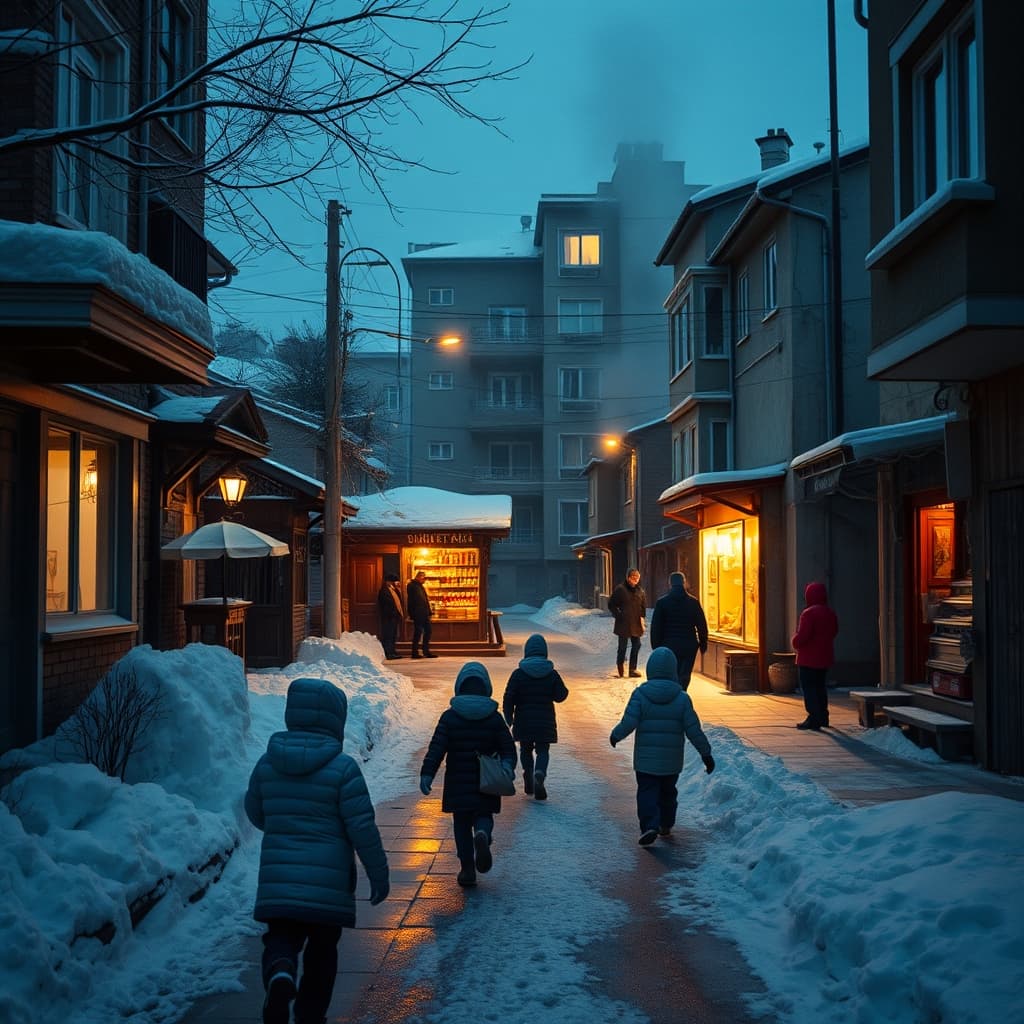
There was a time when streets did not empty as soon as it snowed. On the contrary, the whiteness slowly settling over the city tied the neighborhood to itself with a different sense of closeness. Even in the hours when windows were misted, stove smoke drifted between rooftops, and evening arrived early, life continued in the streets. Children went downstairs for snowball fights, the grocer kept his doorway open despite the slippery pavement, and neighbors talking at apartment entrances did not scatter immediately because of the cold. The blanket of snow that softened every sound made the street feel not more dangerous, but more sheltered. Everyone knew everyone else; people knew which family lived in which building, the footsteps of a child coming home late were noticed, and if someone had forgotten a scarf another person would call them back from the doorway.
From the perspective of neighborhood culture, streets that did not empty in snowfall are among the clearest scenes in which old forms of neighborliness can be seen. The sense of security was not related only to physical safety. It was nourished by streets surrounded by familiar faces, by children being watched by more than one pair of eyes, and by adults feeling responsible not only for their own children but for the children of others as well. On winter evenings, the smell of warm bread from the neighborhood bakery, stacks of wood left at the doorway, adults returning home with market bags in hand, and building caretakers shoveling snow all reminded people of the continuity of daily life. Even when the weather became harsher, social life did not withdraw; instead, it tightened its weave. The street was not an empty zone outside the house, but an extension of a shared responsibility.
One important reason the hours spent under snow nourished a generation’s sense of security was that public space was not entirely forbidden to children. After returning from school, children still went outside for a while, used pieces of cardboard as makeshift sleds, and scattered melting snow with their boots in apartment entrances. Adults watched from half-open windows, occasionally calling out by name, yet they did not treat the street itself as a total threat. Time spent outside gave children a sense of moving on their own while also being protected by a visible social web. Roads narrowed by snow, slowed traffic, and reduced noise made the neighborhood easier to read. In an environment where no one hurried and every step was taken more carefully, the feeling of safety ceased to be an abstract notion and became a bodily experience.
Part of why this memory remains so bright lies in the balance between the warmth inside the home and the chill of the street. When children came in from outside and the feeling returned to their fingers, mothers served hot soup, socks drying by the stove gave off steam, and someone would ask, “who was downstairs?” That question came not only from curiosity, but from a need to know that the neighborhood fabric remained intact. Hours spent in the street were retold inside the house: who slipped, who made the largest snowball, which neighbor cleared the path in front of the building. In that way the experience outside was confirmed indoors, and the relationship between house and street remained not rigid but permeable. The sense of security was born precisely from that permeability. The street was familiar because it belonged to the home, and the home felt relaxed because the street was being watched.
Today, when snowfall no longer leaves streets full in the same way, that older feeling of security becomes even more visible in memory. For one generation, snow signified not only cold or inconvenience, but a social order in which neighborliness, visible solidarity, and the naturalness of being outdoors were still alive. The hours spent on streets that did not empty when it snowed taught children that the world was not entirely dangerous, and that moving freely among familiar people was both possible and beautiful. Perhaps that is why white streets look so warm in hindsight. In those days snow covered not only winter, but also the protective confidence of a neighborhood that watched over itself.
How Did the Hours Spent on Streets That Did Not Empty When It Snowed Nourish a Generation’s Sense of Security?