🇹🇷 Türkçe | duvar halısı ve elden ele geçen aile yadigârı oluşu: nasıl bir aile mirasına dönüştü
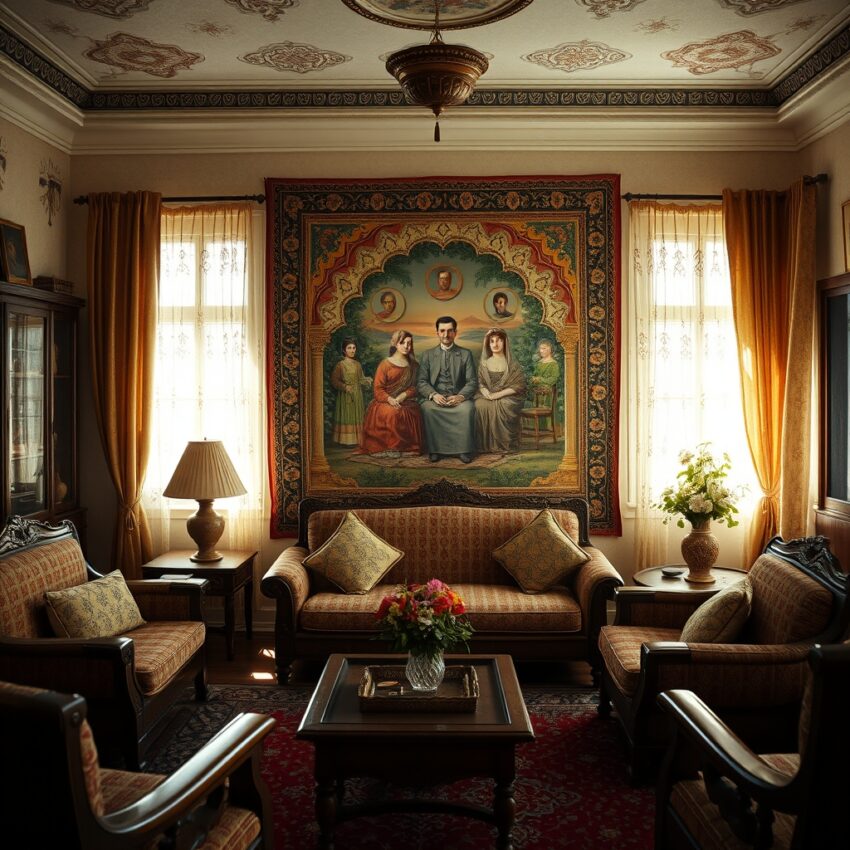
Bir zamanlar evlerin en sessiz ama en dikkat çekici tanıklarından biri duvar halılarıydı. Salonun baş köşesinde asılı duran bu dokumalar, yalnız boş bir yüzeyi örtmek için değil, evin hafızasını görünür kılmak için oradaydı sanki. Üstlerinde bazen geyikli bir orman, bazen servi ağaçlarıyla çevrili bir köşk, bazen de sabırla işlenmiş geometrik desenler yer alırdı. Gündüzleri pencere ışığını yumuşatır, akşamları soba sıcaklığıyla birlikte odanın havasına ağırbaşlı bir derinlik katarlardı. Çocuklar için arka planda duran alışıldık bir eşya gibi görünse de yıllar geçtikçe o halının önünde çekilmiş bayram fotoğrafları, misafir sohbetleri, düğün hazırlıkları ve aile içi sessizlikler onun sıradan bir süs olmadığını gösterirdi. Elden ele geçtikçe bir eşya olmaktan çıkıp aile yadigârına dönüşmesinin sebebi de tam burada başlar.
Obje Hikayeleri açısından duvar halısı, işlevinden çok taşıdığı anlamla yaşayan nesnelerden biridir. Çoğu zaman çeyizle eve gelir, bazen anneannenin sandığından çıkar, bazen şehir dışındaki bir akrabadan özel bir hediye olarak ulaşırdı. Onu değerli kılan yalnız dokuma tekniği, renk uyumu ya da deseni değildi. Hangi evin duvarını yıllarca gördüğü, hangi kuşağın ona bakarak büyüdüğü ve hangi aile konuşmalarına sessizce eşlik ettiği de önem taşırdı. Bu yüzden duvar halısının bir yerden sökülüp başka bir eve taşınması, sıradan bir nakil gibi yaşanmazdı. Sanki evle birlikte bir dönem, bir zevk anlayışı ve bir aile sesi de taşınıyor gibiydi. El değiştirdikçe eskimiyor, tersine hatıra yoğunluğu artıyordu.
Onu aile mirasına dönüştüren şey biraz da ev içi düzenin merkezinde durmasıydı. Vitrindeki porselenler kırılabilir, masa örtüleri değişebilir, koltuk kumaşları eskir ve yenilenebilirdi; ama duvar halısı çoğu kez yıllarca yerinden kıpırdamazdı. Bu sabitlik, ona evin zamanını biriktirme gücü verirdi. Bir çocuk için dedesinin koltuğunun hemen arkasındaki desen, yıllar sonra bile çocukluk hissini geri çağırabilir. Bir gelin için ilk geldiği evde gördüğü o halı, yadırgadığı mekânı zamanla tanıdık hale getiren ilk ayrıntı olabilir. Aile büyükleri öldükten sonra bile duvardan indirilen halının nereye asılacağı uzun uzun konuşuluyorsa, bunun nedeni yalnız estetik değildir. İnsanlar o nesnenin içinde saklı duran devamlılığı korumak ister.
Elden ele geçme meselesi, bu yüzden maddi devrin çok ötesindedir. Bir halının kıvrılıp sandığa kaldırılması, naftalin kokusu eşliğinde yıllarca beklemesi ve sonra başka bir evde yeniden duvara asılması, geçmişin fiziksel olarak yeni bir hayata katılması demektir. Üstelik her yeni ev, ona başka bir katman ekler. Bir zamanlar soba dumanı sinmiş olan liflere sonra apartman salonunun deterjan kokusu karışır; bir kuşağın sessiz akşamlarını taşıyan desenler, başka bir kuşağın çocuk seslerine fon olur. Böylece nesne sabit kalırken anlamı genişler. Bugün minimal dekorasyon anlayışıyla bu halılar bazen modası geçmiş bulunabilir; ama aileler onları saklamaya devam ediyorsa, bunun nedeni belleğin modern zevk ölçülerinden daha güçlü olmasıdır.
Sonunda duvar halısının aile mirasına dönüşmesi, geçmişin gündelik eşyalar içinde nasıl saklandığını anlatan çok zarif bir örnek sunar. Çünkü aile dediğimiz şey yalnız soy ağacı ya da resmî kayıtlarla sürmez; aynı duvara yıllarca bakan desenlerle, aynı nesneye yüklenen ortak hislerle de devam eder. Duvar halısı, elden ele geçerken bize şunu hatırlatır: bazı eşyalar kullanıldıkları için değil, bakıldıkları ve birlikte yaşlandıkları için kıymet kazanır. Her yeni evde biraz başka görünse de taşıdığı sessiz ağırlık değişmez. Bu nedenle bir duvar halısı, yalnız eski bir dekor parçası değil; kuşakların birbirine bıraktığı dokunulabilir bir hafıza yüzeyidir.
🇬🇧 English | Wall Tapestry and Its Becoming a Family Heirloom Passed from Hand to Hand: How Did It Turn into a Family Legacy?
There was a time when one of the quietest yet most striking witnesses inside a home was the wall tapestry. Hanging in the main room, it seemed to exist not merely to cover an empty surface, but to make the memory of the house visible. Sometimes it showed a forest with deer, sometimes a pavilion framed by cypress trees, and sometimes patient geometric motifs woven in careful repetition. During the day it softened the window light, and in the evening it added a composed depth to the room along with the warmth of the stove. For children it might have looked like an ordinary object always present in the background, yet as the years passed, holiday photographs taken in front of it, guest conversations held beneath it, wedding preparations, and family silences all revealed that it was never a simple decoration. The reason it turned from an object into an heirloom as it passed from hand to hand begins exactly there.
From the perspective of object stories, the wall tapestry belongs to that class of things that live less through function than through the meanings they accumulate. It often entered a home as part of a dowry, sometimes came out of a grandmother’s chest, and sometimes arrived as a special gift from a relative living in another city. What made it valuable was not only its weaving technique, its harmony of colors, or its design. It also mattered which walls it had looked at for years, which generation had grown up beneath it, and what family conversations it had silently accompanied. That is why taking it down from one wall and carrying it into another home was never experienced as an ordinary move. It felt as if a period, a sense of taste, and even a family voice were being carried along with it. With every transfer it did not wear out; its density of memory increased.
Part of what turned it into a family legacy was the fact that it stood at the center of domestic arrangement. Porcelain in the display cabinet could break, tablecloths could change, and sofa fabric could wear out and be replaced, but the wall tapestry often remained in place for years. That stillness gave it the power to gather the time of a house. For a child, the pattern behind a grandfather’s armchair might later bring back the feeling of childhood in an instant. For a bride, the tapestry seen on the wall of the house she entered for the first time might be the detail that slowly turned an unfamiliar place into something intimate. If, after the elders of a family are gone, there is still a long discussion about where the tapestry should be hung, the reason is not merely aesthetic. People want to preserve the continuity hidden inside the object.
For that reason, being passed from hand to hand goes far beyond material transfer. A tapestry folded up, placed into a cedar chest, left for years among mothballs, and then hung once more on another wall means that the past is physically joining a new life. Each new house adds another layer to it. Fibers that once carried the smell of stove smoke later absorb the detergent scent of an apartment living room; patterns that held the quiet evenings of one generation become the backdrop to the voices of children from another. In this way, the object stays the same while its meaning expands. Today such tapestries may be called outdated by minimalist taste, yet if families continue to keep them, it is because memory is stronger than changing fashion.
In the end, the transformation of a wall tapestry into a family legacy offers a graceful example of how the past survives inside everyday objects. A family does not continue only through genealogy or official records; it also continues through patterns looked at for years on the same wall and through feelings attached collectively to the same object. As it passes from hand to hand, the tapestry reminds us of something simple: some objects become valuable not because they are merely used, but because they are looked at, lived with, and allowed to age beside us. It may appear slightly different in each new home, yet the quiet weight it carries does not change. For that reason, a wall tapestry is not merely an old decorative piece, but a tangible surface of memory passed between generations.
🇧🇷 Português (Brasil) | Tapeçaria de Parede e Seu Tornar-se uma Herança de Família Passada de Mão em Mão: Como se Transformou em um Legado Familiar?
Houve um tempo em que uma das testemunhas mais silenciosas, mas também mais marcantes, dentro de uma casa era a tapeçaria de parede. Pendurada no ponto principal da sala, ela parecia estar ali não apenas para cobrir uma superfície vazia, mas para tornar visível a memória do lar. Às vezes trazia uma floresta com cervos, às vezes um pavilhão cercado por ciprestes, às vezes desenhos geométricos tecidos com paciência. Durante o dia suavizava a luz da janela; à noite, junto do calor do fogão, acrescentava uma profundidade serena ao ambiente. Para as crianças podia parecer apenas um objeto habitual ao fundo da sala, mas, com os anos, as fotos de festas tiradas diante dela, as conversas de visita, os preparativos de casamento e os silêncios da família revelavam que ela nunca foi uma simples decoração. É exatamente aí que começa a razão de ter se transformado em relíquia de família ao passar de mão em mão.
Do ponto de vista das histórias dos objetos, a tapeçaria de parede pertence ao grupo das coisas que vivem menos por sua função e mais pelos significados que acumulam. Muitas vezes entrava na casa como parte do enxoval, às vezes saía do baú da avó, às vezes chegava como presente especial de um parente de outra cidade. O que a tornava valiosa não era só a técnica do tear, a harmonia das cores ou o desenho. Também importava quais paredes ela havia acompanhado durante anos, qual geração crescera olhando para ela e de quais conversas familiares participara em silêncio. Por isso, tirá-la de uma parede e levá-la para outra casa nunca era vivido como uma simples mudança. Era como se junto dela se transportassem um período, um gosto doméstico e até uma voz de família. A cada passagem ela não perdia valor; ganhava mais densidade de lembrança.
Uma parte do que a transformou em legado familiar vinha do fato de ocupar um lugar central na organização da casa. As porcelanas da cristaleira podiam quebrar, as toalhas de mesa podiam ser trocadas e os tecidos do sofá podiam envelhecer e ser substituídos; a tapeçaria, porém, muitas vezes permanecia durante anos no mesmo lugar. Essa permanência lhe dava o poder de acumular o tempo da casa. Para uma criança, o desenho atrás da poltrona do avô pode devolver de imediato a sensação da infância. Para uma noiva, a tapeçaria vista na casa em que entrou pela primeira vez pode ser o detalhe que lentamente transformou um espaço estranho em algo familiar. Se, depois da morte dos mais velhos, ainda se discute longamente em qual parede ela deve ser colocada, isso não acontece apenas por razão estética. O que se quer preservar é a continuidade escondida dentro daquele objeto.
Por isso, o fato de passar de mão em mão vai muito além de uma transferência material. Dobrar a tapeçaria, guardá-la no baú, deixá-la durante anos entre bolas de naftalina e depois pendurá-la outra vez em uma nova parede significa fazer o passado entrar fisicamente em outra vida. Cada casa acrescenta uma camada. Fibras antes impregnadas pelo cheiro de fumaça do fogão depois recebem o perfume de detergente de uma sala de apartamento; desenhos que acompanharam os serões silenciosos de uma geração tornam-se o fundo das vozes infantis de outra. Assim, o objeto permanece o mesmo enquanto o seu significado se amplia. Hoje essas tapeçarias podem ser consideradas fora de moda por uma estética minimalista, mas se as famílias continuam a guardá-las é porque a memória é mais forte do que a mudança do gosto.
No fim, a transformação de uma tapeçaria de parede em legado familiar oferece um exemplo delicado de como o passado se conserva dentro dos objetos cotidianos. Uma família não continua apenas por árvore genealógica ou registros oficiais; ela também continua pelos desenhos observados durante anos na mesma parede e pelos sentimentos partilhados em torno do mesmo objeto. Ao passar de mão em mão, a tapeçaria nos lembra de algo simples: alguns objetos se tornam valiosos não apenas porque foram usados, mas porque foram contemplados, vividos e deixados envelhecer conosco. Em cada nova casa ela pode parecer um pouco diferente, mas o peso silencioso que carrega não muda. Por isso, uma tapeçaria de parede não é apenas uma antiga peça decorativa, e sim uma superfície palpável de memória transmitida entre gerações.