🇹🇷 Türkçe | dikiş bilen komşuya uğrayan evler günleri: bir neslin güven duygusunu nasıl besledi
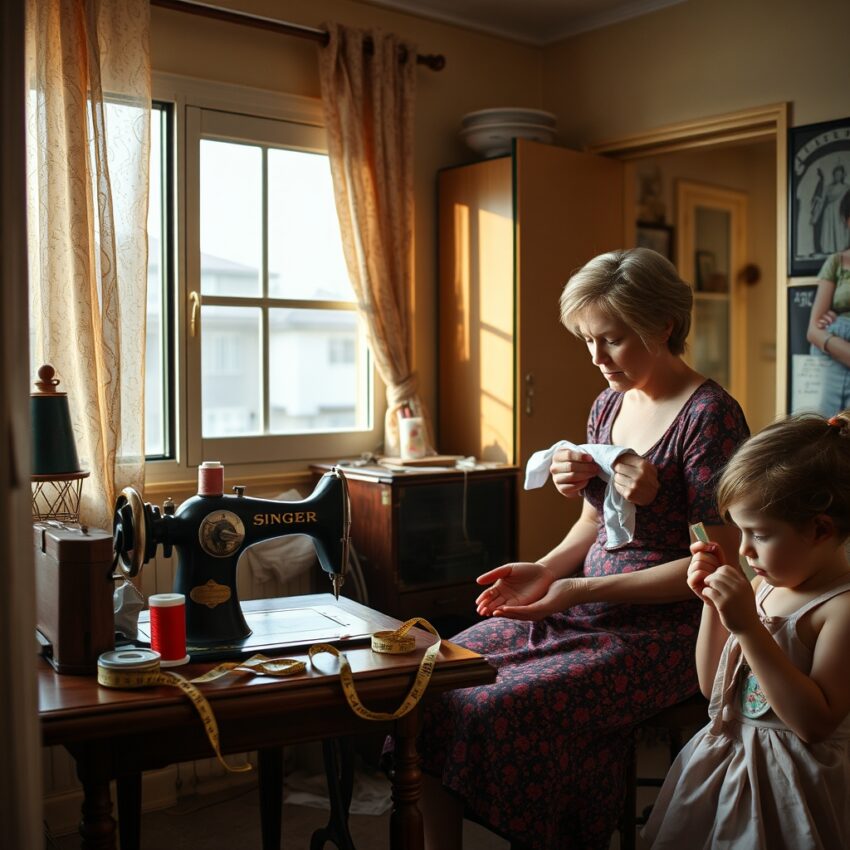
Bir zamanlar mahallede dikiş bilen bir komşunun varlığı, yalnız pratik bir kolaylık değil, gündelik hayatın görünmez güvencelerinden biriydi. Düğmesi kopan gömlek, paçası sökülen pantolon, bayram öncesi daraltılması gereken elbise ya da aceleyle yamalanacak okul önlüğü için kapısı çalınan o evler, mahallenin sessiz dayanışma noktalarıydı. İçeri girildiğinde Singer makinesinin metal parıltısı, sehpanın üstündeki iğne yastığı, makaralara dolanmış renk renk iplikler ve ütü bezinin hafif sıcak kokusu hemen hissedilirdi. İnsan daha ilk anda “bu iş hallolur” duygusuna yaklaşırdı. Dikiş bilen komşu, eşyanın onarıldığı kadar iç huzurunun da toparlandığı bir figürdü.
Mahalle Kültürü açısından bu uğrayışlar, komşuluğun yalnız selamlaşmadan ibaret olmadığını gösterir. O yıllarda uzmanlık gündelik hayatın içinde dağılmıştı. Kimi turşu kurmayı iyi bilir, kimi reçel kaynatır, kimi çocuk bakar, kimi de dikiş dikerdi. Bu küçük beceriler bir mahallenin görünmeyen altyapısını kurardı. Dikiş bilen komşuya gitmek, hizmet satın almaktan çok güvene yaslanmak demekti. Kapı çoğu zaman randevusuz çalınır, “iki dakikada bakabilir misin” denir, iş çoğu zaman çay eşliğinde uzayan bir sohbete dönüşürdü. Böylece tamir edilen yalnız kumaş değil, insanlar arasındaki bağın kendisi olurdu. Çocuklar da bu sahneleri izleyerek büyür, ihtiyaç anında başvurulacak bir insan halkasının varlığını erkenden öğrenirdi.
Bir neslin güven duygusunu besleyen şey tam olarak buydu: hayatta her aksaklık karşısında yalnız kalmayacağını bilmek. Okula giderken sökülen etek ucu, nişan öncesi kısaltılacak perde, misafir gelmeden önce düzeltilmesi gereken masa örtüsü, bütün bunlar büyük krizler değil ama gündelik telaşlardı. Dikiş bilen komşu, bu telaşları yatıştıran mahalle içi bir ritim oluştururdu. Makine çalışmaya başlayınca çıkan düzenli ses, ev halkına yalnızca bir işin yapıldığını değil, dünyanın tekrar yerine oturduğunu hissettirirdi. Üstelik çoğu zaman bu yardımın karşılığı yalnız para değildi; bir tabak börek, mevsimlik bir tabak meyve ya da içten bir teşekkür de aynı dolaşımın parçasıydı. Güven dediğimiz duygu, biraz da bu karşılıksızlık ve tanışıklık ekonomisinde büyürdü.
Dikiş bilen komşuya uğrayan evlerin çocukları için bu ziyaretler başlı başına bir hafıza mekânıdır. Ayaklı makinenin pedalına merakla bakmak, kesilmiş kumaş parçalarıyla oynamak, mezuranın omuza atılışını izlemek ya da tebeşirle çizilen çizgilerin ciddiyetine şaşmak, pek çok çocuk için el emeği kavramıyla ilk karşılaşmalardan biriydi. Orada görülen şey, hazır alınmayan ama beceriyle çözülen bir dünyaydı. Bir kıyafetin paçası kısalıyor, bir yastık kılıfı yeniden dikiliyor, bir önlük ertesi güne hazır hale geliyordu. Bu nedenle dikiş bilen komşu, yalnız bir yardımcı değil, hayatın tamir edilebilir olduğuna dair güçlü bir işaretti. Nesillerin hafızasında güven duygusunu bu kadar kalıcı kılan da buydu.
Bugün pek çok sorun hızlı alışverişle ya da tek kullanımlık çözümlerle aşılmaya çalışılıyor. Bu yüzden dikiş bilen komşuya uğrayan evler günleri daha derin bir özlemle hatırlanıyor. O günler bize, güven duygusunun büyük sözlerle değil küçük erişilebilirliklerle kurulduğunu hatırlatıyor. Bir kapıyı çalabilmek, içeriden “gel, bakalım” sesini duymak ve bir işin birlikte çözüleceğini bilmek, mahalle hayatının en güçlü teminatlarından biriydi. Nostalji burada yalnız geçmişe bakmak değil, toplumsal dokunun nasıl örüldüğünü yeniden anlamaktır. İğne, iplik ve sabır etrafında kurulan bu komşuluk, bir neslin kalbine dünyayı biraz daha onarılabilir, biraz daha güvenli gösterdi.
🇬🇧 English | The Days When Homes Stopped by the Neighbor Who Knew Sewing: How It Nourished a Generation’s Sense of Security
There was a time when the presence of a neighbor who knew sewing was not only a practical convenience, but one of the invisible assurances of everyday life. A shirt with a missing button, trousers with a torn hem, a dress that needed taking in before a holiday, or a school uniform needing a quick patch all found their way to those homes whose doors were knocked on without hesitation. They were the quiet points of solidarity in the neighborhood. Once inside, one immediately noticed the metallic shine of the Singer machine, the pin cushion on the side table, the spools of thread in different colors, and the faint warm scent of the pressing cloth. From the very first moment, a person moved closer to the feeling that “this can be handled.” The neighbor who knew sewing was a figure around whom not only garments but inner calm could be repaired.
From the perspective of neighborhood culture, these visits show that being neighbors was never only about exchanging greetings. In those years, expertise was spread throughout daily life. One person knew how to pickle vegetables, another how to make jam, another how to mind children, and another how to sew. Such small skills built the unseen infrastructure of a neighborhood. Going to the neighbor who knew sewing meant relying less on a purchased service than on trust. The door was usually knocked on without an appointment, someone would say, “Could you look at this for just a minute?” and the task often grew into a conversation prolonged over tea. In that way, what was repaired was not only fabric, but the bond between people themselves. Children grew up watching these scenes and learned early that in times of need there existed a circle of people to turn to.
That was exactly what nourished a generation’s sense of security: the knowledge that one would not remain alone in the face of every small disruption of life. A skirt hem coming loose on the way to school, curtains needing shortening before an engagement, or a tablecloth needing repair before guests arrived were not grand crises, but they were everyday anxieties. The neighbor who could sew created a local rhythm that soothed such anxieties. Once the machine began to work with its regular sound, the household felt not only that a task was being done, but that the world itself was settling back into place. And very often the return for such help was not simply money. A plate of pastries, a seasonal bowl of fruit, or a heartfelt thanks belonged to the same circulation. The feeling we call trust grew, in part, within this economy of familiarity and generosity.
For the children of the homes that stopped by the sewing neighbor, these visits became places of memory in themselves. Watching the foot pedal with curiosity, playing with fabric scraps, seeing the measuring tape thrown over a shoulder, or marveling at the seriousness of the chalk lines was for many children one of the first encounters with the idea of hand labor. What they saw there was a world not solved by buying everything new, but by skill. The hem of a garment was shortened, a pillowcase sewn again, a school apron made ready for the next day. For that reason, the neighbor who knew sewing was not merely a helper, but a strong sign that life itself could be mended. That is what made the feeling of security so lasting in the memory of generations.
Today many problems are overcome through fast shopping or disposable solutions. That is why the days when homes stopped by the neighbor who knew sewing are remembered with a deeper longing. Those days remind us that a sense of security is built not by grand promises, but by small forms of access. To be able to knock on a door, to hear the answer “Come in, let’s see,” and to know that a problem would be solved together was one of the strongest guarantees of neighborhood life. Here nostalgia is not only a way of looking back, but also a way of understanding how the social fabric was woven. Around needle, thread, and patience, this form of neighborliness made the world appear a little more repairable and a little safer in the heart of a generation.
🇧🇷 Português (Brasil) | Os Dias em que as Casas Passavam na Vizinha que Sabia Costurar: Como Isso Alimentou o Sentimento de Segurança de uma Geração
Houve um tempo em que a presença de uma vizinha que sabia costurar não era apenas uma praticidade, mas uma das garantias invisíveis da vida cotidiana. Uma camisa com botão faltando, uma calça com a barra solta, um vestido que precisava ser ajustado antes da festa ou um uniforme escolar pedindo remendo chegavam sem cerimônia àquelas casas cuja porta era batida com confiança. Eram pontos silenciosos de solidariedade no bairro. Ao entrar, logo se notava o brilho metálico da máquina Singer, a almofada de alfinetes sobre a mesa lateral, os carretéis coloridos e o leve cheiro morno do pano de passar. Já no primeiro instante, surgia a sensação de que “isso vai se resolver”. A vizinha que sabia costurar era uma figura em torno da qual não apenas a roupa, mas também a tranquilidade interior podia ser recomposta.
Do ponto de vista da cultura de bairro, essas visitas mostram que ser vizinho nunca significou apenas trocar cumprimentos. Naqueles anos, as habilidades estavam espalhadas pela vida comum. Uma pessoa sabia fazer conservas, outra fazia geleias, outra cuidava de crianças, e outra costurava. Essas pequenas competências montavam a infraestrutura invisível do bairro. Ir à vizinha que sabia costurar significava apoiar-se menos em um serviço comprado e mais na confiança. A porta quase sempre era batida sem hora marcada, alguém dizia “você pode dar uma olhada nisso rapidinho?” e o trabalho muitas vezes se transformava numa conversa mais longa acompanhada de chá. Assim, o que era consertado não era só o tecido, mas o próprio vínculo entre as pessoas. As crianças cresciam vendo essas cenas e aprendiam cedo que, em momentos de necessidade, existia uma rede humana à qual recorrer.
Era justamente isso que alimentava o sentimento de segurança de uma geração: saber que ninguém ficaria sozinho diante de cada pequeno contratempo da vida. A barra da saia soltando a caminho da escola, a cortina que precisava ser encurtada antes de um noivado ou a toalha de mesa a ser arrumada antes da visita dos convidados não eram grandes crises, mas eram aflições cotidianas. A vizinha costureira criava um ritmo local capaz de acalmar essas aflições. Quando a máquina começava a funcionar com seu som regular, a família sentia não apenas que um serviço estava sendo feito, mas que o próprio mundo voltava ao lugar. E muitas vezes a retribuição por essa ajuda não era só dinheiro. Um prato de salgados, uma tigela de frutas da estação ou um agradecimento sincero faziam parte da mesma circulação. O sentimento que chamamos de confiança crescia, em parte, dentro dessa economia de familiaridade e generosidade.
Para as crianças das casas que passavam na vizinha costureira, essas visitas se tornavam lugares de memória. Observar o pedal com curiosidade, brincar com retalhos, ver a fita métrica pendurada no ombro ou admirar a seriedade das linhas feitas com giz era, para muitas delas, um dos primeiros contatos com a ideia de trabalho manual. O que se via ali era um mundo resolvido não pela compra de tudo novo, mas pela habilidade. A barra de uma roupa era encurtada, a fronha era costurada de novo, o avental escolar ficava pronto para o dia seguinte. Por isso a vizinha que sabia costurar não era apenas uma ajudante, mas um sinal forte de que a vida podia ser reparada. Foi isso que tornou tão duradouro o sentimento de segurança na memória das gerações.
Hoje muitos problemas são resolvidos com compras rápidas ou soluções descartáveis. Por isso os dias em que as casas passavam na vizinha que sabia costurar são lembrados com uma saudade mais funda. Esses dias nos lembram que o sentimento de segurança não é construído por grandes promessas, mas por pequenas formas de acesso. Poder bater numa porta, ouvir “entra, vamos ver” e saber que um problema seria resolvido junto era uma das maiores garantias da vida de bairro. Aqui a nostalgia não é apenas olhar para trás, mas compreender novamente como o tecido social foi costurado. Em torno de agulha, linha e paciência, essa vizinhança fazia o mundo parecer um pouco mais reparável e um pouco mais seguro dentro do coração de uma geração.