🇹🇷 Türkçe | Pasajlarda Uzayan Okul Çıkışı Saatlerinin Şehre Bıraktığı İz
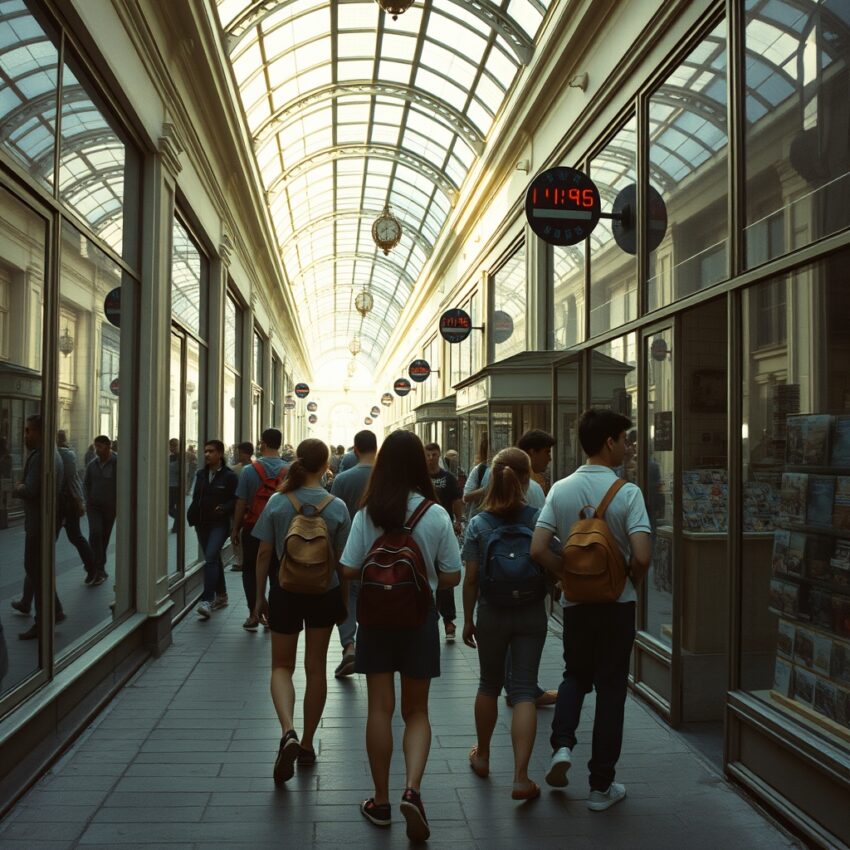
Bir zamanlar okul çıkışı yalnız eve dönülen bir ara saat değildi; gençliğin yavaş yavaş şehre karıştığı, vitrinlere bakarken büyümenin fark edilmeden başladığı bir zaman aralığıydı. Ders zilinin ardından sokaklara dökülen çocuklar ve gençler, çoğu gün doğrudan mahalleye yönelmez, şehir merkezindeki pasajlara doğru hafif bir eğri çizerek yürürdü. Camlı geçitlerin içine girildiğinde dışarıdaki rüzgarın sesi kesilir, ayakkabı tabanları taş zeminde daha belirgin duyulur, dükkânlardan karışık kokular yükselirdi. Kasetçilerin önünden gelen hafif müzik sızıntısı, kırtasiyelerin kağıt ve kalem kokusu, küçük saatçilerin metal sesi, döner kapıların usul hareketi, bütün bu ayrıntılar okul yorgunluğunu bir anda başka bir havaya çevirirdi. O pasajlarda oyalanmak, gençliğin kendine küçük bir sahne bulması demekti.
Zamanın İzinde bakıldığında bu alışkanlık, şehir belleğinde yalnız bir gezi biçimi olarak kalmaz; kamusal hayatın incelmiş bir terbiyesi olarak da görünür. Pasajlar ne bütünüyle sokaktı ne de bütünüyle iç mekân. Tam da bu aralık hali, gençlere şehirle tanışmanın ölçülü bir yolunu sunardı. Büyüklerin dükkân başında olduğu, esnafın bakışının sert değil tanıdık kaldığı, vitrinde sergilenen eşyaların bir hayal alanı açtığı bu yarı kapalı dünyada gençler kendi adımlarını denemeyi öğrenirdi. Defter kapaklarına bakılır, yeni çıkan dergilere göz atılır, bazen yalnızca serinlemek ya da yağmurdan kaçmak için içeri girilirdi. Ama asıl mesele alışverişten çok oyalanma hakkıydı. Pasajlar, acele etmeden bakmanın, arkadaşla birkaç dakika daha konuşmanın, eve varmadan önce günün ağırlığını üzerinden atmanın kabul gördüğü yerlerdi.
Cam açtıran sabahlar ifadesi de bu hafızaya boşuna eklenmiş değildir. O yılların sabahları, özellikle ilkbahar ile yaz arasındaki geçiş günlerinde, evlerde perdelerin aralandığı, sınıflarda pencerelerin açıldığı, teneffüslerde dışarıdaki havanın içeri çağrıldığı sabahlardı. Böyle günlerde okul çıkışı daha da uzar, gençler kendilerini doğrudan ev duvarları arasında tutmak istemezdi. Pasajların gölgeli serinliği ile dışarıdaki aydınlık arasında gidip gelen bu yürüyüşler, mevsimin şehirle kurduğu ilişkiyi de görünür kılardı. Bir yandan sabahın temizliği hâlâ üzerlerinde durur, bir yandan akşama yaklaşan şehir kalabalığı yavaş yavaş artardı. O ince geçiş saatlerinde gençlik, ne çocukluk kadar korunmuş ne de yetişkinlik kadar ağır hissedilirdi; tam ortada, hafif ve meraklı bir halde dururdu.
Pasajların derin iz bırakmasının bir nedeni de hafızayı yalnız görüntüyle değil, ritimle kurmalarıdır. Aynı yolun tekrar tekrar yürünmesi, aynı vitrinin önünde durulması, aynı simitçinin dumanını görmek, aynı kitapçının önünde arkadaş beklemek şehirle duygusal bir bağ yaratırdı. Bugün pek çok kişi çocukluğunu bir mahalle sokağından çok bir pasajın iç ışığıyla, merdiven boşluğundaki yankıyla ya da cam tavandan süzülen solgun gün ışığıyla hatırlar. Çünkü gençlik çoğu zaman büyük olaylarla değil, böyle küçük tekrarlarla yer eder. Okul çantasının omuzda hafiflemesi, harçlığın dikkatle sayılması, bir plakçı önünde fazla oyalanınca saatin fark edilmesi, bütün bunlar şehir yaşamının kişisel takvimine yazılırdı.
Şimdi geriye dönüp bakınca o okul çıkışı pasaj saatleri, bir kuşağın içini ısıtan günlerin sessiz özeti gibi görünür. Şehir belleğinde derin iz açmalarının sebebi yalnız orada geçirilen zaman değil, o zamanın taşıdığı duygu yoğunluğudur. Gençlik, kendine tam da bu yarı gölgeli geçitlerde ölçülü bir serbestlik bulmuştu. Ne bütünüyle denetimsiz ne bütünüyle kapalı olan bu alanlarda arkadaşlık, merak, utanma, heves ve büyüme aynı yürüyüşe karışıyordu. Bu yüzden cam açtıran sabahlar ile okul çıkışı pasaj oyalanmaları bugün hâlâ birlikte anılır: çünkü ikisi de insanın içini hafifleten, şehri biraz daha yaşanır ve gençliği biraz daha hatırlanır kılan aynı mevsim duygusuna aitti.
🇬🇧 English | The Mark Left on the City by Those Long After-School Hours in the Arcades
There was a time when the hour after school was not merely an interval for going home; it was a stretch of time in which youth slowly blended into the city and growing up began almost unnoticed while looking into shop windows. Once the bell rang, children and teenagers spilling into the streets would often avoid heading straight back to the neighborhood and instead draw a slight curve toward the arcades in the city center. The moment they stepped into those glass-roofed passages, the sound of the wind outside softened, shoe soles echoed more clearly on the stone floor, and mixed scents rose from the shops. A faint leak of music from cassette sellers, the paper-and-pencil smell of stationers, the metallic tone of tiny watch repair shops, the calm turn of revolving doors, all these details transformed school fatigue into another mood at once. Lingering in those arcades meant that youth had found itself a small stage.
Seen through the trace of time, that habit remains in urban memory as more than a way of wandering; it appears as a refined lesson in public life. Arcades were neither entirely street nor fully interior. Precisely that in-between condition offered young people a measured way of getting acquainted with the city. In that half-enclosed world, where adults stood at their shop counters, where the gaze of tradesmen felt familiar rather than harsh, and where objects displayed behind glass opened a field of imagination, the young learned to test their own steps. They looked at notebook covers, leafed through new magazines, and sometimes entered only to cool off or escape the rain. Yet the real matter was not shopping, but the right to linger. Arcades were places where looking without hurry, speaking a few minutes longer with a friend, and shaking off the weight of the day before reaching home were accepted as natural.
The phrase window-opening mornings belongs to this memory for a reason. The mornings of those years, especially in the days between spring and summer, were mornings when curtains were parted at home, classroom windows were opened, and the outside air was invited indoors during recess. On such days, the after-school hours stretched even longer, and young people did not want to keep themselves immediately within the walls of home. These walks, moving between the shaded coolness of the arcades and the brightness outside, also made visible the season’s bond with the city. The cleanliness of the morning still remained on them, while the crowd of the approaching evening slowly thickened. In those delicate transitional hours, youth felt neither as protected as childhood nor as burdened as adulthood; it stood somewhere in the middle, light and curious.
Another reason the arcades left such a deep mark is that they built memory not only through image, but through rhythm. Walking the same route again and again, stopping before the same display, seeing the steam of the same simit seller, waiting for a friend in front of the same bookshop, all this created an emotional tie with the city. Many people today remember their youth less through a neighborhood street than through the interior light of an arcade, the echo in a stairwell, or the pale daylight falling from a glass ceiling. Youth is often fixed in memory not by great events, but by small repetitions like these. The schoolbag growing lighter on the shoulder, pocket money being counted with care, the sudden realization of time after lingering too long in front of a record shop, all of these were written into the city’s personal calendar.
Looking back now, those after-school hours spent in arcades seem like a quiet summary of the days that warmed a generation. The reason they opened such a deep mark in urban memory lies not only in the time spent there, but in the emotional density of that time. Youth had found, in those half-shadowed passages, a measured freedom for itself. In places that were neither fully uncontrolled nor fully closed, friendship, curiosity, shyness, enthusiasm, and the act of growing up blended into the same walk. That is why window-opening mornings and after-school lingering in arcades are still remembered together: both belonged to the same seasonal feeling that lightened the heart, made the city more livable, and made youth more unforgettable.
🇧🇷 Português (Brasil) | A Marca que as Longas Horas Depois da Escola nos Passagens Deixaram na Cidade
Houve um tempo em que a saída da escola não era apenas uma passagem entre a aula e a casa; era uma faixa de horas em que a juventude se misturava lentamente à cidade e crescer começava sem alarde, diante das vitrines. Quando o sinal tocava, crianças e adolescentes não iam sempre direto para o bairro. Muitas vezes faziam uma pequena curva em direção aos passagens do centro. Ao entrar nesses corredores cobertos de vidro, o som do vento de fora diminuía, os passos ecoavam com mais nitidez sobre o chão de pedra e os cheiros das lojas começavam a se misturar. Um fio de música que escapava das lojas de fitas, o cheiro de papel das papelarias, o som metálico dos relojoeiros, o movimento sereno das portas giratórias, tudo isso transformava o cansaço da escola em outro estado de espírito. Ficar ali mais um pouco significava que a juventude tinha encontrado um pequeno palco para si.
Quando se olha pelo rastro do tempo, esse hábito permanece na memória urbana como algo maior do que um simples passeio; ele aparece como uma forma delicada de aprendizado da vida pública. Os passagens não eram totalmente rua nem totalmente interior. Era justamente essa condição intermediária que oferecia aos jovens uma maneira medida de conhecer a cidade. Nesse mundo semiaberto, onde os adultos estavam atrás dos balcões, onde o olhar dos comerciantes era familiar e não duro, e onde os objetos nas vitrines abriam espaço para a imaginação, os jovens aprendiam a experimentar os próprios passos. Olhavam capas de caderno, folheavam revistas novas e às vezes entravam apenas para se refrescar ou fugir da chuva. O ponto principal, porém, não era comprar, mas o direito de demorar. Os passagens eram lugares onde olhar sem pressa, falar alguns minutos a mais com um amigo e deixar o peso do dia cair antes de chegar em casa era algo permitido.
A ideia das manhãs que faziam abrir as janelas também não está nessa memória por acaso. As manhãs daqueles anos, sobretudo entre a primavera e o verão, eram manhãs em que as cortinas eram afastadas, as janelas da sala de aula se abriam e o ar de fora era chamado para dentro no recreio. Em dias assim, a saída da escola parecia durar mais, e os jovens não queriam se prender imediatamente entre as paredes de casa. Essas caminhadas, indo e voltando entre a sombra fresca dos passagens e a claridade da rua, tornavam visível também a relação da estação com a cidade. A limpeza da manhã ainda permanecia sobre eles, enquanto o movimento do fim de tarde começava a crescer. Nessas horas delicadas de transição, a juventude não se sentia nem tão protegida quanto a infância nem tão pesada quanto a vida adulta; ficava no meio, leve e curiosa.
Outra razão para esses lugares terem deixado uma marca tão funda é que eles construíam a memória não apenas pela imagem, mas pelo ritmo. Percorrer o mesmo caminho repetidas vezes, parar diante da mesma vitrine, ver o vapor do mesmo vendedor de simit, esperar um amigo diante da mesma livraria, tudo isso criava um vínculo afetivo com a cidade. Hoje muita gente recorda a juventude menos por uma rua do bairro do que pela luz interior de um passagem, pelo eco na escada ou pela claridade pálida que descia do teto de vidro. A juventude costuma se fixar menos por grandes acontecimentos do que por pequenas repetições como essas. A mochila ficando mais leve no ombro, as moedas contadas com cuidado, a hora percebida tarde demais depois de ficar parado em frente à loja de discos, tudo isso entrava no calendário íntimo da cidade.
Olhando para trás, essas horas depois da escola passadas nos passagens parecem um resumo silencioso dos dias que aqueciam uma geração. A profundidade de sua marca na memória urbana não vem apenas do tempo vivido ali, mas da densidade afetiva desse tempo. A juventude encontrou nesses corredores meio sombreados uma liberdade medida. Em lugares que não eram totalmente sem controle nem totalmente fechados, amizade, curiosidade, timidez, entusiasmo e crescimento se misturavam na mesma caminhada. É por isso que as manhãs que faziam abrir as janelas e as demoras depois da escola nos passagens ainda são lembradas juntas: ambas pertenciam ao mesmo sentimento de estação que tornava o coração mais leve, a cidade mais habitável e a juventude mais inesquecível.