🇹🇷 Türkçe | Tamir Masasında Yeniden Hayat Bulan Küçük Fırça
Bir zamanlar teknoloji mağazalarında en çok dikkat çeken şey büyük cihazlar değil, onların yanında sessizce duran küçük yardımcı eşyalardı. Plak temizleme fırçası da bunlardan biriydi. İnce kılları, avuca tam oturan sapı ve çoğu zaman kadife yüzeyiyle gösterişsiz bir nesneydi; ama sesle kurulan ilişkinin inceliğini temsil ederdi. Evlerde anten çevrildikçe görüntünün netleşmesini bekleyen, radyoda cızırtı arasından sevdiği şarkıyı yakalamaya çalışan bir kuşağın gözünde bu küçük fırça yalnız toz almak için kullanılmazdı. O, sesin berraklığına duyulan inancın, analog düzenin bakım isteyen zarafetinin bir parçasıydı. Defter kokulu sabahlarda okula gitmeden önce masanın üstünde görülen plaklar, akşam eve dönünce yeniden çevrilecek pikap, bütün bunlar bu küçük nesneyi gündelik hayatın içine yerleştirirdi.
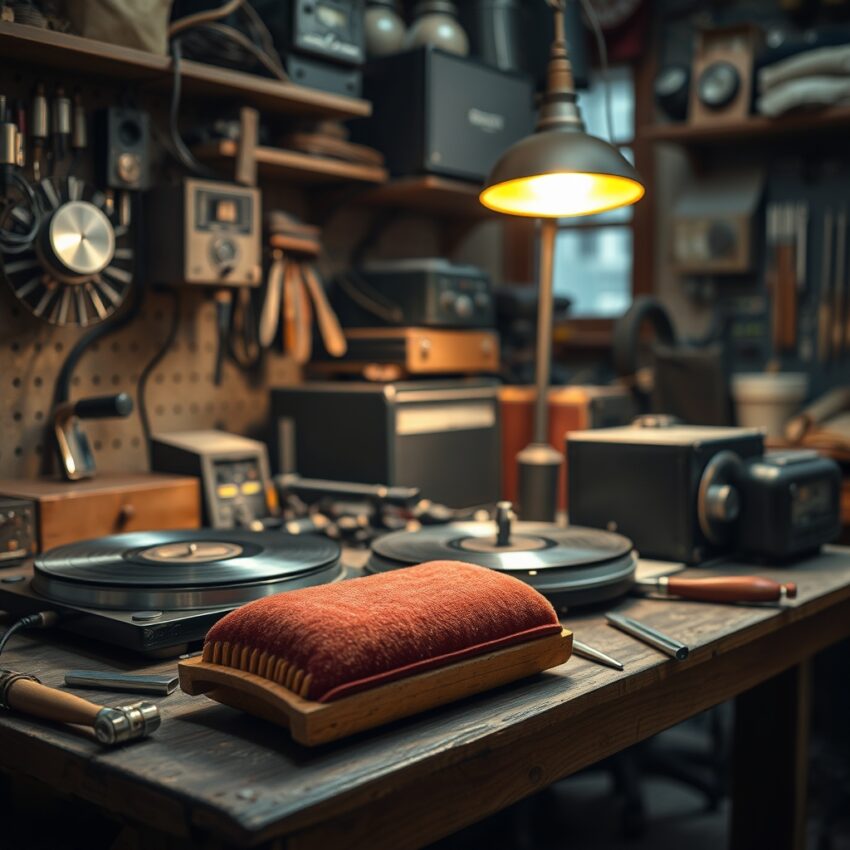
Teknoloji Mirası açısından plak temizleme fırçasının asıl hikâyesi, tamircilerin elinde bulduğu ikinci ömürde gizlidir. Çünkü eski şehir hayatında bir eşyanın işi bittiğinde hemen çöpe gitmesi beklenmezdi. Tamirciler, radyocular ve küçük elektronik ustaları, nesnelere ikinci bir anlam kazandıran ara kuşak gibiydi. Plak fırçası zamanla yalnız ev kullanıcılarının değil, tamir tezgâhlarının da malzemesi hâline gelirdi. Toz tutan devre yüzeylerinde, pikap iğnelerinin çevresinde, dar aralıklarda biriken ince kirde bu fırçanın hafif ama etkili dokunuşu işe yarardı. Ustalar bazen onu alışılmış işleviyle, bazen de başka bir temizlik ihtiyacına uyarlayarak kullanırdı. Böylece müzik için üretilmiş küçük bir araç, tamir kültürünün sessiz yardımcılarından birine dönüşürdü.
Bu dönüşümün kent belleğine incece yerleşmesi tesadüf değildi. Çünkü şehir, geçmişte büyük yenilikler kadar küçük tamir sahneleriyle de hatırlanırdı. Dar sokaklara açılan elektronikçi dükkânlarında anten ayarı, lehim kokusu, lambalı radyoların sıcak yüzeyi ve raflarda sıralı küçük aletler yan yana dururdu. Bir müşteri elindeki cihazın düzelmesini beklerken, tezgâhın üzerinde duran fırça da ustanın parmakları arasında bir an görünürdü. O anda teknoloji yalnız makineden ibaret kalmaz, bakım ve dikkat isteyen canlı bir düzen gibi algılanırdı. Anteni çevirdikçe netleşen umut da biraz buradan gelirdi: bir şeyin yeniden çalışabileceğine, sesin yeniden berraklaşabileceğine, bozulmuş olanın tamamen kaybolmadığına dair inanç.
Plak temizleme fırçasının ikinci bir ömür bulması, geçmiş kuşakların eşya ile kurduğu ahlâkı da anlatır. Bir nesnenin değerini yalnız satın alındığı gün değil, yıllar boyunca işe yarayabilme biçimi belirlerdi. Bu nedenle küçük araçlar evden dükkâna, dükkândan tamir masasına, bazen de yeniden eve dönen bir dolaşıma girerdi. Fırçanın kadife yüzeyi, tozu çizmeden kaldırma inceliği, ustanın elindeki sabırlı hareketlerle birleşince teknolojiye karşı aceleci olmayan bir kültür görünür olurdu. O kültürde bakım, kullanım kadar önemliydi. Bir cihazı çalıştırmak kadar onu korumak da gündelik bilginin parçasıydı.
Bugün o küçük fırça pek çok kişiye önemsiz görünebilir; ama eski kent hayatını hatırlayanlar için onda başka bir çağın terbiyesi saklıdır. Plak temizleme fırçası, anten çevrilirken duyulan sabrı, defter kokulu sabahların düzenini ve tamircilerin nesnelere verdiği ikinci şansı bir arada taşır. Bu yüzden kent belleğine büyük bir gürültüyle değil, ince bir çizgi gibi yerleşmiştir. Hatırlanan şey bazen dev cihazlar değil; bir dönemin umudunu, bakım bilgisini ve yeniden çalıştırma arzusunu sessizce üstünde toplayan böyle küçük araçlardır.
🇬🇧 English | The Small Brush That Found New Life on the Repair Bench
There was a time when the most striking things in technology shops were not always the large devices, but the quiet helper objects standing beside them. The record cleaning brush was one of these. With its fine bristles, its handle fitting neatly into the palm, and often its velvet surface, it was an unassuming object, yet it represented the delicacy of the relationship people had with sound. For a generation that waited for the picture to sharpen as the antenna turned and tried to catch a beloved song through the crackle of the radio, that little brush was never merely a tool for dust. It belonged to the belief in clarity, to the analog elegance of systems that required care. Records resting on a table in mornings that smelled of notebooks, the turntable that would spin again in the evening after school, all these details placed the object quietly inside everyday life.
From the perspective of technological heritage, the deeper story of the record cleaning brush lies in the second life it found in the hands of repairmen. In older urban life, an object whose first task was over was not expected to go straight into the trash. Repairmen, radio technicians, and small electronics masters formed an in-between generation that gave objects a second meaning. Over time, the record brush became material not only for home listeners but also for repair benches. Its soft, controlled touch proved useful on dusty circuit surfaces, around turntable needles, and in narrow spaces where fine dirt gathered. Craftsmen used it sometimes for its original purpose, sometimes by adapting it to a different cleaning need. In that way, a small tool made for music turned into one of the quiet assistants of repair culture.
The fact that this transformation settled gently into urban memory was no accident. Cities used to be remembered not only through large innovations, but also through small repair scenes. In electronics shops opening onto narrow streets, antenna adjustments, the smell of solder, the warm surface of tube radios, and shelves lined with tiny tools stood side by side. While a customer waited for a device to be restored, the brush would appear for a moment between the technician’s fingers above the bench. At that moment, technology ceased to be merely machinery and was understood as a living arrangement that required maintenance and attention. The hope that sharpened as the antenna turned came partly from here: from the belief that something could work again, that sound could become clear again, and that what had broken had not entirely disappeared.
The second life of the record cleaning brush also reveals the ethic older generations built with objects. The value of a thing was determined not only on the day it was purchased, but by how long it could remain useful. For that reason, small tools entered a circulation from home to shop, from shop to repair table, and sometimes back to the home again. The velvet surface of the brush, its ability to lift dust without scratching, joined with the patient movements of a technician’s hand to make visible a culture that was not hurried in its approach to technology. In that culture, maintenance mattered as much as use. Preserving a device was part of daily knowledge, just as much as turning it on.
Today that little brush may seem insignificant to many people, yet for those who remember older city life it carries the discipline of another era. The record cleaning brush gathers together the patience felt while turning an antenna, the order of notebook-scented mornings, and the second chance repairmen gave to objects. That is why it entered urban memory not with noise, but as a fine line. Sometimes what remains is not the large machine itself, but a small tool that quietly collected an era’s hope, care, and desire to make things work again.
🇧🇷 Português (Brasil) | A Pequena Escova que Ganhou Vida Nova na Bancada do Conserto
Houve um tempo em que o que mais chamava a atenção nas lojas de tecnologia nem sempre eram os aparelhos grandes, mas os pequenos objetos auxiliares que ficavam ao lado deles em silêncio. A escova de limpar discos era um desses objetos. Com suas cerdas finas, o cabo que encaixava bem na mão e muitas vezes a superfície de veludo, era discreta, mas representava a delicadeza da relação com o som. Para uma geração que esperava a imagem ficar nítida ao girar a antena e tentava capturar uma música querida no meio do chiado do rádio, aquela pequena escova nunca serviu apenas para tirar pó. Ela fazia parte da crença na nitidez, da elegância analógica de sistemas que exigiam cuidado. Discos sobre a mesa em manhãs com cheiro de caderno, o toca-discos que voltaria a girar no fim da tarde, tudo isso colocava esse objeto dentro da vida cotidiana.
Do ponto de vista do legado tecnológico, a história mais funda da escova de limpar discos está na segunda vida que ela encontrou nas mãos dos consertadores. Na vida urbana de antes, um objeto cujo primeiro uso havia terminado não era enviado imediatamente ao lixo. Consertadores, técnicos de rádio e mestres de eletrônica formavam uma geração intermediária que dava um segundo sentido às coisas. Com o tempo, a escova passou a servir não apenas aos ouvintes em casa, mas também às bancadas de reparo. Seu toque leve e controlado funcionava bem sobre superfícies com pó, ao redor da agulha do toca-discos e em frestas estreitas onde a sujeira fina se acumulava. Os mestres a usavam às vezes em sua função original, às vezes adaptando-a a outra necessidade de limpeza. Assim, uma pequena ferramenta criada para a música se transformava numa ajudante silenciosa da cultura do conserto.
O fato de essa transformação ter se instalado de leve na memória da cidade não foi acaso. Antigamente, as cidades eram lembradas não só por grandes novidades, mas também por pequenas cenas de conserto. Em lojas de eletrônica abertas para ruas estreitas, o ajuste da antena, o cheiro de solda, o calor dos rádios valvulados e as prateleiras alinhadas de ferramentas miúdas conviviam no mesmo espaço. Enquanto um cliente esperava o aparelho voltar a funcionar, a escova surgia por um instante entre os dedos do técnico. Nesse momento, a tecnologia deixava de ser apenas máquina e passava a parecer uma ordem viva, que exigia manutenção e atenção. A esperança que ficava mais nítida ao girar a antena vinha um pouco daí: da confiança de que algo podia voltar a funcionar, de que o som podia voltar a clarear e de que o que havia quebrado não estava totalmente perdido.
Essa segunda vida da escova também revela a ética que as gerações antigas construíam com os objetos. O valor de uma coisa não era definido apenas no dia da compra, mas pela forma como ela podia continuar útil ao longo dos anos. Por isso, pequenas ferramentas circulavam de casa para a loja, da loja para a bancada e às vezes de volta para casa. A superfície de veludo da escova, sua capacidade de retirar o pó sem riscar, unida ao gesto paciente do técnico, tornava visível uma cultura que não era apressada diante da tecnologia. Nessa cultura, manter era tão importante quanto usar. Cuidar de um aparelho fazia parte do saber cotidiano tanto quanto ligá-lo.
Hoje essa pequena escova pode parecer sem importância para muita gente, mas para quem se lembra da antiga vida urbana ela guarda a disciplina de outro tempo. A escova de limpar discos reúne a paciência sentida ao girar a antena, a ordem das manhãs com cheiro de caderno e a segunda chance que os consertadores davam aos objetos. Por isso ela entrou na memória da cidade não com barulho, mas como um traço fino. Às vezes o que permanece não é a grande máquina, mas uma pequena ferramenta que recolheu em silêncio a esperança, o cuidado e o desejo de fazer tudo funcionar de novo.