🇹🇷 Türkçe | işlemeli mendil ve çeyiz odasında büyüyen bekleyişi: ev hayatının ritüellerini nasıl şekillendirdi
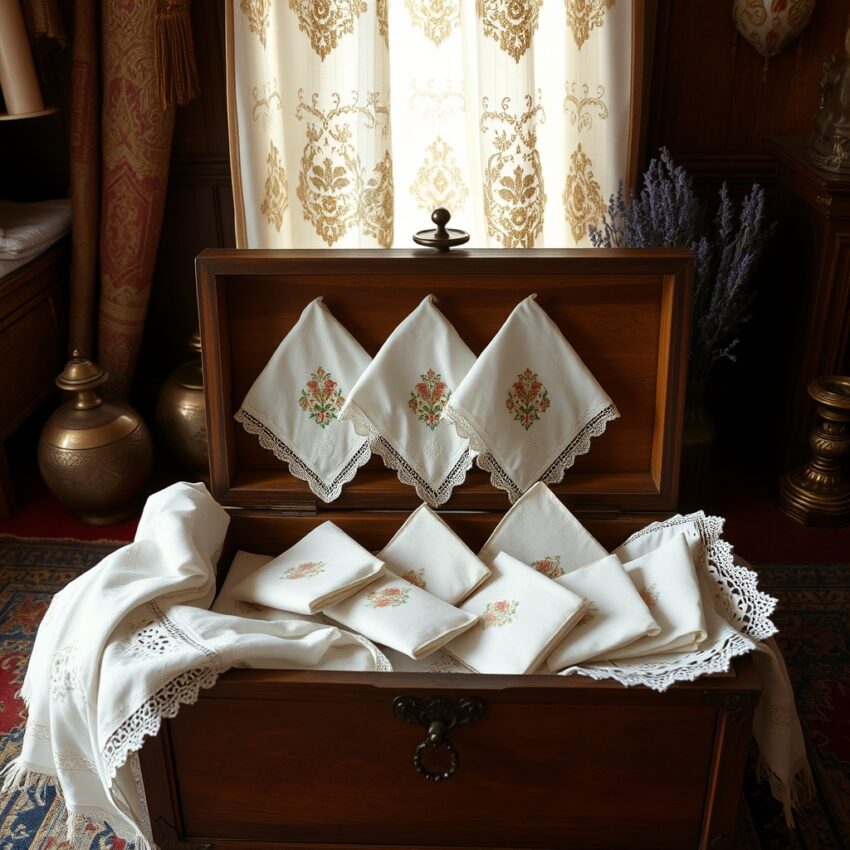
Bir zamanlar evlerin en sessiz ama en yoğun anlam taşıyan köşelerinden biri çeyiz odasıydı. Sandıkların kapağı her gün açılmaz, ama açıldığında içeriden yalnız kumaş değil, geleceğe dair uzun bir bekleyiş hissi yükselirdi. İşlemeli mendiller bu dünyanın en zarif parçalarındandı. Kenarlarına oyalar geçirilmiş, köşelerine harfler işlenmiş, bazen lavanta ya da sabun kokusuyla saklanmış bu küçük bez parçaları, yalnız kullanıma hazır eşya değil; kurulacak hayatın önceden düşünülmüş ayrıntılarıydı. Onlara bakılırken gelecekteki misafirler, bayram günleri, gelin sandığı, yeni evin çekmeceleri ve hatta aile içinde nasıl bir düzen kurulacağı hayal edilirdi. Bu yüzden işlemeli mendil, küçüklüğüne rağmen ev hayatının ritüellerini biçimlendiren güçlü bir simgeydi.
Obje Hikayeleri açısından bakıldığında mendilin asıl hikâyesi, eşya olmaktan çok beklenti taşıyan bir nesne oluşunda saklıdır. Özellikle genç kız çeyizlerinde yer bulan işlemeli mendiller, sabrın, el emeğinin ve hazırlığın görünür hâliydi. Bir mendilin kenarına atılan her ilmek, gelecek zaman için kurulmuş sessiz bir cümle gibiydi. Düğünde sunulacak bohçalar, misafire uzatılacak temiz kumaşlar, özel günlerde çekmeceden çıkarılacak özenli parçalar, bütün bunlar daha hayat başlamadan düşünülürdü. Ev içi ritüeller tam da böyle biçimlenirdi: henüz yaşanmamış anlar, önceden hazırlanmış eşyalar etrafında şekil kazanırdı. Mendil burada yalnız kişisel bir eşya değil, aile düzeninin küçük ama etkili bir ön provasına dönüşürdü.
Çeyiz odasında büyüyen bekleyişin gündelik hayata etkisi, kadın emeğinin eve kattığı görünmez düzenle de ilgilidir. Sandığın içindeki mendiller sayılır, kat izleri bozulmasın diye dikkatle yerleştirilir, bazen komşuya ya da akrabaya gösterilir, bazen “bunu kızım için ayırdım” denerek gelecek kuşaklara bağlanırdı. Böylece mendil, nesiller arasında dolaşan bir hazırlık dili kurardı. Evde temizlik, düzen ve misafir ağırlama anlayışı da bu dilin içinden şekillenirdi. Hangi eşyanın gündelik, hangisinin özel; neyin saklanacağı, neyin yalnız belli zamanlarda kullanılacağı bu küçük objelerle öğrenilirdi. İşlemeli mendilin çeyiz odasında büyüyen bekleyişi, aslında ev hayatının sınırlarını, inceliklerini ve zaman duygusunu öğreten bir okul gibiydi.
Bu objenin ritüel gücü, dokunulabilir ama kolay harcanamaz oluşundan da gelir. Mendil bir yandan gündelik bir ihtiyaçtır; ter siler, avuç içinde taşınır, bir çekmecede hazır bekler. Ama işlemeli hâle geldiğinde sıradan işlevini aşar, daha törensel bir anlam kazanır. Herkesin kullanacağı bir bez olmaktan çıkar, özen gösterilecek, saklanacak, belki yalnız belirli zamanlarda ortaya çıkacak bir parça olur. Eski ev hayatında bazı nesnelerin değerini tam da bu çift anlam belirlerdi: hem işe yarar hem de simgesel olurlar. İşlemeli mendil, bu iki hâli bir arada taşıdığı için, ev içi ritüellerin sessiz ama kalıcı unsurlarından biri olarak hafızada yer etti.
Bugün çeyiz odaları azalmış, hazırlık gelenekleri değişmiş olabilir. Yine de işlemeli mendil ve onun etrafında büyüyen bekleyiş anıldığında, insanın aklına yalnız eski bir eşya değil, geleceği sabırla kuran bir hayat anlayışı gelir. Bu anlayışta ev, hazır alınan değil emekle örülen bir dünyadır. Ritüeller de işte bu emekle, saklama biçimiyle ve küçük nesnelere yüklenen anlamla doğar. İşlemeli mendil, bu yüzden geçmişte ev hayatını yalnız süslememiş; onun zamanını, ciddiyetini ve duygusal düzenini de şekillendirmiştir. Küçük bir kumaş parçasının böylesine büyük bir hafıza taşıması biraz da bundandır.
🇬🇧 English | The Embroidered Handkerchief and the Waiting That Grew in the Dowry Room: How Did It Shape the Rituals of Domestic Life
There was a time when one of the quietest yet most meaningful corners of the house was the dowry room. The trunks were not opened every day, but whenever they were, they released not only fabric but also a long feeling of expectation about the future. Embroidered handkerchiefs were among the most delicate pieces in that world. With lace edging, initials stitched into the corners, and sometimes stored with the scent of lavender or soap, these small pieces of cloth were more than household items waiting to be used; they were details of a life being imagined in advance. Looking at them called forth future guests, holiday visits, wedding bundles, the drawers of a new home, and even the kind of order that would one day govern family life. That is why the embroidered handkerchief, despite its modest size, became a strong symbol shaping the rituals of the home.
Seen through the lens of object stories, the true story of the handkerchief lies in the fact that it carried expectation more than mere utility. Especially in dowries prepared for young women, embroidered handkerchiefs made patience, hand labor, and preparation visible. Every stitch laid along the edge felt like a silent sentence written for a future time. Bundles to be presented at weddings, clean cloths to be offered to guests, carefully kept pieces to be taken from drawers on special days, all of these were imagined before that stage of life had even begun. Domestic rituals were shaped exactly in this way: moments not yet lived took form around objects prepared in advance. Here the handkerchief turned from a personal belonging into a small yet influential rehearsal for the order of family life.
The effect of the waiting that grew in the dowry room also relates to the invisible order created by women’s labor in the home. The handkerchiefs inside the trunk would be counted, arranged so their fold lines would not be disturbed, shown sometimes to neighbors or relatives, and sometimes linked to the next generation with the phrase, “I have set this aside for my daughter.” In this way the handkerchief created a language of preparation moving across generations. Ideas of cleanliness, order, and hospitality within the home were shaped through that language. Which objects belonged to everyday use and which to special occasions, what should be stored away and what brought out only at certain times, all were learned through such small possessions. The waiting around the embroidered handkerchief in the dowry room was in fact like a school teaching the boundaries, refinements, and sense of time of domestic life.
The ritual power of this object also comes from the fact that it was touchable yet not easily consumed. A handkerchief is, on one level, an everyday necessity: it wipes a brow, rests in the palm, waits ready in a drawer. Yet once embroidered, it rises beyond ordinary function and gains a more ceremonial meaning. It stops being just a cloth anyone might use and becomes something to protect, to store, perhaps to bring out only at specific moments. In old domestic life, the value of many objects was defined precisely by this double meaning: they were useful, yet symbolic at the same time. Because the embroidered handkerchief carried both qualities together, it remained in memory as one of the quiet but durable elements of household ritual.
Today dowry rooms have largely disappeared and traditions of preparation have changed. Yet when the embroidered handkerchief and the waiting that grew around it are remembered, what comes to mind is not only an old object, but a way of life that built the future with patience. In that understanding, the home was not something simply acquired ready-made; it was a world woven by labor. Rituals arose from that labor, from ways of storing, and from the meanings attached to small objects. For that reason the embroidered handkerchief did more than decorate domestic life in the past; it shaped its time, its seriousness, and its emotional order. That a small piece of cloth can carry so much memory is due precisely to this.
🇧🇷 Português (Brasil) | O Lenço Bordado e a Espera que Cresceu no Quarto do Enxoval: Como Moldou os Rituais da Vida Doméstica
Houve um tempo em que um dos cantos mais silenciosos, mas também mais carregados de sentido da casa, era o quarto do enxoval. Os baús não eram abertos todos os dias, mas, quando isso acontecia, de dentro deles saía não apenas tecido, e sim uma longa sensação de espera voltada para o futuro. Os lenços bordados estavam entre as peças mais delicadas desse universo. Com rendas nas bordas, iniciais costuradas nos cantos e às vezes guardados com cheiro de lavanda ou sabonete, esses pequenos panos não eram somente objetos prontos para uso; eram detalhes de uma vida pensada com antecedência. Ao olhar para eles, imaginavam-se visitas futuras, dias de festa, os embrulhos do casamento, as gavetas da nova casa e até o tipo de ordem que um dia se instalaria dentro da família. Por isso o lenço bordado, apesar do tamanho pequeno, se tornou um símbolo forte na formação dos rituais da vida doméstica.
Pela perspectiva das histórias dos objetos, a verdadeira história do lenço está no fato de ele carregar mais expectativa do que utilidade simples. Especialmente nos enxovais preparados para moças, os lenços bordados tornavam visíveis a paciência, o trabalho manual e a preparação. Cada ponto feito na borda parecia uma frase silenciosa escrita para um tempo futuro. Os embrulhos oferecidos no casamento, os panos limpos entregues às visitas, as peças bem guardadas para dias especiais, tudo isso era pensado antes mesmo de essa etapa da vida começar. Era exatamente assim que os rituais domésticos se moldavam: momentos ainda não vividos ganhavam forma ao redor de objetos preparados com antecedência. Nesse sentido, o lenço deixava de ser apenas um pertence pessoal e se convertia numa pequena, porém influente, prévia da ordem familiar.
O efeito da espera que crescia no quarto do enxoval também se relaciona com a ordem invisível criada pelo trabalho feminino dentro da casa. Os lenços guardados no baú eram contados, arrumados com cuidado para que as marcas da dobra não se perdessem, mostrados às vezes a vizinhas e parentes e, em alguns casos, ligados à geração seguinte com a frase “guardei este para minha filha”. Assim, o lenço criava uma linguagem de preparação que atravessava gerações. A ideia de limpeza, organização e hospitalidade no lar também nascia dentro dessa linguagem. O que era de uso cotidiano e o que era especial, o que deveria ficar guardado e o que seria usado apenas em certas ocasiões, tudo isso se aprendia por meio desses pequenos objetos. A espera em torno do lenço bordado no quarto do enxoval funcionava, no fundo, como uma escola silenciosa dos limites, das delicadezas e do tempo da vida doméstica.
O poder ritual desse objeto também nasce de ele ser tocável, mas não facilmente gasto. Um lenço, por um lado, é uma necessidade cotidiana: enxuga o suor, cabe na mão, espera pronto numa gaveta. Mas, quando recebe bordado, ultrapassa sua função comum e ganha um sentido mais cerimonial. Deixa de ser um pano que qualquer pessoa usa e passa a ser algo a preservar, guardar e talvez mostrar apenas em momentos determinados. Na antiga vida doméstica, o valor de muitos objetos era definido justamente por esse sentido duplo: eles eram úteis e simbólicos ao mesmo tempo. Como o lenço bordado carregava essas duas qualidades, ficou guardado na memória como um dos elementos silenciosos, porém duradouros, do ritual da casa.
Hoje os quartos de enxoval diminuíram e as tradições de preparação mudaram. Ainda assim, quando o lenço bordado e a espera criada ao seu redor são lembrados, o que surge não é apenas um objeto antigo, mas um modo de vida que construía o futuro com paciência. Nessa visão, a casa não era algo comprado pronto; era um mundo tecido com trabalho. Os rituais nasciam desse esforço, do modo de guardar e do significado atribuído aos pequenos objetos. Por isso o lenço bordado não apenas adornou a vida doméstica no passado; ele também moldou seu tempo, sua seriedade e sua ordem afetiva. Se um pequeno pedaço de tecido pode carregar tanta memória, é justamente por causa disso.