 Eski Pano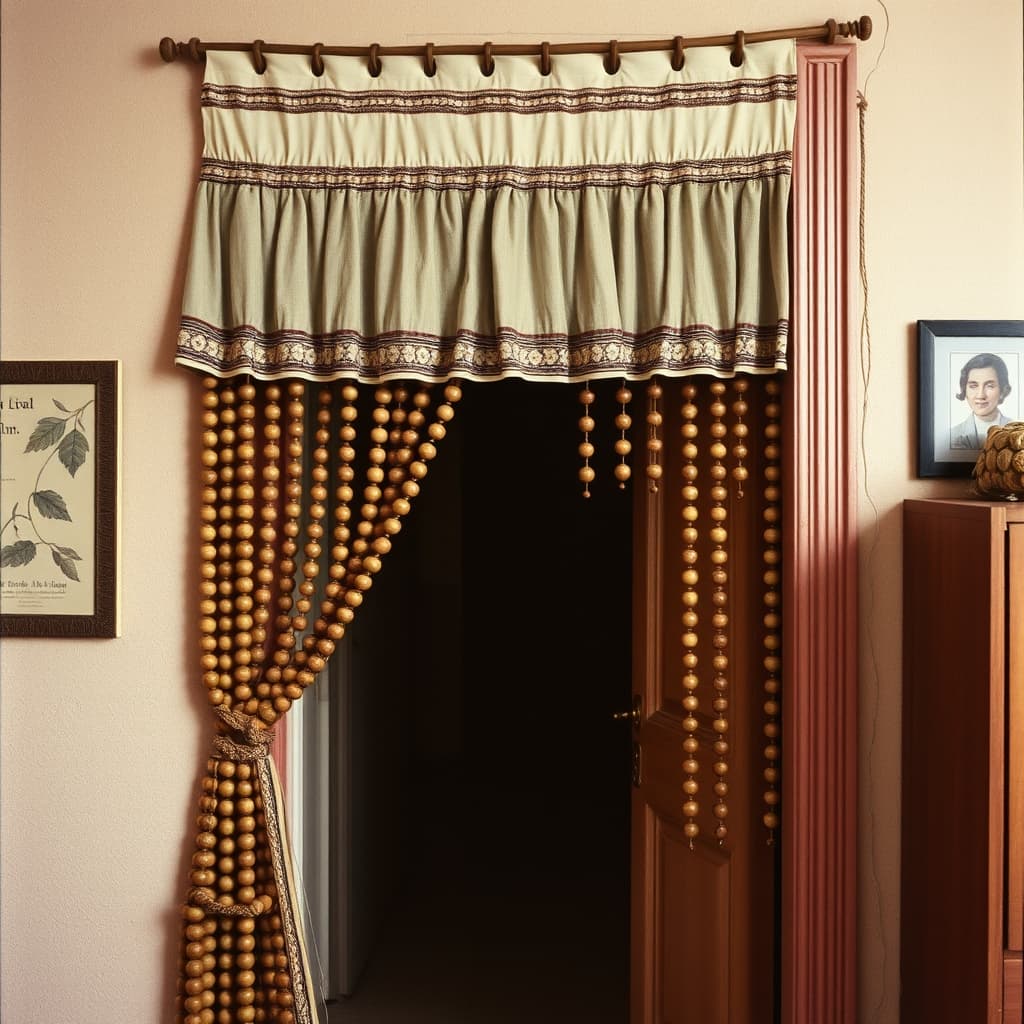
An inherited beaded curtain could arrive with the memory of a doorway that no longer fitted its new home. The strands remained, but the opening was wider, narrower or simply used differently. Passing the curtain from one household to another therefore involved more than transferring an ornament. Someone had to decide what to do with an object whose shape had belonged to another room.
No particular maker, move or generation should be invented for a surviving curtain. Its history may be known through photographs and family accounts, or only partly remembered. The useful question is what happens when that history meets a new setting. Keeping an heirloom does not necessarily mean repeating its former position or everyday use.
The Header Held the Old Arrangement Together
The piece from which the strands hung preserved their spacing and sequence. Seen apart from the old doorway, it could make the original width more evident. A new opening might leave gaps beside the curtain or make the same pattern feel denser. The object had not changed, yet its relation to the room had.
A photograph of the earlier installation can help show that relation. It may identify the height, surrounding frame and direction from which people approached. A later recollection that the curtain once covered the whole door should be checked against such evidence where possible. The remembered fit may be as approximate as the remembered room.
Rehanging Was a Choice, Not an Automatic Continuation
A family could move the curtain to a less-used opening or display it without walking through it. This altered how its sound and movement were encountered. A curtain that once announced each passage might become a pattern seen from a chair. The heirloom continued, but the routine around it changed.
Such a decision could preserve fragile material while also making the old experience less available. There is no need to call that a failure of inheritance. A household inherits circumstances as well as objects, and those circumstances are not identical to the previous home. Record the reason for the new placement when the family can explain it.
A Shortened Strand Can Belong to the Move
Uneven lengths or extra knots may invite a story about adapting the curtain. They can also have earlier causes. Do not date every alteration to the most recent move simply because the curtain now hangs differently. The visible change and the account of making it should be recorded separately until they can be connected.
If loose beads or detached strands accompanied the object, keep their association clear. They may help explain a repair without being evidence of a complete original pattern. A reconstruction made for display should remain identifiable as a reconstruction, rather than quietly replacing the curtain’s irregular working state.
Two Households May Remember Two Different Curtains
A person from the earlier home may recall brushing through the strands; someone in the new home may know them only as decoration. Both memories concern the same object, but not the same use. Asking how each person met the curtain can prevent inheritance from being reduced to one repeated family scene.
Bayram preparations might bring the curtain into attention through cleaning, rearrangement or a visitor’s recognition. That is a possible occasion for remembering, not evidence that beaded curtains belonged to one fixed festive custom. The object’s actual family history should lead the account.
A different doorway made the inherited curtain’s dimensions and habits newly visible. What once fitted without thought now required a decision. Preserving that decision lets the heirloom carry change alongside continuity: the same strands, the remembered passage and the new place where a family found room for them.