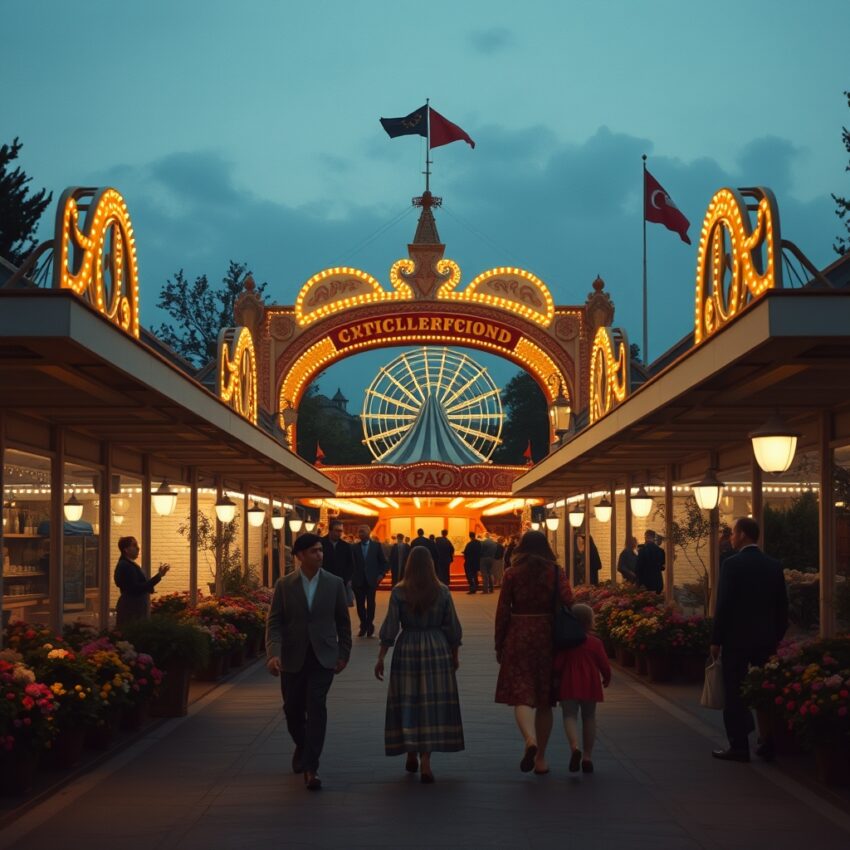
🇹🇷 Türkçe | Memleketin Vitrine Çıktığı Çiçek Kokulu Günler
Bir zamanlar bir şehrin en heyecanlı mevsimi, takvime yalnız bahar ya da yaz diye değil, fuarın kurulacağı günler diye düşerdi. Daha afişler duvarlara tam asılmadan, kamyonlar alanın çevresinde görünmeden, mahalle çocukları hangi salıncağın geleceğini, hangi pavyonun ışık saçacağını, hangi tezgahta rengarenk şekerler satılacağını konuşmaya başlardı. Fuar alanı yalnız eğlence için kurulmuş bir yer değildi; memleketin kendini kendine gösterdiği büyük bir sahneydi. Çiçek kokulu sokaklardan geçip oraya varan insanlar, günlük hayatın ölçülü akışından çıkıp daha parlak, daha meraklı, daha toplu bir hayalin içine girerdi. Akşamüstü üstüne serinlik çökerken anneler çocukların yakalarını düzeltir, babalar yürüyüşü biraz ağırdan alır, ailece gidilen o yol küçük bir bayram alayına benzerdi.
Zamanın İzinde bakıldığında fuar mevsimleri, Türkiye’de şehir hayatının modernleşme arzusuyla mahalle alışkanlıklarının aynı anda görünür olduğu eşsiz dönemlerdi. Belediyelerin, ticaret odalarının ve yerel basının önem verdiği bu alanlarda yalnız lunaparklar değil; yeni makineler, dikiş makineleri, radyolar, traktörler, cam eşyalar, kitap stantları ve bölgesel ürünler de sergilenirdi. Bu yüzden fuar, bir şehrin dışarıya açılan yüzü olduğu kadar içeride yaşayanların da geleceği nasıl hayal ettiğini gösteren bir aynaydı. Bir tarafta parlak ampuller altında yükselen modernlik hissi, öbür tarafta elde taşınan çekirdek kâğıtları, ailece edilen akşam gezmeleri ve “önce biraz dolaşalım” diyen gündelik ölçü vardı. Memleket vitrine çıkarken mahalle terbiyesi de onunla birlikte dolaşırdı.
Bugüne sessizce kalan alışkanlıklar tam da bu eşikte birikti. İnsanların akşamüstü hazırlanıp amaçsız değil, birlikte görünmek ve birlikte gezmek için sokağa çıkması; vitrinden bakmanın yalnız tüketim değil, ortak merak anlamı taşıması; yeni bir şeyi önce kalabalığın içinde görüp sonra eve dönünce uzun uzun konuşma geleneği; çocukların ellerine sıkı sıkı tutunulsa da onlara hayret etme hakkı tanınması; bütün bunlar fuar mevsimlerinin bıraktığı ince miraslar arasındaydı. Çiçek kokulu sokaklar burada boş bir süs değildir. Çünkü fuara giden yol çoğu zaman parkların, bahçe duvarlarının, akşam sulanmış kaldırımların içinden geçerdi. Şehrin sert kalabalığıyla mahalle kokusu yan yana yürür, toplumsal hayat kendini biraz da o geçişte belli ederdi.
Bu mevsimlerin hafızada canlı kalmasının bir nedeni de ses ve ışık düzenidir. Hoparlörden yükselen anonslar, uzaktan duyulan dönme dolap gıcırtısı, gazoz kapaklarının açılırken çıkardığı tok ses, pamuk şeker tezgâhının başındaki kıpırtı, fotoğraf çektiren ailelerin kısa ciddiyeti, her şey bir sergi kadar düzenli ama bir mahalle akşamı kadar tanıdıktı. İnsanlar yalnız eğlenmeye gitmez, kendilerini zamanın akışı içinde nereye koyacaklarını da yoklardı. Hangi eşya “yenilik” sayılıyor, hangi oyuncak “şehirli” görünüyordu, hangi müzik kalabalığı bir arada tutuyordu; fuar alanı bütün bunların sessiz laboratuvarı gibiydi. Eve dönüldüğünde ceplerde birkaç bilet, elde küçük bir balon ya da broşür kalırdı; ama asıl kalan, kalabalığın içinde terbiyeli bir yakınlıkla dolaşma hâliydi.
Bugün fuar alanlarının eski ihtişamı birçok şehirde geri çekilmiş olsa da onların bıraktığı alışkanlıklar bütünüyle kaybolmuş değildir. Hafta sonu meydanlarda gezinme isteği, ailece akşam yürüyüşünü küçük bir tören gibi yaşama hâli, yeni açılan bir dükkânı ya da sergiyi yalnız görmek için değil konuşmak için de ziyaret etme refleksi, biraz o günlerin devamıdır. Fuar mevsimleri memlekete yalnız parlak ışıklar bırakmadı; birlikte bakmanın, birlikte gezmenin ve sokakta ölçülü bir sevinç taşımayı bilmenin inceliğini de bıraktı. Çiçek kokulu sokaklar bu yüzden hâlâ hatırlanır. Çünkü oradan geçerek gidilen fuar, aslında bir ülkenin gündelik zarafetini sahneye çıkarıyordu.
🇬🇧 English | Flower-Scented Days When the Country Stepped into the Display Window
There was a time when the most exciting season in a city was marked on the calendar not merely as spring or summer, but as the days when the fair would arrive. Even before posters were fully pasted onto walls, before trucks appeared around the grounds, neighborhood children had already begun talking about which swing ride would come, which pavilion would glow with light, and which stalls would sell bright sweets. The fairground was never just a place built for amusement. It was a great stage on which the country showed itself to itself. People who walked there through flower-scented streets stepped out of the measured flow of daily life and into a brighter, more curious, more collective dream. As coolness settled over the late afternoon, mothers straightened their children’s collars, fathers slowed their steps a little, and the family walk toward the fair resembled a small holiday procession.
Seen through the trail of time, fair seasons were rare moments when the desire for modernization in urban life and the habits of neighborhood life became visible at once. In these spaces, valued by municipalities, chambers of commerce, and local newspapers, there were not only amusement rides, but also new machines, sewing machines, radios, tractors, glassware, book stands, and regional products on display. For that reason, the fair was not only the outward face of a city, but a mirror showing how the people living there imagined the future. On one side stood the feeling of modernity under bright bulbs; on the other were paper cones of sunflower seeds, evening walks made as a family, and the everyday restraint of saying, “Let’s stroll a little first.” While the country entered the display window, neighborhood manners walked beside it.
The quiet habits that survived into the present were gathered at exactly that threshold. People dressing in the late afternoon and stepping out not aimlessly but to be seen together and to walk together; the idea that looking at a display window meant not only consumption but shared curiosity; the habit of first seeing something new in a crowd and then discussing it at length once back home; children being held by the hand, yet still granted the right to wonder, all belonged to the subtle inheritance left by fair seasons. The flower-scented streets are not an empty ornament in this memory. The road to the fair often passed through parks, garden walls, and pavements freshly watered at dusk. The harder density of the city and the scent of the neighborhood walked side by side, and social life revealed itself in that passage.
Another reason these seasons remain vivid in memory lies in their arrangement of sound and light. Loudspeaker announcements rising in the air, the distant creak of a Ferris wheel, the full click of soda bottle caps being opened, the movement around the cotton-candy stand, the brief seriousness of families posing for photographs, everything felt as orderly as an exhibition and yet as familiar as a neighborhood evening. People did not go only to be entertained; they also went to test where they stood within the flow of time. Which object counted as “new,” which toy looked “urban,” which music could hold a crowd together: the fairground was like a quiet laboratory for all of this. When people returned home, a few tickets, a small balloon, or a brochure might remain in their pockets, but what truly stayed was the habit of moving among crowds with a courteous sense of closeness.
Today the old splendor of fairgrounds has faded in many cities, yet the habits they left behind have not disappeared entirely. The desire to stroll in squares on weekends, the tendency to experience the family evening walk as a small ceremony, the reflex of visiting a newly opened shop or exhibition not only to see it but also to talk about it, all carry something of those days. Fair seasons left the country more than bright lights. They also left the grace of looking together, walking together, and carrying a measured joy through the street. That is why flower-scented streets are still remembered. Passing through them toward the fair was, in truth, a way of bringing a country’s everyday elegance onto the stage.
🇧🇷 Português (Brasil) | Dias com Cheiro de Flores em que o País Entrava na Vitrine
Houve um tempo em que a estação mais aguardada de uma cidade não era marcada no calendário apenas como primavera ou verão, mas como os dias em que a feira seria montada. Antes mesmo de os cartazes ocuparem completamente os muros, antes de os caminhões aparecerem em volta do terreno, as crianças do bairro já falavam sobre qual brinquedo chegaria, qual pavilhão brilharia mais e em qual barraca se venderiam doces coloridos. O parque de feira não era apenas um espaço de diversão. Era um grande palco em que o país se mostrava para si mesmo. Quem passava por ruas com cheiro de flores para chegar até ali saía do fluxo medido do cotidiano e entrava em um sonho mais luminoso, mais curioso e mais coletivo. Quando o fim de tarde começava a esfriar, as mães ajeitavam a gola das crianças, os pais desaceleravam o passo, e o caminho feito em família parecia um pequeno cortejo de festa.
No rastro do tempo, as temporadas de feira foram momentos raros em que o desejo de modernização da vida urbana e os hábitos do bairro podiam ser vistos ao mesmo tempo. Nesses espaços valorizados por prefeituras, associações comerciais e jornais locais, não havia apenas parque de diversões, mas também máquinas novas, máquinas de costura, rádios, tratores, peças de vidro, estandes de livros e produtos regionais. Por isso, a feira era não só o rosto de uma cidade voltado para fora, mas também um espelho de como seus moradores imaginavam o futuro. De um lado estava a sensação de modernidade sob lâmpadas brilhantes; do outro, os saquinhos de sementes nas mãos, os passeios em família ao entardecer e a medida cotidiana de dizer “vamos dar mais uma volta”. Enquanto o país entrava na vitrine, os modos do bairro caminhavam ao lado.
Os hábitos silenciosos que chegaram até hoje se acumularam exatamente nessa passagem. O costume de se arrumar no fim da tarde e sair não sem rumo, mas para aparecer junto e passear junto; a ideia de que olhar vitrines significava não só consumir, mas também compartilhar curiosidade; o hábito de primeiro ver uma novidade no meio da multidão e depois comentá-la demoradamente em casa; o gesto de segurar a mão das crianças sem lhes tirar o direito de se maravilhar; tudo isso pertence à herança delicada deixada pelas estações de feira. As ruas com cheiro de flores não são um enfeite vazio nessa lembrança. Muitas vezes o caminho até a feira passava por parques, muros de jardim e calçadas molhadas ao anoitecer. A densidade da cidade e o perfume do bairro caminhavam lado a lado, e a vida social se revelava justamente nessa travessia.
Outro motivo para essas temporadas permanecerem tão vivas está na combinação de som e luz. Os anúncios saindo dos alto-falantes, o rangido distante da roda-gigante, o som seco das garrafas de refrigerante sendo abertas, o movimento em volta da barraca de algodão-doce, a breve seriedade das famílias ao posar para uma foto, tudo parecia tão organizado quanto uma exposição e, ao mesmo tempo, tão familiar quanto uma noite de bairro. As pessoas não iam apenas para se divertir; iam também para medir em que lugar estavam dentro do movimento do tempo. Qual objeto parecia “novo”, qual brinquedo dava um ar mais “urbano”, qual música mantinha a multidão unida: o parque de feira era como um laboratório silencioso de tudo isso. Ao voltar para casa, podiam sobrar alguns bilhetes, um balão pequeno ou um folheto, mas o que realmente ficava era o modo educado de circular entre os outros.
Hoje o antigo esplendor dos parques de feira já recuou em muitas cidades, mas os hábitos que eles deixaram não desapareceram por completo. A vontade de passear nas praças no fim de semana, o costume de transformar a caminhada da família ao entardecer em uma pequena cerimônia, o impulso de visitar uma loja ou mostra nova não apenas para ver, mas para comentar, tudo isso continua um pouco daqueles dias. As temporadas de feira deixaram ao país mais do que luzes brilhantes. Deixaram também a delicadeza de olhar junto, caminhar junto e levar para a rua uma alegria medida. É por isso que as ruas com cheiro de flores ainda são lembradas. Passar por elas a caminho da feira era, na verdade, colocar em cena a elegância cotidiana de um país.