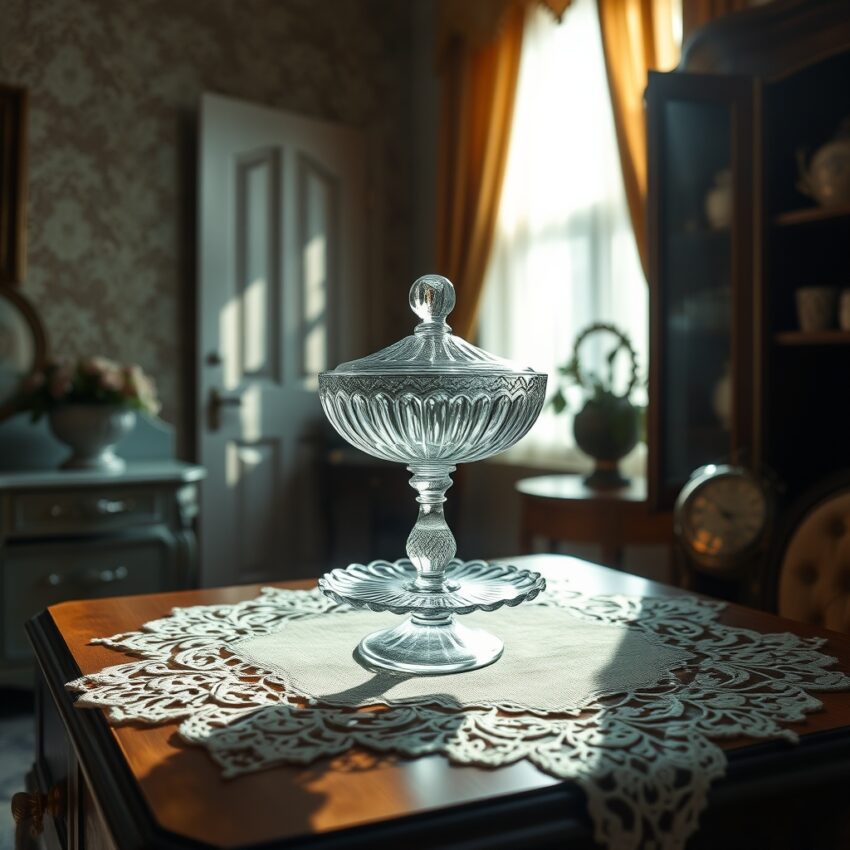
🇹🇷 Türkçe | Vitrin İçinde Parlayan Sessiz Bir Aile Hafızasının İnceliği
Bir zamanlar kristal şeker kâsesi, yalnız sofraya konan zarif bir eşya değil; aile içindeki özenin ve devamlılığın küçük bir işaretiydi. Işığı yakaladığında cam kesimlerinin duvarda bıraktığı titrek yansımalar, bayram sabahlarında ya da misafirli akşamlarda evin havasını bir anda daha itinalı kılardı. İçine konan kesme şekerler kadar önem taşıyan şey, o kâsenin nasıl tutulduğu, nasıl yerine bırakıldığı ve kim tarafından kime emanet edildiğiydi. Çünkü bazı eşyalar kullanıldıkları kadar aktarıldıkları için de kıymetlidir. Kristal şeker kâsesi de tam böyle bir nesneydi; masa üstündeki görünürlüğüyle birlikte aile içindeki sessiz sürekliliği temsil ederdi.
Obje Hikayeleri açısından bakıldığında bu tür eşyaların aile yadigârına dönüşmesi, maddi değerden çok sembolik anlamla ilgilidir. Bir kristal kâse çoğu zaman düğünde gelin bohçasına konmuş, sonra salon vitrininde yıllarca korunmuş, ardından ev kuran kıza ya da aile içinde düzeni sürdürecek görülen birine verilmiştir. Bu aktarım, sadece eşyanın yer değiştirmesi değildir. Onunla birlikte bir sofra adabı, misafir karşılama biçimi ve “eşyanın da hatırası vardır” duygusu da taşınır. Eski evlerde vitrin raflarına dizilen objeler, gösteriş olsun diye değil; aile içindeki düzenin görünür hafızası olarak tutulurdu. Şeker kâsesi de bu görünür hafızanın en ince parçalarından biriydi.
Elden ele geçtikçe kristal kâsenin anlamı büyür. İlk sahibi için yeni evin gururu olan bir obje, sonraki kuşak için anneannenin salonunu hatırlatan bir parıltıya dönüşür. Kâsenin kapağındaki küçücük çizik, kulbundaki hafif aşınma ya da tabanındaki soluk iz, onun sadece saklanmadığını, yaşanan hayatın içinden geçtiğini gösterir. Bayram kahvelerinde uzatılması, nişan gününde sehpanın üzerine konması, çocukların izinsiz dokunmaması için tembihlenmesi ve temizlik günlerinde ayrı bir özenle silinmesi, o nesneyi sıradan bir cam eşyadan çıkarır. Aile mirası bazen büyük sözlerle değil, tam da böyle tekrar eden küçük dikkatlerle kurulur.
Gündelik hayatın ayrıntıları bu dönüşümü daha iyi açıklar. Bir evde şeker kâsesi salon vitrininden yalnız misafir geldiğinde indirilir, başka bir evde pazar kahvaltılarında dantel örtünün üstüne konur. İçindeki şekerin erimesemesi için kapak dikkatle kapatılır, servis sonrası mutlaka aynı rafa döndürülür. Çocuklar o kâseyi önce yalnız parlak bir eşya sanır; sonra yıllar içinde hangi teyzeden kaldığını, hangi çeyizin içinden çıktığını, neden her taşınmada ayrı bir gazeteye sarıldığını öğrenir. İşte o anda obje, estetik bir eşya olmaktan çıkıp aile anlatısına katılır. İnsanlar bazen geçmişi bir fotoğraftan çok, eline aldığı böyle bir nesnenin ağırlığında hisseder.
Kristal şeker kâsesinin aile mirasına dönüşmesi bu yüzden tesadüf değildir. O, hem kırılgan hem kalıcı olabilen eşyalardan biridir. Bir yandan büyük bir dikkat ister, bir yandan kuşakları birbirine bağlayan sessiz bir direnç taşır. Bugün daha sade sofralar, değişen ev düzenleri ve hızla tüketilen eşyalar arasında böyle bir objeye bakınca insanlar yalnız estetik bir tasarımı değil; özenle korunmuş bir aile devamlılığını da görür. Elden ele geçen kristal şeker kâsesi, geçmişteki evlerin ışığını, sesini ve misafirlik terbiyesini birlikte taşır. Bu yüzden nasıl aile mirasına dönüştüğü sorusunun cevabı, aslında ailelerin hatırayı hangi nesnelerin içine yerleştirmeyi seçtiğinde saklıdır.
🇬🇧 English | The Delicacy of a Quiet Family Memory Shining Inside the Display Cabinet
There was a time when a crystal sugar bowl was not merely an elegant object placed on the table, but a small sign of care and continuity within the family. When it caught the light, the cut glass scattered trembling reflections onto the walls, and on holiday mornings or evenings with guests, the room suddenly felt more attentive and composed. What mattered was not only the sugar cubes placed inside, but how the bowl was held, where it was returned, and by whom it was entrusted to the next pair of hands. Some objects are precious not only because they are used, but because they are passed on. The crystal sugar bowl belonged to that category. Visible on the table, it also represented the quiet continuity inside the household.
From the perspective of object stories, the transformation of such items into heirlooms depends less on material value than on symbolic meaning. A crystal bowl might first have entered a house in a bridal trousseau, then remained for years in a display cabinet, and later been given to a daughter or to the person seen as capable of carrying the domestic order onward. That transfer is never only a change of place. Along with the object moves a way of setting the table, a style of receiving guests, and the feeling that objects themselves carry memory. In older homes, items lined up on cabinet shelves were not kept merely for show. They served as visible memory for the order of family life. The sugar bowl was one of the most delicate parts of that memory.
As it passes from hand to hand, the meaning of the crystal bowl grows. For the first owner, it may have been a proud sign of a new home. For the next generation, it becomes a flash of light that recalls the grandmother’s sitting room. A small scratch on the lid, a slight wear near the handle, or a faint mark at the base shows that it was not simply stored away, but lived through with the family. It was offered with holiday coffee, placed on the table during engagement visits, protected from children’s careless hands, and polished with special attention on cleaning days. Family legacy is not always built through grand declarations. Often it is formed through such repeated acts of care.
The details of daily life explain this transformation even better. In one house the sugar bowl might be taken out only when guests arrived; in another, it might stand on embroidered cloth at Sunday breakfast. The lid was closed carefully so the sugar would not soften, and after serving it was returned to the same shelf without fail. At first, children saw it only as a bright object. Over time they learned which aunt it had come from, which wedding chest had once carried it, and why during every move it was wrapped separately in newspaper. At that moment the object stopped being merely decorative and entered the family narrative. Sometimes people feel the past less in a photograph than in the weight of such an object resting in their hands.
For that reason, the crystal sugar bowl becoming a family legacy is no accident. It belongs to the class of objects that are both fragile and enduring. It demands care, yet carries a quiet resilience that can bind generations together. In a time of simpler tables, changing domestic arrangements, and quickly consumed possessions, to look at such an object is to see not only an elegant design, but a continuity of family life that has been carefully protected. The crystal sugar bowl passed from hand to hand holds within it the light, sounds, and etiquette of older homes. How it turned into a family legacy is therefore answered by something larger: the way families choose certain objects as vessels for memory itself.
🇧🇷 Português (Brasil) | A Delicadeza de uma Memória Familiar Silenciosa Brilhando Dentro da Cristaleira
Houve um tempo em que a tigela de açúcar de cristal não era apenas um objeto elegante colocado à mesa, mas um pequeno sinal de cuidado e continuidade dentro da família. Quando captava a luz, os cortes do vidro espalhavam reflexos trêmulos pelas paredes, e nas manhãs de festa ou nas noites com visita a casa parecia de repente mais atenta e mais bem composta. Importava não só o açúcar em cubos guardado ali, mas a maneira como a peça era segurada, o lugar exato em que voltava a ser guardada e por quem ela era confiada às mãos seguintes. Alguns objetos são preciosos não apenas porque são usados, mas porque são transmitidos. A tigela de cristal pertencia exatamente a essa categoria. Visível sobre a mesa, ela também representava a continuidade silenciosa dentro do lar.
Do ponto de vista das histórias de objetos, a transformação desse tipo de peça em herança depende menos do valor material do que do valor simbólico. Uma tigela de cristal muitas vezes entrou na casa dentro do enxoval de casamento, ficou anos protegida na cristaleira e depois foi entregue à filha ou à pessoa vista como capaz de levar adiante a ordem doméstica. Essa passagem nunca é apenas mudança de lugar. Junto com a peça seguem uma forma de arrumar a mesa, um modo de receber visitas e a sensação de que os objetos também guardam lembranças. Nas casas antigas, os itens alinhados nas prateleiras não estavam ali só para enfeitar. Funcionavam como memória visível da organização familiar. A tigela de açúcar era uma das partes mais delicadas dessa memória.
À medida que passa de mão em mão, o sentido da tigela cresce. Para a primeira dona, ela podia ser um orgulho da casa nova. Para a geração seguinte, transforma-se num brilho capaz de lembrar a sala da avó. Um risco pequeno na tampa, um desgaste discreto perto da pega ou uma marca suave na base mostram que a peça não ficou apenas guardada, mas atravessou a vida junto com a família. Ela era oferecida junto do café de festa, colocada sobre a mesa num noivado, protegida dos toques descuidados das crianças e polida com atenção especial nos dias de limpeza. A herança familiar nem sempre se constrói com grandes frases. Muitas vezes ela nasce justamente nesses atos repetidos de cuidado.
Os detalhes da vida cotidiana explicam ainda melhor essa transformação. Numa casa a tigela saía da cristaleira apenas quando chegavam visitas; noutra, ficava sobre a renda no café da manhã de domingo. A tampa era fechada com cuidado para o açúcar não amolecer, e depois do uso ela voltava sem falta para a mesma prateleira. No começo, as crianças a viam só como um objeto brilhante. Com o tempo, aprendiam de qual tia ela viera, de que enxoval tinha saído e por que em toda mudança era enrolada separadamente em folhas de jornal. Nesse momento, o objeto deixava de ser apenas decorativo e passava a integrar a narrativa da família. Às vezes as pessoas sentem o passado menos numa fotografia do que no peso de uma peça assim repousando nas mãos.
Por isso, não é acaso que a tigela de açúcar de cristal se torne uma herança de família. Ela pertence ao tipo de objeto que consegue ser frágil e duradouro ao mesmo tempo. Exige cuidado, mas carrega uma resistência silenciosa capaz de unir gerações. Num tempo de mesas mais simples, casas reorganizadas e objetos consumidos com rapidez, olhar para uma peça dessas é enxergar não só um desenho elegante, mas uma continuidade familiar cuidadosamente preservada. A tigela de cristal passada de mão em mão guarda a luz, os sons e a etiqueta das casas de antigamente. Assim, a resposta para como ela se transformou em legado familiar está em algo maior: na maneira como as famílias escolhem certos objetos para servir de morada à própria memória.