🇹🇷 Türkçe | Kapı Önü Sohbetleri: Çekirdek ve Mahalle Kilimleri
Gün batımına doğru mahallede ilk duyulan ses genellikle bir taburenin kaldırıma sürtünmesidir. Kapı açılır, evin içindeki sessizlik yavaşça sokağa taşar ve bir tabure ya da küçük bir sandalye kapının önüne yerleştirilir. İşte o an, evin oturma odası sınırlarını aşar ve mahalleye yayılır. Kaldırım, merdiven basamakları ve kapı önleri bir anda ortak bir yaşam alanına dönüşür. Bu alan ne tamamen özel ne de tamamen kamusaldır; tam ortasında duran, sıcak ve samimi bir buluşma noktasıdır.
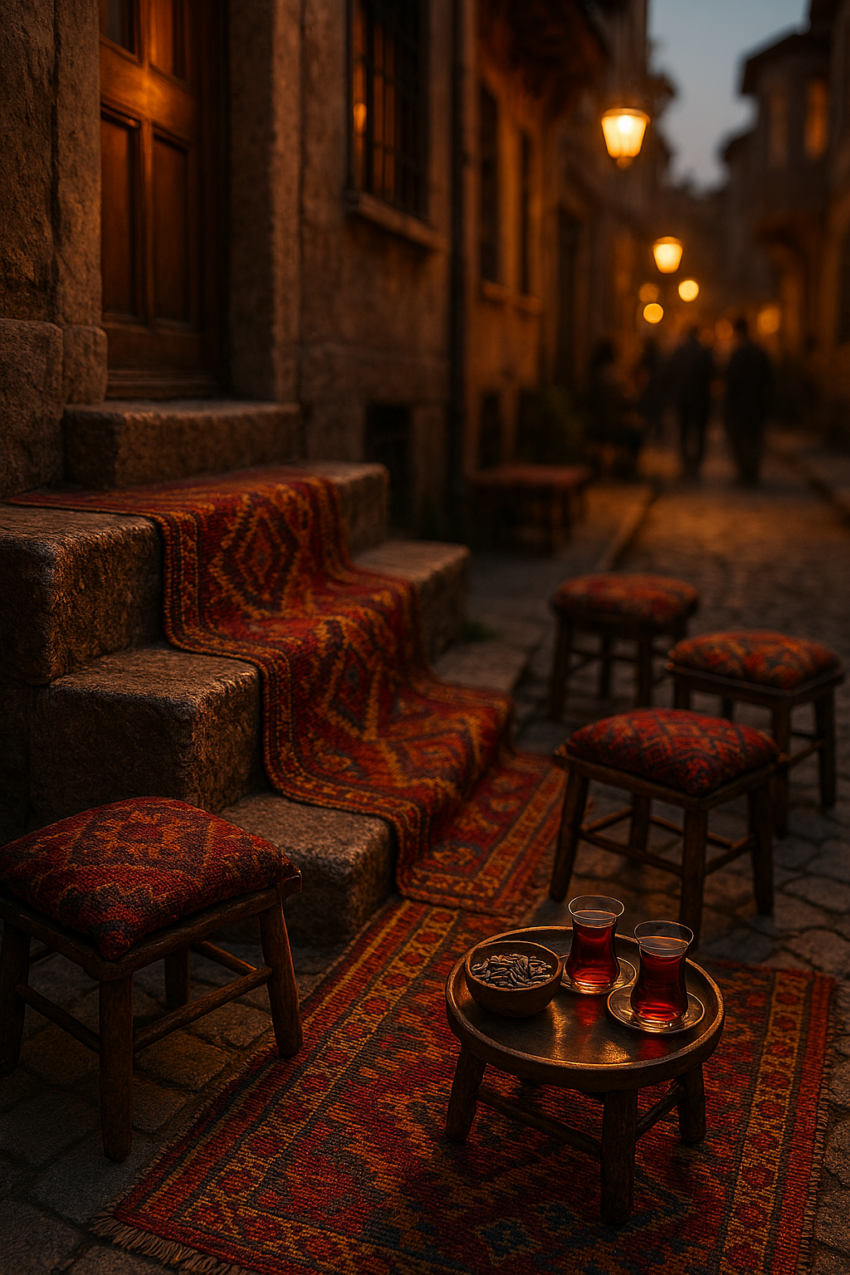
Bir süre sonra yan kapı açılır, ardından bir başkası… Herkes kendi taburesini, küçük sandalyesini ya da minderini getirir. Kapı önlerine serilen eski kilimler, sokak taşlarının sertliğini yumuşatırken aynı zamanda o alanı bir oturma odası gibi hissettirir. Bu kilimler çoğu zaman yılların izini taşır; solmuş desenleri, biraz aşınmış kenarlarıyla adeta mahalle hayatının sessiz tanıklarıdır.
Sohbetin başlaması için fazla bir şeye gerek yoktur. Bir tabak çekirdek ortaya konur, ince belli çay bardakları elden ele dolaşır ve akşamın fon müziği başlar: çekirdeğin o tanıdık çıtırtısı. Her çıt sesinin ardından bir hikâye gelir. Gün içinde yaşanan küçük olaylar, mahalledeki yeni haberler, çocukların yaramazlıkları ya da hayatın küçük dertleri bu sohbetlerde paylaşılır. Bazen kahkahalar yükselir, bazen de sessiz bir anlayışla dinlenen bir hüzün hikâyesi anlatılır.
Kapı önü sohbetleri aslında mahallenin gayriresmi meclisidir. Kim hastalanmış, kimin oğlu askerden dönmüş, hangi evde düğün var… Tüm bu haberler bu küçük toplantılarda öğrenilir. Ama mesele yalnızca bilgi paylaşmak değildir; bu sohbetler insanların birbirine destek olduğu, yükünü hafiflettiği bir dayanışma alanıdır. Bir fincan çay ve birkaç avuç çekirdek eşliğinde insanlar birbirlerine iyi gelir.
Bu kültür yalnızca bizim mahallelerimize özgü değildir. Akdeniz’in dar sokaklarında, İtalya’nın küçük kasabalarında, Yunan adalarının beyaz duvarlı evlerinde ya da Güney Amerika’nın sıcak mahallelerinde de benzer manzaralar görmek mümkündür. İnsanlar kapılarının önünde oturur, sokaktan geçenleri selamlar, kısa sohbetler eder. Sokak bu kültürlerde yalnızca bir geçiş yolu değil, aynı zamanda bir yaşam alanıdır.
Bu ortamın en güzel taraflarından biri de seslerin uyumudur. Bir yanda çocukların top oynarken attığı kahkahalar, diğer yanda yetişkinlerin sohbeti… Bazen bir radyo uzaktan duyulur, bazen bir kedinin miyavlaması araya karışır. Bu çok sesli atmosfer mahalle yaşamının doğal müziğini oluşturur.
Bugün yüksek katlı apartmanlar ve güvenlikli siteler, bu doğal buluşma alanlarını büyük ölçüde ortadan kaldırdı. İnsanlar artık kapı önünde oturmak yerine balkonlarda ya da kapalı salonlarda vakit geçiriyor. Ancak bu durum beraberinde önemli bir kaybı da getiriyor: göz teması ve selamlaşma kültürü.
Oysa bir toplumu güçlü kılan şey çoğu zaman büyük projeler değil, küçük ama sürekli temaslardır. Kapı önünde edilen kısa bir sohbet, paylaşılan bir bardak çay ya da birlikte yenilen bir avuç çekirdek… Tüm bunlar mahalle kültürünün görünmez bağlarını oluşturur. Ve belki de bu yüzden, eski mahallelerdeki kapı önü sohbetleri yalnızca bir alışkanlık değil, bir toplumu bir arada tutan en güçlü harçlardan biridir.
🇬🇧 English | Front Door Chats: Sunflower Seeds and Neighborhood Rugs
Toward sunset, the first sound heard in the neighborhood is often the scraping of a small stool against the pavement. A door opens, and the quiet of the house slowly spills into the street as a stool or small chair is placed in front of the doorway. At that moment, the living room expands beyond the walls of the house and spreads into the neighborhood. The sidewalk, the steps, and the doorways suddenly transform into a shared living space. It is neither entirely private nor completely public, but something warmly balanced between the two.
Soon another door opens, and then another. Everyone brings their own stool, small chair, or cushion. Old rugs spread in front of the doors soften the hardness of the pavement while making the space feel like an outdoor living room. These rugs often carry the marks of time; their faded patterns and worn edges silently witness years of neighborhood life.
A conversation needs very little to begin. A plate of sunflower seeds is placed in the middle, slender tea glasses pass from hand to hand, and the evening’s background music begins: the familiar crack of sunflower shells. With every crack comes a story. Small events from the day, neighborhood news, children’s mischief, or the simple worries of life are shared in these conversations. Sometimes laughter rises loudly; sometimes a quiet story of sadness is told and listened to with understanding.
Front-door gatherings are, in a way, the informal council of the neighborhood. Who has fallen ill, whose son has returned from military service, which family is preparing for a wedding—such news spreads through these casual meetings. Yet the purpose is not only to exchange information. These conversations are moments of solidarity where people support one another and lighten each other’s burdens. Over a glass of tea and a handful of sunflower seeds, people simply make each other feel better.
This culture is not unique to one place. Similar scenes can be found in the narrow streets of the Mediterranean, in small Italian towns, in the white-walled houses of Greek islands, or in warm neighborhoods across South America. People sit outside their doors, greet passersby, and exchange a few words. In these cultures, the street is not merely a passageway but also a living room.
One of the most beautiful aspects of this environment is the harmony of sounds. On one side are the laughter of children playing ball; on the other, the conversations of adults. Sometimes the sound of a distant radio drifts through the air, sometimes a cat’s meow joins the background. Together, these sounds create the natural music of neighborhood life.
Today, high-rise apartment buildings and gated residential complexes have largely erased these natural meeting spaces. Instead of sitting outside their doors, people spend time on balconies or inside closed living rooms. With this change comes an important loss: the culture of eye contact and simple greetings.
Yet what truly holds a community together is often not grand projects but small, repeated interactions. A short chat in front of the door, a shared glass of tea, or a handful of sunflower seeds enjoyed together—these are the invisible threads of neighborhood culture. And perhaps that is why those front-door conversations in old neighborhoods are remembered not merely as a habit, but as one of the strongest bonds that once held communities together.
🇧🇷 Português (Brasil) | Conversas de Calçada: Sementes de Girassol e Tapetes do Bairro
Ao entardecer, o primeiro som ouvido no bairro costuma ser o arrastar de um pequeno banco sobre a calçada. A porta se abre e o silêncio da casa lentamente se espalha pela rua, enquanto um banquinho ou uma cadeira pequena é colocado diante da entrada. Nesse momento, a sala de estar ultrapassa as paredes da casa e se estende até a rua. A calçada, os degraus e as portas se transformam de repente em um espaço de convivência compartilhado. Não é totalmente privado nem completamente público; é um ponto de encontro acolhedor que existe entre os dois.
Logo outra porta se abre, e depois mais uma. Cada pessoa traz seu próprio banco, cadeira pequena ou almofada. Tapetes antigos estendidos diante das portas suavizam a dureza das pedras da rua e fazem aquele espaço parecer uma sala de estar ao ar livre. Esses tapetes frequentemente carregam as marcas do tempo; seus desenhos desbotados e bordas gastas testemunham silenciosamente anos de vida no bairro.
Para que a conversa comece, não é preciso muito. Um prato de sementes de girassol é colocado no meio, os copos de chá passam de mão em mão, e a trilha sonora da noite começa: o conhecido estalo das cascas sendo quebradas. A cada estalo surge uma história. Pequenos acontecimentos do dia, notícias do bairro, travessuras das crianças ou preocupações simples da vida são compartilhados nesses encontros. Às vezes as gargalhadas ecoam pela rua; outras vezes alguém conta uma história mais triste, ouvida com silêncio e compreensão.
Essas conversas diante da porta são, de certa forma, o conselho informal do bairro. Quem ficou doente, quem voltou do serviço militar, qual casa está preparando um casamento… todas essas notícias circulam nesses encontros espontâneos. No entanto, o objetivo não é apenas trocar informações. Esses momentos também são espaços de solidariedade, onde as pessoas se apoiam e aliviam os pesos umas das outras. Com um copo de chá e um punhado de sementes de girassol, as pessoas simplesmente fazem bem umas às outras.
Essa cultura não pertence apenas a um único lugar. Cenas semelhantes podem ser vistas nas ruas estreitas do Mediterrâneo, em pequenas cidades italianas, nas casas brancas das ilhas gregas ou em bairros acolhedores da América do Sul. As pessoas sentam-se diante de suas portas, cumprimentam quem passa e trocam algumas palavras. Nessas culturas, a rua não é apenas um caminho de passagem, mas também um espaço de convivência.
Uma das partes mais bonitas desse ambiente é a harmonia dos sons. De um lado estão as risadas das crianças brincando de bola; do outro, as conversas dos adultos. Às vezes o som distante de um rádio atravessa o ar, outras vezes o miado de um gato se mistura ao fundo. Juntos, esses sons criam a música natural da vida no bairro.
Hoje, prédios altos e condomínios fechados eliminaram em grande parte esses espaços naturais de encontro. Em vez de sentar diante da porta, as pessoas passam mais tempo em varandas ou dentro de salas fechadas. Com essa mudança surge também uma perda importante: a cultura do contato visual e do simples cumprimento.
No entanto, o que realmente mantém uma comunidade unida raramente são grandes projetos, mas sim pequenos contatos repetidos. Uma conversa rápida diante da porta, um copo de chá compartilhado ou um punhado de sementes de girassol dividido entre amigos… tudo isso forma os fios invisíveis da cultura de bairro. Talvez por isso essas conversas de calçada sejam lembradas não apenas como um costume, mas como um dos laços mais fortes que já mantiveram as comunidades unidas.