🇹🇷 Türkçe | emaye tencere ve mutfak raflarında saklı kalan sessiz ihtişamı: ustalık ve sabrın izini neden hâlâ taşıyor
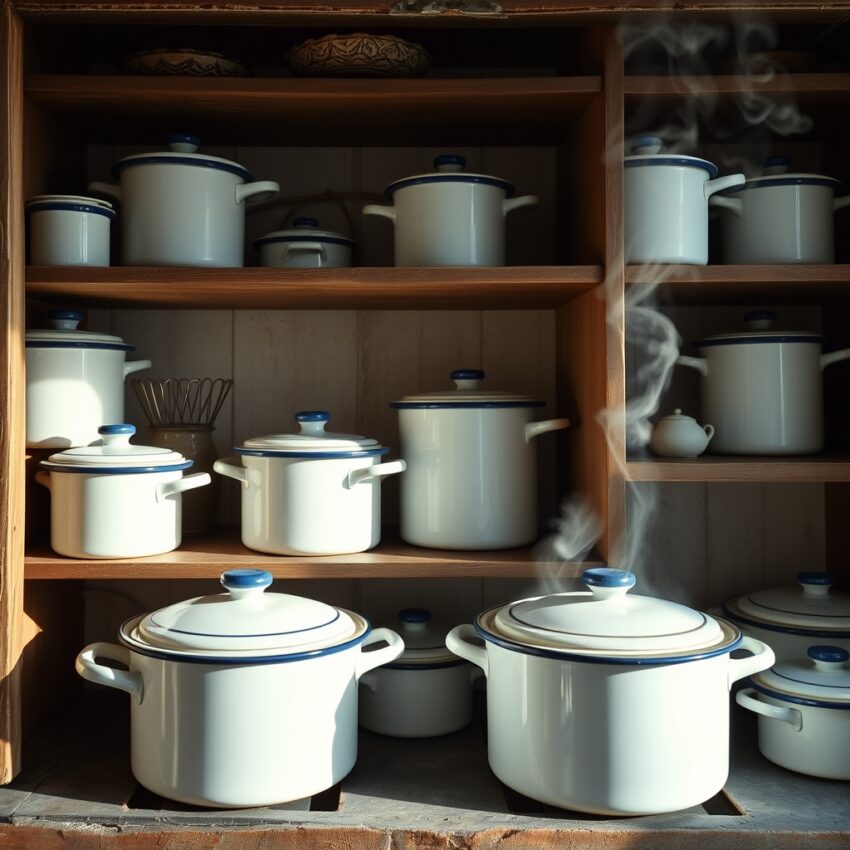
Bazı mutfaklar ilk bakışta sade görünür, ama raflarına biraz dikkatle bakıldığında gündelik hayatın içinde saklanan bir zarafet fark edilir. Emaye tencereler de böyle nesnelerdendir. Beyaz zemin üzerine mavi çizgili olanı, kenarında küçük yıpranma izi taşıyanı, yıllarca kaynamış yemeklerin buharını sessizce üstünde toplamış olanı… Hepsi mutfağın gösterişli değil ama güven veren eşyalarıydı. Sabah çorbası, öğle yemeği, kışlık komposto ya da yazdan kalma domates sosu aynı kapta pişebilir; sonra tencere yıkanıp yeniden rafına kaldırılırdı. Bu tekrar içinde nesne yalnız kullanılmaz, yavaş yavaş aile hayatının sessiz ihtişamına dönüşürdü. Çünkü emaye, lüksün değil; özenin ve uzun süreli kullanımın malzemesiydi.
Obje Hikâyeleri açısından emaye tencere, mutfak tasarımının işlev ve estetiği nasıl aynı kapta topladığını gösteren güçlü örneklerden biridir. Metal gövdenin emaye kaplamayla korunması, bir yandan hijyen ve dayanıklılık sağlarken öte yandan nesneye tanınabilir bir görünüm kazandırıyordu. Eski mutfak raflarında bu tencereler genellikle açıkça görünür biçimde dizilirdi; çünkü saklanmaları gereken değil, evin düzenini temsil eden eşyalardı. Ustalık izi biraz burada başlar. Kenar kıvrımı, kapak oturuşu, kulpun elde bıraktığı his ve rengin yıllar geçse de bütünlüğünü koruması, seri üretimin bile belli bir dikkatle yapıldığı bir dönemi hatırlatır. Sabır izi ise mutfağın içindeki kullanımdan gelir. Emaye tencere, çabuk sonuç isteyen bir dünyanın eşyası değildir; ağır ağır kaynayan yemeklerle anlam kazanır.
Bu sessiz ihtişamın mutfak raflarında kalmasının nedeni, onun bağırmayan bir güzelliğe sahip olmasıdır. Parlak vitrin nesneleri gibi dikkat istemez; ama varlığı hissedilir. Öğleden sonra mutfağa vuran ışıkta hafifçe parlayan yüzeyi, kapağı kaldırıldığında yükselen buharla birlikte daha da canlı görünür. Çocuk için emaye tencere çoğu zaman mutfakta pişen şeyin habercisidir; anne ya da büyükanne içinse düzenli emeğin, tekrarın ve ölçünün bir parçasıdır. Aynı kapta defalarca mercimek, sütlaç, dolma içi ya da reçel yapılması, nesnenin zamanla yalnız eşya olmaktan çıkmasına yol açar. O artık belli tariflerin hafıza kabıdır. Bu yüzden bugün eski bir mutfak rafında ya da antika pazarında görüldüğünde insan yalnız tasarımı değil, kaynayan yemeğin kokusunu ve ocağın başında geçirilen sabırlı saatleri de hatırlar.
Ustalık ve sabrın izinin hâlâ taşınması, emaye tencerenin kusursuz kalmasından değil; tam tersine hafif aşınmalarıyla yaşamış görünmesinden kaynaklanır. Ağız kısmındaki küçük matlaşma, kulpun dibindeki ince iz, kapağın içinde zamanla oluşan renk farkı, nesnenin kullanıldığını, saklandığını ve tekrar tekrar sofraya hizmet ettiğini gösterir. Modern mutfaklarda çoğu araç hız, hafiflik ve yenilenebilirlik vaat ederken, emaye tencere başka bir ölçü sunar. O, dayanıklılığı gösterişli sözlerle değil, yıllarca yerinden eksilmeyerek kanıtlar. Bu yüzden ona bakan kişi yalnız eski bir mutfak eşyası görmez; düzenli ev emeğinin biçim kazanmış hâlini görür. Sessiz ihtişam denilen şey biraz da budur: işini iyi yapan, gösterişsiz ama unutulmayan nesnenin asaleti.
Bugün emaye tencerenin neden hâlâ iz taşıdığını sorduğumuzda, aslında geçmiş mutfak kültürünün zaman anlayışını da sormuş oluruz. O kültürde yemek yalnız sonuç değil, süreçti; raf yalnız depolama alanı değil, evin ritmini gösteren bir sahneydi. Emaye tencere o sahnede hem işlevsel hem duygusal bir rol üstleniyordu. İçinde pişen yemekler kadar, pişirme biçimini de hafızada tutuyordu. Belki de bu yüzden hâlâ etkileyici görünür. Çünkü o nesne, el emeğinin ve sabrın mutfakta bir zamanlar ne kadar görünür olduğunu hatırlatır. Raflarda sessizce duran bu tencereler, çoğu evin en yüksek sesle konuşmayan ama en uzun süre hatırlanan tanıkları olarak yaşamayı sürdürür.
🇬🇧 English | The Quiet Splendor Hidden in Enamel Pots and Kitchen Shelves: Why Does It Still Carry the Trace of Craft and Patience?
Some kitchens appear simple at first glance, yet when one looks carefully at their shelves a hidden elegance within everyday life becomes visible. Enamel pots belong to that kind of object. The one with blue lines on a white surface, the one carrying a small worn mark on the rim, the one that has quietly collected the steam of years of cooking, all of them were pieces of kitchen life that did not show off but inspired trust. Morning soup, lunch, winter compote, or tomato sauce made from summer produce could all be prepared in the same pot, and then the pot would be washed and returned to its shelf. Through that repetition, the object was not merely used. It slowly turned into part of the household’s quiet splendor. Enamel was never the material of luxury. It was the material of care and long use.
As a story of objects, the enamel pot is a strong example of how kitchen design once gathered function and beauty in the same vessel. The metal body protected by enamel coating offered hygiene and durability while also giving the object a recognizable appearance. On old kitchen shelves these pots were usually arranged in clear view, because they were not things to hide but things that represented the order of the home. Part of the trace of craftsmanship begins there. The folded rim, the way the lid settled into place, the sensation left by the handle in the hand, and the way the color remained whole even after many years all recall a period in which even serial production still carried attention. The trace of patience comes from use within the kitchen itself. The enamel pot does not belong to a world asking for instant results. It gains meaning through dishes that simmer slowly.
The reason this quiet splendor remained on kitchen shelves is that it possesses a beauty that never raises its voice. It does not demand attention like a shining display piece, yet its presence is felt. Its surface catches the afternoon light softly, and when the lid is lifted it seems to come alive with the rising steam. For a child, the enamel pot is often the first sign of what is cooking. For a mother or grandmother, it is part of measured labor, repetition, and order. Lentils, rice pudding, stuffing for dolma, or jam made time and again in the same vessel eventually turn the object into more than equipment. It becomes a container of memory for certain recipes. That is why seeing one today on an old shelf or at an antique market does not bring back design alone. It recalls the smell of food simmering and the patient hours spent beside the stove.
The reason it still carries the trace of craft and patience lies not in remaining flawless, but in appearing visibly lived with. The slight dullness along the edge, the fine mark near the handle, the difference of tone formed inside the lid over time all show that the object was used, stored, and brought back to the table again and again. While many modern kitchen tools promise speed, lightness, and easy replacement, the enamel pot offers another measure. It proves durability not through dramatic claims, but by simply remaining present for years. That is why the person looking at it sees more than an old kitchen item. One sees domestic labor given shape. This is what quiet splendor means: the dignity of an object that performs its work well, modestly, and without being forgotten.
When we ask today why the enamel pot still carries a trace, we are really asking about the time sense of older kitchen culture. In that culture, food was not only a result but a process, and the shelf was not only a storage place but a stage showing the rhythm of the home. The enamel pot played both a practical and emotional role on that stage. It preserved not only the meals cooked inside it, but also the manner of cooking itself. Perhaps that is why it still appears so moving. It reminds us how visible hand labor and patience once were in the kitchen. Standing quietly on shelves, these pots continue to live as some of the most enduring witnesses in the home, never speaking loudly yet remembered for the longest time.
🇧🇷 Português (Brasil) | o esplendor silencioso escondido nas panelas esmaltadas e nas prateleiras da cozinha: por que ele ainda carrega o traço da habilidade e da paciência
Algumas cozinhas parecem simples à primeira vista, mas, quando se olha com mais atenção para suas prateleiras, percebe-se uma elegância escondida dentro da vida cotidiana. As panelas esmaltadas pertencem a esse tipo de objeto. A de fundo branco com filete azul, a que carrega uma pequena marca de desgaste na borda, a que reuniu por anos, em silêncio, o vapor dos pratos preparados ali, todas eram peças da cozinha que não chamavam atenção de forma espalhafatosa, mas inspiravam confiança. Sopa de manhã, almoço, compota de inverno ou molho de tomate guardando o verão podiam ser feitos na mesma panela, e depois ela era lavada e devolvida à prateleira. Dentro dessa repetição, o objeto não era apenas usado. Aos poucos, ele se transformava em parte do esplendor silencioso da casa. O esmaltado nunca foi o material do luxo. Foi o material do cuidado e do uso prolongado.
Como história de objeto, a panela esmaltada é um exemplo forte de como o design da cozinha reunia função e beleza no mesmo recipiente. O corpo metálico protegido pela camada de esmalte oferecia higiene e durabilidade, ao mesmo tempo em que dava ao objeto uma aparência reconhecível. Nas prateleiras das cozinhas antigas, essas panelas quase sempre ficavam visíveis, porque não eram coisas para esconder, e sim para representar a ordem da casa. Uma parte do traço da habilidade começa aí. A dobra da borda, o encaixe da tampa, a sensação do cabo na mão e a forma como a cor permanecia inteira mesmo depois de muitos anos lembram um período em que até a produção em série ainda guardava atenção. O traço da paciência vem do uso dentro da própria cozinha. A panela esmaltada não pertence a um mundo de resultados imediatos. Ela ganha sentido com pratos que cozinham devagar.
O motivo de esse esplendor silencioso permanecer nas prateleiras está no fato de que ele tem uma beleza que não grita. Não exige atenção como uma peça de vitrine brilhante, mas sua presença é percebida. Sua superfície reflete de leve a luz da tarde e, quando a tampa é erguida, parece ganhar vida junto com o vapor que sobe. Para a criança, a panela esmaltada costuma ser o primeiro sinal do que está sendo preparado. Para a mãe ou a avó, ela faz parte do trabalho medido, da repetição e da ordem. Lentilha, arroz-doce, recheio de dolma ou geleia feitos muitas vezes no mesmo recipiente acabam transformando o objeto em algo maior do que um utensílio. Ele se torna um recipiente de memória para certas receitas. Por isso, quando aparece hoje numa cozinha antiga ou num mercado de antiguidades, ele não faz lembrar apenas o desenho. Faz lembrar o cheiro da comida fervendo e as horas pacientes passadas ao lado do fogão.
O fato de ele ainda carregar o traço da habilidade e da paciência não vem de permanecer perfeito, mas de parecer claramente vivido. O leve desgaste na borda, a marca fina perto do cabo, a diferença de tom formada no interior da tampa com o passar do tempo mostram que o objeto foi usado, guardado e trazido de volta à mesa repetidas vezes. Enquanto muitos utensílios modernos prometem rapidez, leveza e reposição fácil, a panela esmaltada oferece outra medida. Ela prova sua durabilidade não com frases grandiosas, mas simplesmente permanecendo por muitos anos. Por isso, quem olha para ela não vê apenas um item antigo de cozinha. Vê o trabalho doméstico tomando forma. É isso que significa esplendor silencioso: a dignidade de um objeto que cumpre bem seu papel, de modo discreto e inesquecível.
Quando perguntamos hoje por que a panela esmaltada ainda carrega um traço tão forte, estamos na verdade perguntando pelo sentido de tempo da antiga cultura da cozinha. Nessa cultura, a comida não era apenas resultado, mas processo; e a prateleira não era apenas lugar de guardar, mas palco do ritmo da casa. A panela esmaltada assumia nesse palco um papel prático e emocional. Guardava não só os pratos preparados dentro dela, mas também a própria maneira de cozinhar. Talvez seja por isso que continue tão comovente. Ela nos lembra como o trabalho manual e a paciência já foram visíveis na cozinha. Quietas nas prateleiras, essas panelas seguem vivendo como algumas das testemunhas mais duradouras da casa: não falam alto, mas permanecem entre as mais lembradas.