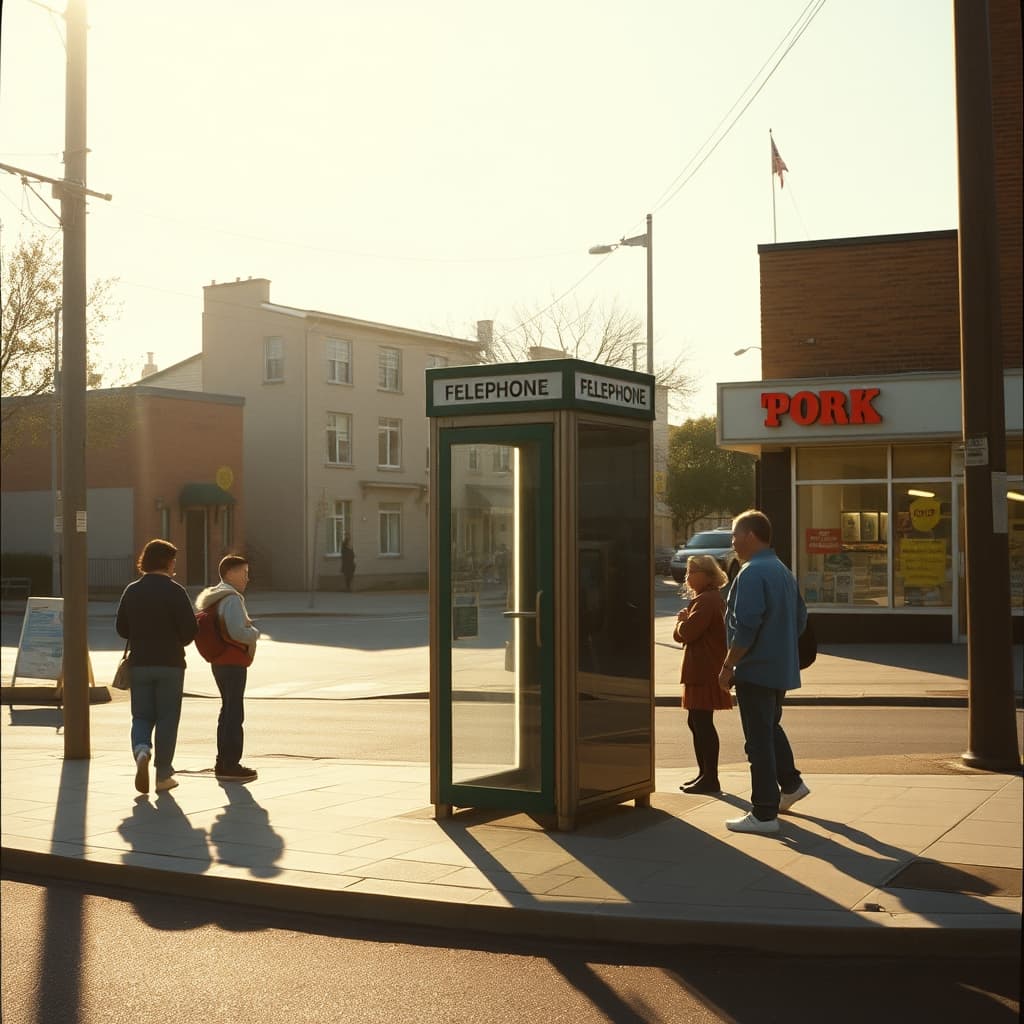
Eski Pano
After school let out, the rhythm of the neighborhood changed. The sun still held its place in the sky, yet the shadows grew longer; the simit seller began his return route, crates were stacked in front of corner shops, and the voices of children playing football in side streets blended into a more metallic evening. In those hours, the first cool touch on the glass of the phone booth at the corner turned the whole day into another feeling. Anyone stepping inside was not merely dialing a number, but entering a small ritual of carrying news and waiting for an answer. The metal door shut, coins clicked into the slot, and for a moment the city seemed to listen only to those sounds.
Phone booths taught the weight of news more than the speed of communication. Unlike today’s instant calls, a call in those years required preparation: memorizing the number, counting coins in your pocket, remaining calm under the eyes of people waiting in line. In many middle-class households, even a brief call to relatives in another city became the event of the week. “Did we reach you?”, “Can you hear me?”, “Are the children well?” were ordinary sentences, yet inside the booth they sounded more valuable. There was a walk taken to get there, a queue endured, and a private moment accepted in public view. Behind the glass walls, you were visible and alone at the same time.
During those cooling afternoons, the booth became the neighborhood’s invisible news desk. Aunts calling after a hospital visit, fathers reporting overtime, guests from the village confirming arrival times, students with trembling voices asking about exam results: each message briefly fogged the glass, then spread across the street. Children lined up outside, planning their games while adults finished their calls. Shopkeepers never asked who had called, yet they could read outcomes from faces alone. In this way, technology was not an isolated object apart from local life; it became a habit woven into curiosity, solidarity, and familiar social rules. Around the booth, a quiet choreography of community took shape every day.
That shared waiting is exactly what carved a deep mark in urban memory. The cooling afternoons of that era remind us that communication is not only information transfer: walking to a place, standing in line, hoping a voice becomes clear, and opening the door slowly before returning to the street are also parts of communication. Most booths are gone now, replaced by ATM corners, ad boards, or empty concrete spaces. Yet many people still remember the echo of “hello” inside a glass cabin, the delicate ring of falling coins, and the long emotional tail of short conversations. That is why the phone booth is not only old technology; it is a generation’s schooling in impatient yet graceful waiting.
What made that schooling especially valuable was its social discipline. You learned to shorten your own call when others were waiting, to let urgent voices go first, to respect another person’s time in a shared public space. In that sense, the booth was more than communication hardware. It was a practical classroom for coexistence, teaching courtesy through everyday necessity. The cool afternoons around those cabins still survive in memory because they trained not only how to call, but how to belong to a neighborhood rhythm.
In the Days That Warmed an Entire Generation, the Impatient Minutes When Phone Booths Carried News: How Did Cooling Afternoons Carve Such a Deep Mark in Urban Memory?