 Eski Pano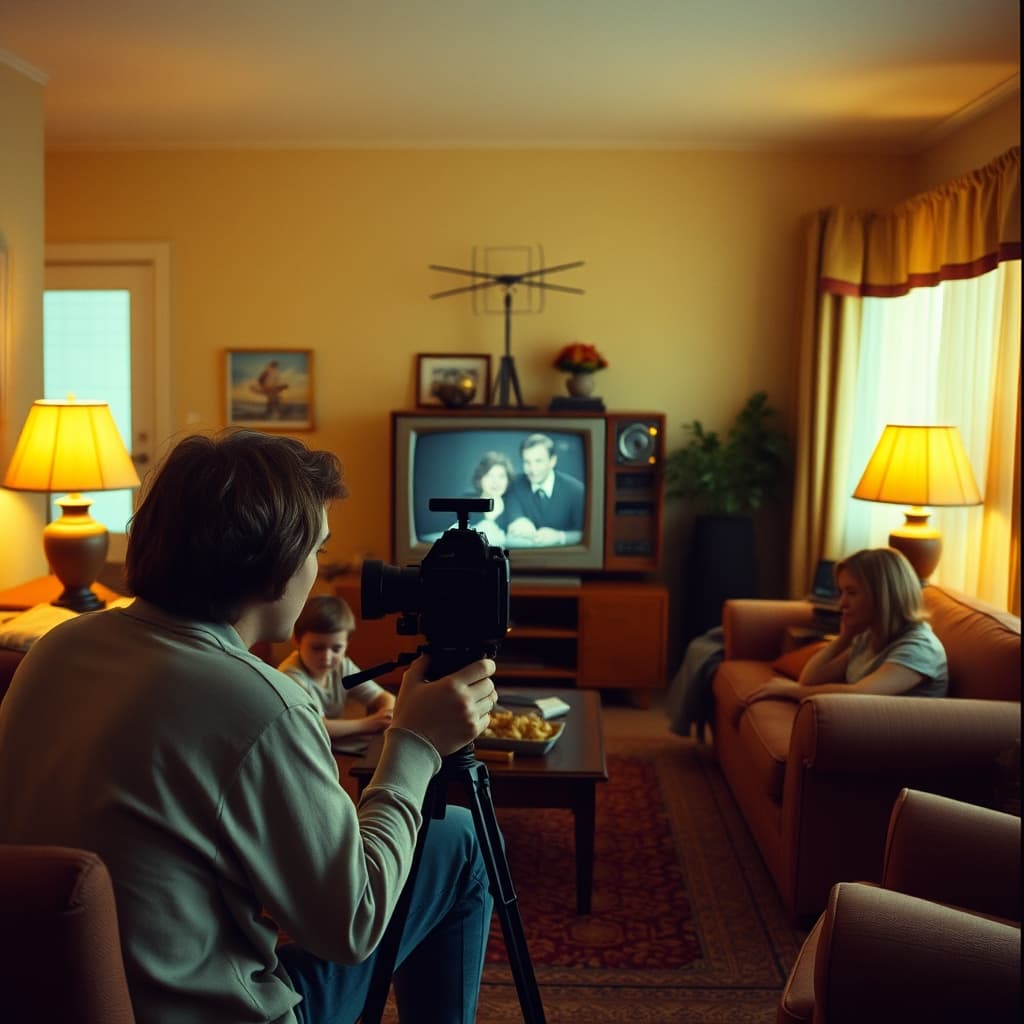
A Super 8 camera invited movement into the family archive, but every press of the trigger consumed scarce film. Before a birthday, excursion, or visit, the operator checked the cartridge, batteries, lens, and light. The camera was lifted only when a moment appeared worth the remaining seconds. This limit encouraged short scenes: a child approaching the cake, relatives turning toward the lens, a ferry leaving the quay, or hands waving before the shot ended.
Introduced by Kodak in 1965, the Super 8 format simplified home filming through a cartridge system, although cameras and film stocks still varied. The cartridge carried narrow film with small perforations, and the camera advanced it past the gate frame by frame. Light travelled through the lens to the emulsion. The process relied on optics, mechanics, electricity, and chemistry; it had no technical relationship to a television antenna, despite later memories sometimes placing both objects in the same room.
Limited Footage Shaped Behaviour
A standard cartridge offered only a few minutes at common filming speeds. Operators learned to avoid long, indecisive takes. They anticipated action, held the camera steady, and stopped quickly. Exposure systems ranged from manual judgement to automatic meters, while focus could be fixed, estimated, or adjusted through the lens. Indoor scenes challenged slow film and modest lamps, producing dark or warm images. Fast panning and shaky walking made projection uncomfortable.
People also performed for the camera. They repeated an entrance, arranged themselves in sunlight, or waved on instruction. The resulting film was therefore evidence of family life and of the family’s decision to stage itself. The person behind the camera often appeared least, and relatives considered unimportant or unavailable could vanish entirely. Home movies are selective records, not transparent windows.
Processing Delayed the Reward
The exposed cartridge went to a laboratory. Until processing and return, the household could not know whether exposure, focus, transport, or handling had succeeded. That interval added uncertainty. When the small reel arrived, it had to be threaded through a compatible projector, focused on a wall or screen, and watched in a darkened room. Many Super 8 films were silent, so viewers supplied names, jokes, and explanation live.
The camera and projector required different care. Old batteries should be removed because leakage can corrode contacts. Projector lamps become hot, belts deteriorate, and film can jam or tear in an unserviced mechanism. Valuable reels should not be repeatedly tested on uncertain equipment. A specialist transfer or conservation assessment is safer when film smells strongly, curls, sticks, or shows mould.
Preserving Motion and Its Context
Digitisation makes viewing easier, but a good archive retains original reels, boxes, processing envelopes, handwritten titles, and sequence. Files should be stored in more than one location and in preservation-quality formats as well as convenient viewing copies. Dates should be recorded as estimates when uncertain. Family commentary can be captured separately, identifying speakers rather than embedding unsupported claims as fact.
The Super 8 ritual joined economy, technical judgement, delayed anticipation, and collective interpretation. Its emotional force came partly from not filming everything. Someone had to decide when the camera would run, and the family later decided what the silent fragments meant. By preserving the film alongside the cartridge notes, equipment history, and spoken recollections, a digital nostalgia archive can respect both the visible celebration and the careful choices outside the frame.