 Eski Pano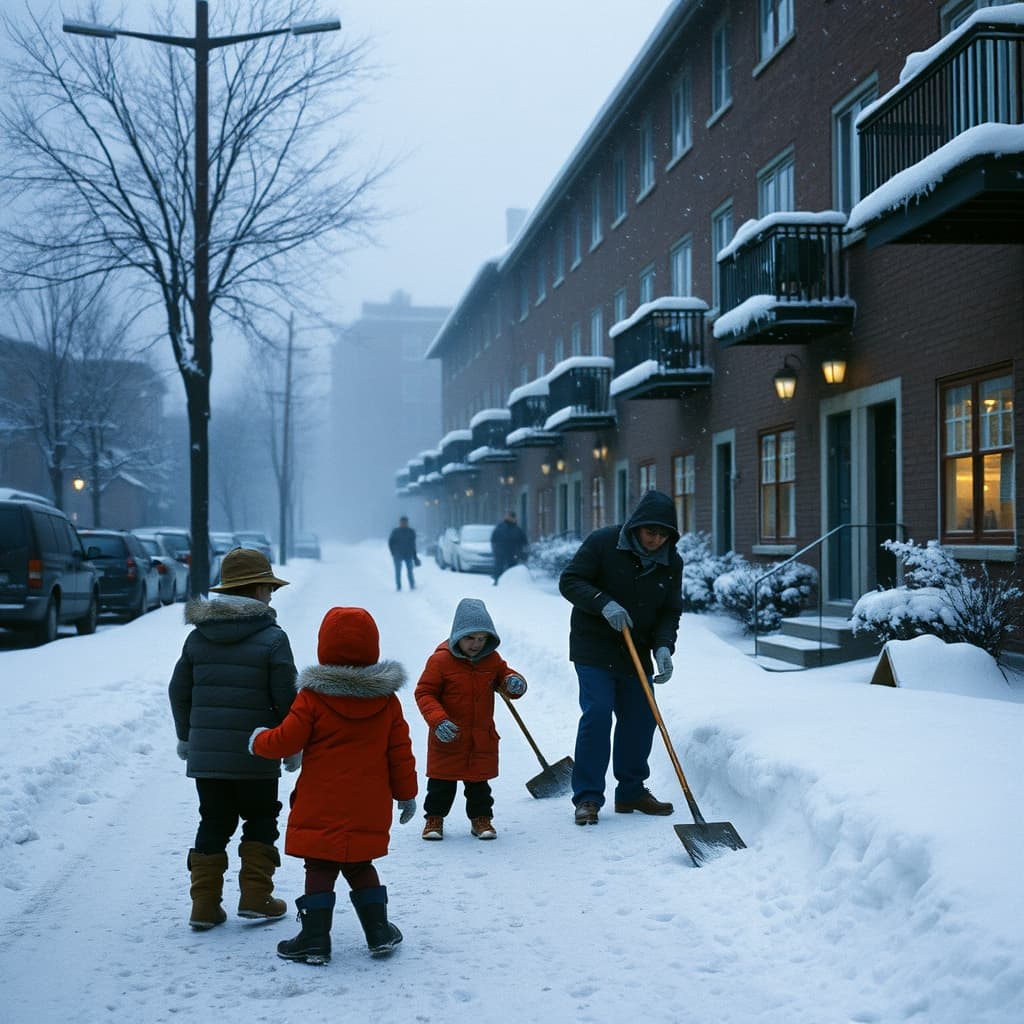
When snow settled deeply enough to slow traffic and soften familiar sounds, a neighbourhood street could begin to function differently. Doorways opened more often, children tested the untouched surface, and adults looked for the safest route between entrances, shops, and public transport. The street did not literally become a home, but for several hours it could acquire some of a shared room’s qualities: people watched over one another, negotiated space, exchanged tools, and remained outside longer than an ordinary winter evening allowed.
The transformation depended on practical work before it became play. Someone cleared the building steps, another cut a narrow path through the pavement, and shopkeepers dealt with snow pushed towards their thresholds. Ash, salt, or other available material might be used on slippery patches, depending on local practice and supply. These actions were rarely perfectly coordinated. A cleared section could end abruptly at the next frontage, and snow moved away from one doorway might obstruct another. Cooperation grew from such immediate problems rather than from an ideal picture of neighbourliness.
The First Cleared Path Set the Street’s Rules
Children quickly read the street as a landscape of slopes, corners, parked vehicles, garden walls, and improvised boundaries. A tray, board, or shared sledge could circulate between several households. Turns had to be negotiated, younger children needed room, and an adult might stop a game when speed carried it too close to a road or window. These informal rules mattered because excitement did not remove risk. Cold hands, wet clothes, hidden kerbs, and limited visibility were part of the scene alongside laughter.
Snow also altered the social distance between people who normally passed with a brief greeting. A stuck vehicle or heavy gate required several pairs of hands. A thermos, hot drink, dry gloves, or a spare shovel could cross the threshold from private property into common use. Children called up to balconies; adults exchanged news while watching them. Not everyone joined, and not every relationship became close. Elderly residents, workers returning late, and people with limited mobility could experience the same snow mainly as difficulty. A responsible memory holds inconvenience and warmth together.
Evening Light Extended the Playground
Under streetlamps, the snow reflected enough light to make the familiar street appear wider and strangely theatrical. Footprints showed who had crossed, while tyre marks and shoveled banks mapped the day’s activity. Games continued until clothing became too wet or a voice from a window announced that it was time to come inside. The call home was part of the neighbourhood soundscape: individual families set their own limits, yet everyone could hear the sequence of departures as the street gradually emptied.
Inside, boots and coats left evidence near radiators or stoves. Stories from the street entered the household with them: who fell, who lent the sledge, which path had frozen again, and whether more snow was expected. In this way, the outdoor event continued around the table. The memory was reinforced not only by exceptional weather but by repeated retelling, often attaching a particular winter to a friend, a building, or a small act of help.
A Temporary Common Room, Not a Perfect Past
Changes in traffic, building design, working hours, climate patterns, and children’s routines have altered how many streets respond to snow. Some neighbourhoods still produce the same spontaneous cooperation; elsewhere professional services, enclosed sites, or heavier vehicle use leave less room for extended play. It would be misleading to claim that every older street was safer or more united. The important evidence lies in the specific arrangements people made when ordinary movement was interrupted.
For a Digital Nostalgia Archive, the snowy street matters because it reveals neighbourhood culture in action. Trust was not an abstract virtue; it appeared in a borrowed shovel returned to the right door, a child watched for a few minutes, a path widened for an older neighbour, or a warning shouted before a sledge reached the corner. Snow temporarily redrew the boundary between household and street. What made the hours memorable was not weather alone, but the practical, sometimes untidy way residents turned disruption into a space they could share.