Eski Pano
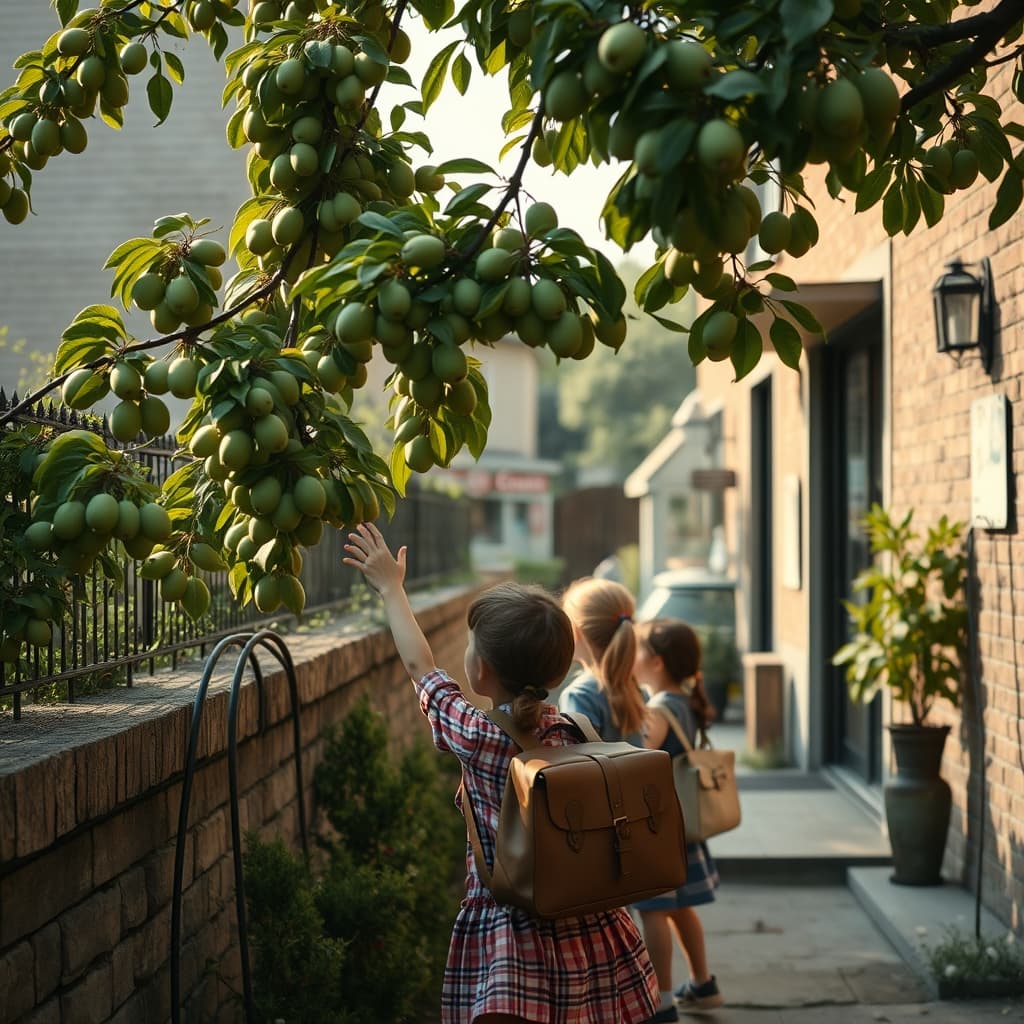
In old neighborhoods, school dismissal hour was never just a time slot; it was a brief street festival when daily life came alive again. Children walked home shifting bags from one shoulder to the other, shoes carrying classroom dust onto the pavement, pausing first near the corner grocer before scattering into narrow side streets. In the middle of that walk, certain houses revealed plum branches stretching over garden walls. The small green plums, not fully ripe yet, swayed gently in the breeze and turned school fatigue into play in an instant. One of the warmest scenes of neighborhood life often began there.
The branch became such a powerful memory object not only because of taste, but because of what it represented. It marked a subtle culture of shared life inside the neighborhood. Between private garden and public street, that branch formed a tiny social contact zone. Homeowners usually tolerated children picking one or two plums, sometimes opening a window and saying with a smile, “Not too many, leave some for evening.” In that sentence there was both boundary and affection, caution and invitation. Children understood the code: do not break the branch, do not push others, take turns. In this way, simple gestures taught social balance without formal rules.
The link between school-season afternoons and plum branches also strengthened the sense of season. As spring moved toward summer, the smell of air changed, sunlight hardened, street noise stretched longer, and dinner time shifted later. The plum branch signaled this threshold: school was still in session, yet summer had already entered imagination. For children, that meant a delicate balance between responsibility and freedom. Notebooks remained in the bag, but fingers reached toward leaves; the bell still echoed in the ear, but the eye followed street shadows. Neighborhood culture grows through exactly such transitions, because childhood memory holds onto repeated small scenes more strongly than major events.
Today, many walls have been replaced by high fences, empty lots by enclosed residential blocks, and children often move from school into more controlled routes. Yet in stories of old neighborhoods, the plum branch over the wall remains a vivid symbol of warmth. It tells us that community is not always built through grand declarations; sometimes it lives in a branch left close enough for a passing child to touch. That is why the scene endures in memory. In that one image, sharing, season, childhood, and street life meet in the same frame.
The durability of this memory also comes from sensory detail: the tart taste left on the palm, the leaf scent brushed onto a school sleeve, the familiar “wash your hands first” heard at the door. Neighborhood culture is not only spatial; it is sensory, carried by smell, touch, and repeated sounds. The plum-branch scene survives because it is not a single image but a layered lived experience. The warmth we associate with old districts was often created exactly there, in tiny everyday gestures that made life feel collectively held.
Why Plum Branches Hanging Over Garden Walls During the Return of School Season Were the Warmest Scene of Old Neighborhoods