Eski Pano
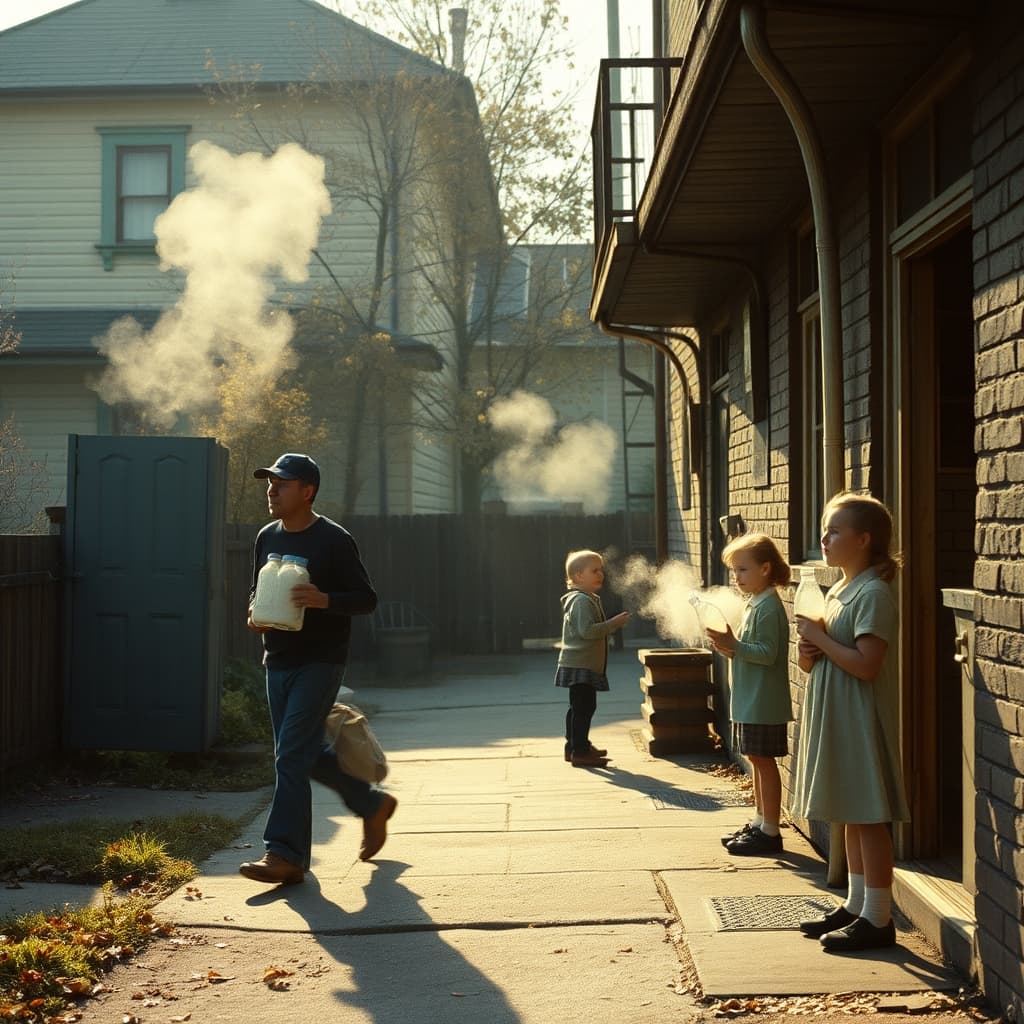
When the loosened rhythm of summer ended and the school term began again, neighborhood mornings also returned to another order. Before daylight had fully opened, certain sounds rising from the street gently lifted the interiors of homes to their feet. The milkman’s bell was one of the warmest among them. A thin yet familiar metallic sound echoed through apartment shafts, mothers called out from kitchens, and children heard it half in sleep and half in school-time anxiety. Bottles left at the door, hands reaching toward the window, cardigans thrown on in haste, and milk waiting to boil in a pot were among the details that made old neighborhood mornings feel not only busy, but tender. The milkman’s bell softened the hardness of the school day before it had even fully begun.
From the perspective of neighborhood culture, this morning scene was one of the clearest signs of older forms of communal life. The milkman was not merely someone delivering a product. He belonged to the neighborhood’s waking hour. He often knew which apartments had children, which older woman lived alone on which floor, who had gone out of town that week, and which door usually opened late. For that reason, the bell was more than a commercial call. It was a public yet intimate signal that started the rhythm of the district. During school days in particular, it announced that different homes were entering the same hurry at the same time. Bags were being readied, toast began to smell from kitchens, uniforms were being straightened, and the bell itself seemed to keep the common pulse of the street.
To understand why this remains one of the warmest scenes of old neighborhoods, one has only to look at domestic details. For a child, the milkman’s bell often meant that the morning had truly begun. Before the eyes were fully open, that sound arrived together with the clatter of plates from the kitchen, and the household rose into motion for another day. Some mothers called down from the window, some left bottles at the door, and some changed the plan at once by asking for another liter. The brief relationship formed with the milkman nourished the neighborhood’s ordinary sense of trust. Once the milk arrived and warmed on the stove, a small but necessary order inside the home had fallen into place before the child went to school. The bell moved not only the door, but the entire flow of the morning.
Everyday examples make that warmth still more visible. While a child tied shoes waiting for the school bus, someone kept an eye on the stove so the milk would not boil over, bread was being sliced, the foamy sound of heating milk rose in the kitchen, hair was braided, and the empty bottles were rinsed. Several doors opening at once in the same building, brief greetings on the stairs, and the sense that everyone knew something of everyone else’s morning made the scene belong not only to one family, but to the neighborhood as a whole. That is why the return to the school term remains so memorable. After the loosened time of summer, the milkman’s bell announced that autumn and routine had come back. Yet it did so not with harsh discipline, but with warm familiarity.
What is missed in remembering that bell today is not only milk in glass bottles or the chill of an early hour. What is missed is also an urban structure in which people still witnessed one another’s mornings. In modern life, breakfast is often assembled through packaged speed, the person at the door remains unknown, and the sounds of morning pass without touching one another. In the older neighborhood, by contrast, the milkman’s bell renewed every day the thin bond between home and street. A trade sound, a childhood morning, and a form of neighborhood tenderness could all be heard at once. That is why the scene remains warm in memory. It carried not a simple service, but a shared feeling of life.
In the end, if the milkman’s morning bell on the return to the school term still occupies such a warm place in memory, the reason is not nostalgia alone. That bell gathered domestic preparation, neighborly familiarity, and the hurried tenderness of mornings with children into a single sound. Urban life often leaves its strongest memories not in great public events, but in small familiar noises repeated at an early hour. The milkman’s bell was exactly such a sound: a call that began the day while drawing the neighborhood a little closer to itself.
Why Was the Milkman’s Morning Bell, on the Return to the School Term, the Warmest Scene of Old Neighborhoods?