 Eski Pano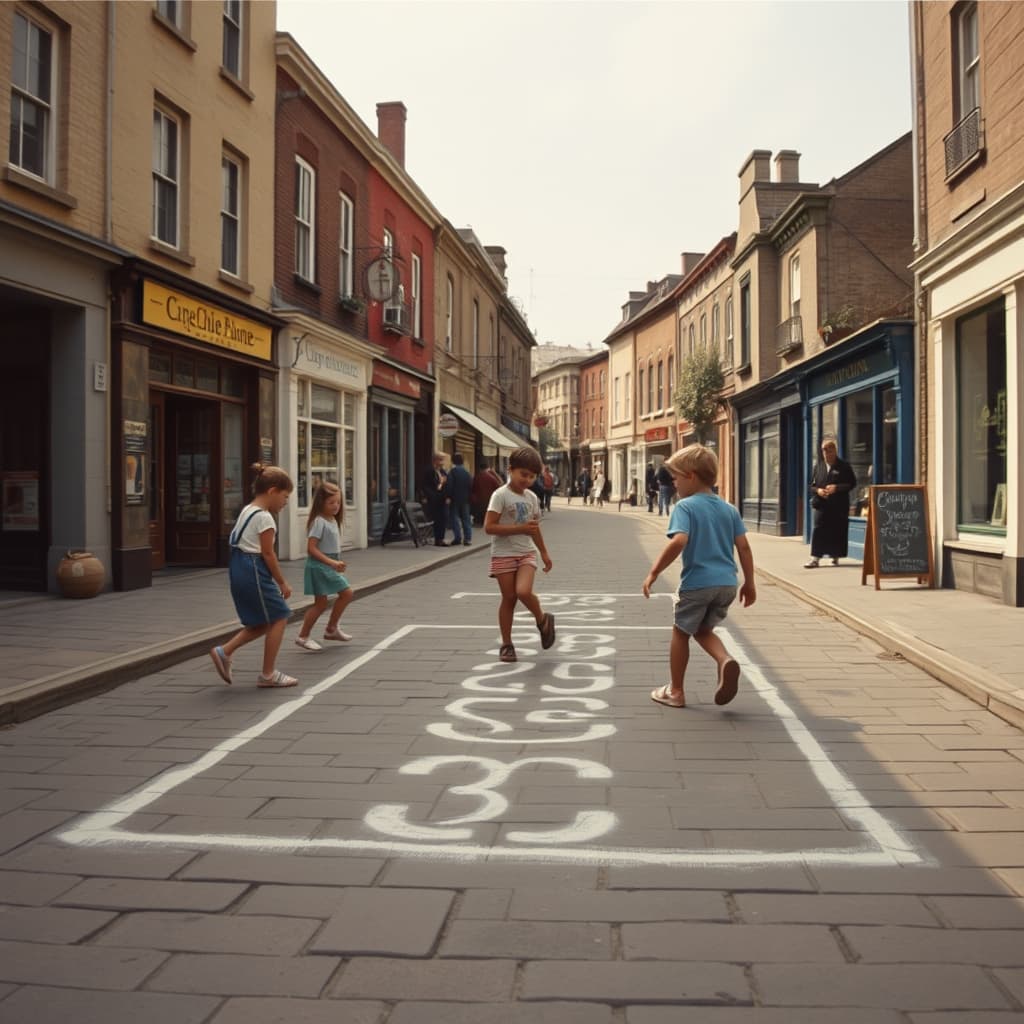
Hopscotch squares drawn near a neighbourhood shop turned a strip of pavement into a place where play and local trade had to accommodate one another. Children wanted a flat surface and enough room to jump; the shopkeeper needed a clear doorway, visible goods, and space for customers. The game survived when its lines recognised those needs. A board might begin beside the entrance rather than across it, and play paused when deliveries or older pedestrians passed.
The diagram varied. Numbers, length, paired squares, turning point, and the stone used as a marker changed according to the group and the available pavement. Chalk was convenient but not always at hand; a piece of plaster or soft stone could substitute. The rules were learned by watching and corrected through argument. Balance, accurate throwing, and remembering which square belonged to whom gave the game its structure.
The Shopfront Was Both Boundary and Audience
A grocer, stationer, baker, or other local trader could see the game without formally supervising every move. Familiar adults warned children about vehicles, asked them to move a line, or kept an eye on a schoolbag left near the wall. Children in turn learned when the entrance was busiest and which behaviour would end the shopkeeper’s tolerance. Trust grew through predictable conduct rather than unrestricted permission.
Conflict was part of the relationship. Chalk could mark a newly cleaned pavement, noise could disturb a customer, and a poorly thrown stone might strike a display. The shopkeeper could be impatient or unfair; children could ignore repeated warnings. Remembering the warmth of local shops should not erase authority or dependence. The bond was negotiated between people with unequal control over the space.
Small Errands Interrupted and Extended the Game
Children often arrived because a household had sent them for bread, milk, a newspaper, or another small item. The errand created a brief pause, then provided a reason to remain with friends. Coins had to be kept safe and change returned correctly. A shopkeeper who knew the family might remind a child what had been requested, but informal credit or special treatment varied and should not be assumed in every neighbourhood.
These repeated encounters produced practical familiarity. The trader learned names and routines; children learned prices, queues, greetings, and the limits of adult patience. A scraped knee might be noticed, a lost marker held behind the counter, or a warning passed towards home. Such acts did not turn the shop into a substitute family. They show how commercial and social roles overlapped in a street used every day.
Chalk Disappeared, but the Route Remained
Rain, cleaning, and footsteps erased the grid, allowing a new version to appear later. That temporary quality was essential: the pavement returned to ordinary circulation. Changes in traffic, chain retail, building setbacks, security, and children’s schedules have reduced this kind of play in some places, while it continues elsewhere. The past should not be presented as uniformly safer or more welcoming; girls, younger players, newcomers, and disabled children could face different barriers.
For a Digital Nostalgia Archive, hopscotch outside the shops matters because it records neighbourhood trust at the scale of repeated adjustments. Chalk squares, customer footsteps, a child’s errand, and a shopkeeper’s warning occupied the same few metres. The relationship strengthened when both sides recognised that the pavement had several users. What remained in memory was not only the game, but learning how to play within a living street whose routines belonged to other people too.