Eski Pano
As holiday mornings approached, kitchen rhythm changed days in advance in many homes. The sound of pot lids, the rustle of washed grape leaves, the aroma of finely chopped onions, and cloudy rice water formed one preparation sentence. Stuffed grape leaves were never just a dish; they were long-form collective labor that gathered the family around one table. Filling was mixed, leaves opened one by one, and fingers activated inherited muscle memory with each roll. In this process, method of working together mattered as much as recipe.
The unforgettable taste of festive sarma begins in this collective preparation. One person sorts leaves, another mixes filling, another arranges rolls in the pot. Even children join through small tasks: “fold edges inward,” “line them tight.” The kitchen becomes intergenerational workshop. Measurements are transmitted orally: “feel the salt by hand,” “don’t pack rice too hard,” “roll without tearing the leaf.” These lines teach not only technique, but patience and attentiveness.
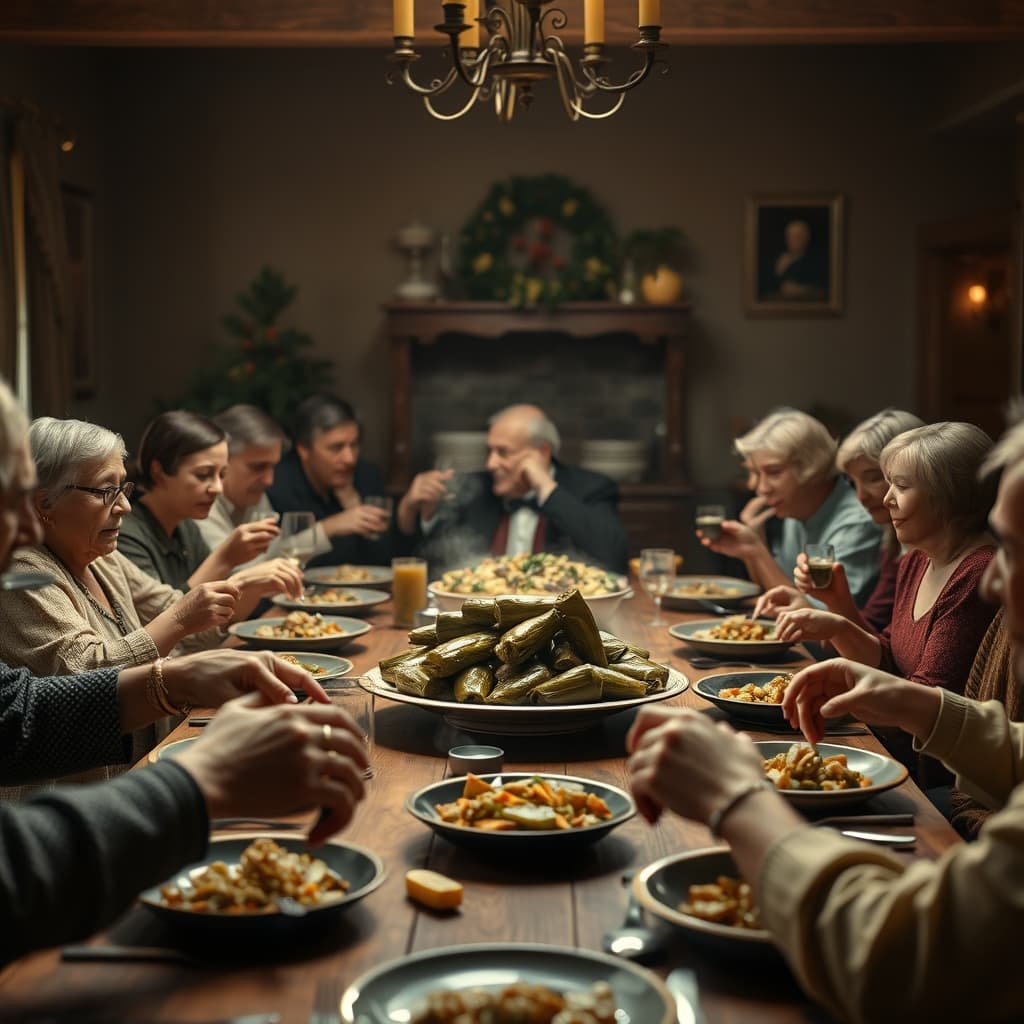
The power of crowded family tables comes less from abundance and more from sharing order. The sarma plate sits at the table center, everyone reaches from the same dish, and portions are not treated as private territory. A quiet courtesy emerges so no one takes the last piece unfairly. Children are taught to serve elders first; elders quietly save best pieces for children. These micro-gestures transform holiday meals from nutrition events into ethical encounters.
In palate memory, unforgettable sarma taste consists not only of acidity balance, olive-oil sheen, and spice profile, but of conversation surrounding it. On holiday tables, stories of earlier holidays return, distant relatives are remembered, and plates for neighbors are planned. Flavor forms inside collective dialogue, not inside isolated tongues. Years later, even when the same recipe is cooked, what feels missing is often this conversational density.
This dish carried a wider sharing culture through circulation economy. The first plate from the pot went to neighbors; incoming desserts completed the table in return. “Please taste from us” worked as both hospitality and relationship renewal. Holiday became not only kin gathering, but neighborhood solidarity cycle. Stuffed grape leaves stood at the cycle’s center as a symbol of trust, because labor was intense and labor gained meaning through distribution.
Even as family units became smaller and holiday tables narrowed, memory weight of this tradition did not fade. Making sarma is more than executing ingredients; it is ritual management: preparation, division of tasks, serving, gifting, storing leftovers for next day. This multi-layered process organized both household economy and social relations. If one pot of sarma is still treated as special in high-speed consumption culture, the reason is not only taste; it is its tie to inherited language of sharing.
Ultimately, festive stuffed grape leaves and the unforgettable taste of crowded tables form a living archive of cultural codes. In this dish there is memory with ingredients, relationships with technique, solidarity with presentation. Nostalgia here is not idealization of the past; it is recognition of how shared labor and shared table strengthened social texture. Every roll, every plate, every offering sentence carries a quiet agreement of intergenerational sharing.
Festive Stuffed Grape Leaves and the Unforgettable Taste of Crowded Family Tables: How İt Carries a Period’s Culture of Sharing