 Eski Pano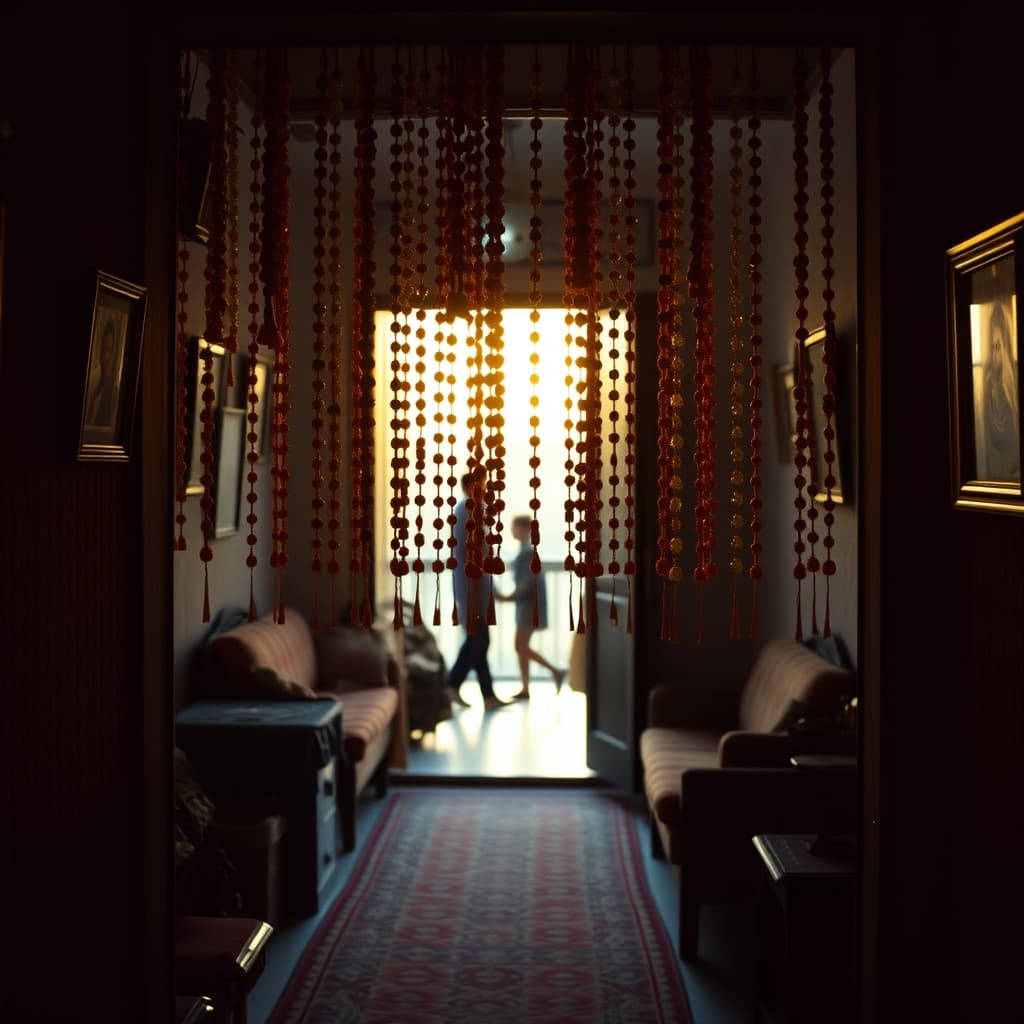
A beaded curtain announced movement before the person entering spoke. Strands shifted, beads struck one another, and the doorway briefly shimmered before falling still. Hung between a corridor and sitting room, at a kitchen entrance, or before a balcony door, it divided space without fully closing it. Air, light, smell, conversation, and people continued to pass. Its sound became part of the household’s daily punctuation.
Materials and construction differed. Wooden, plastic, glass, seed, shell, or composite beads could be threaded on cord or wire and suspended from a rail. Some curtains were bought ready-made; others were assembled or repaired at home. Colour patterns might follow fashion, available materials, or the maker’s own design. Calling every example traditional obscures the influence of modern manufacturing, tourism, craft markets, and changing interior taste.
The Doorway Became a Small Performance
Residents developed ways of passing through without catching hair, buttons, trays, or shopping bags. A child could push through dramatically; an adult carrying tea gathered several strands with one hand. The movement was practical and expressive. Family members learned who had entered from pace and sound, just as they recognised footsteps in a corridor.
The curtain offered partial privacy rather than a firm barrier. It obscured a direct view while allowing voices and kitchen aromas to travel. This could suit a household that wanted separation without isolation. It could also irritate, obstruct, or make cleaning harder. Memories differ because the same object was charming to one person and noisy to another.
An Heirloom Was Often Repaired into Existence
Strings stretched, knots loosened, rails bent, and individual beads disappeared. Repairs introduced new cord, replacement colours, and altered spacing. A curtain passed to another generation may therefore contain several periods of work. Those changes do not necessarily reduce its significance. They show that the family valued continued use enough to adapt it.
Documentation should identify what is original only when evidence supports the claim. Close photographs of knots, rail, pattern, damaged areas, and replacement beads help. Ask who made or bought it, in which doorway it hung, who repaired it, and why it moved homes. A picture showing the curtain in its former interior can establish scale and setting better than memory alone.
Care Includes Practical Safety
Beads and broken fittings can present choking or cutting hazards, particularly for children and animals. Long cords may entangle. Heavy curtains need secure support, while brittle plastic and old wire can fail unexpectedly. Display decisions should consider access and load. Dust should be removed gently according to material; soaking mixed or unknown beads may damage finishes, cord, and metal.
The inherited beaded curtain preserves more than decoration. It records how a family managed thresholds: what remained visible, how air moved, how guests entered, and which sounds signalled ordinary activity. Its aesthetic belongs to use, repair, and placement rather than to pattern alone. When material changes and conflicting memories are kept with the object, the curtain becomes a precise witness to home life instead of a generic emblem of nostalgia.